Traders are now focused on the upcoming US labor market data, including Nonfarm Payrolls and Average Hourly Earnings for July, which could further influence gold prices.
Gold Prices Increase Amid Weak US Economic Data and Fed’s Dovish Policy
Recent US manufacturing and employment data have raised economic concerns, boosting demand for gold as a safe-haven asset. The yellow metal gained additional support from dovish sentiment surrounding Federal Reserve policy.
The Fed kept rates unchanged at 5.25%-5.50% in July and hinted at possible rate cuts due to cooling inflation and a moderating labor market. This pressured the US dollar and bolstered gold prices, as lower interest rates typically enhance the appeal of non-yielding assets.
The US ISM Manufacturing PMI fell to an eight-month low of 46.8 in July, and initial jobless claims rose to 249K, further increasing gold’s attractiveness.
Geopolitical Tensions Drive Up Gold Demand Amid Middle East Conflict
Rising tensions in the Middle East have increased the safe-haven demand for gold. The assassination of Hamas leader Ismail Haniyeh in Iran has escalated the conflict.
According to the New York Times, Haniyeh was killed in Iran’s capital after attending the new president’s inauguration, with both Iranian officials and Hamas accusing Israel of orchestrating the strike.
These developments have further supported gold prices as investors seek refuge in safe-haven assets amid the uncertainty.
Short-Term Forecast
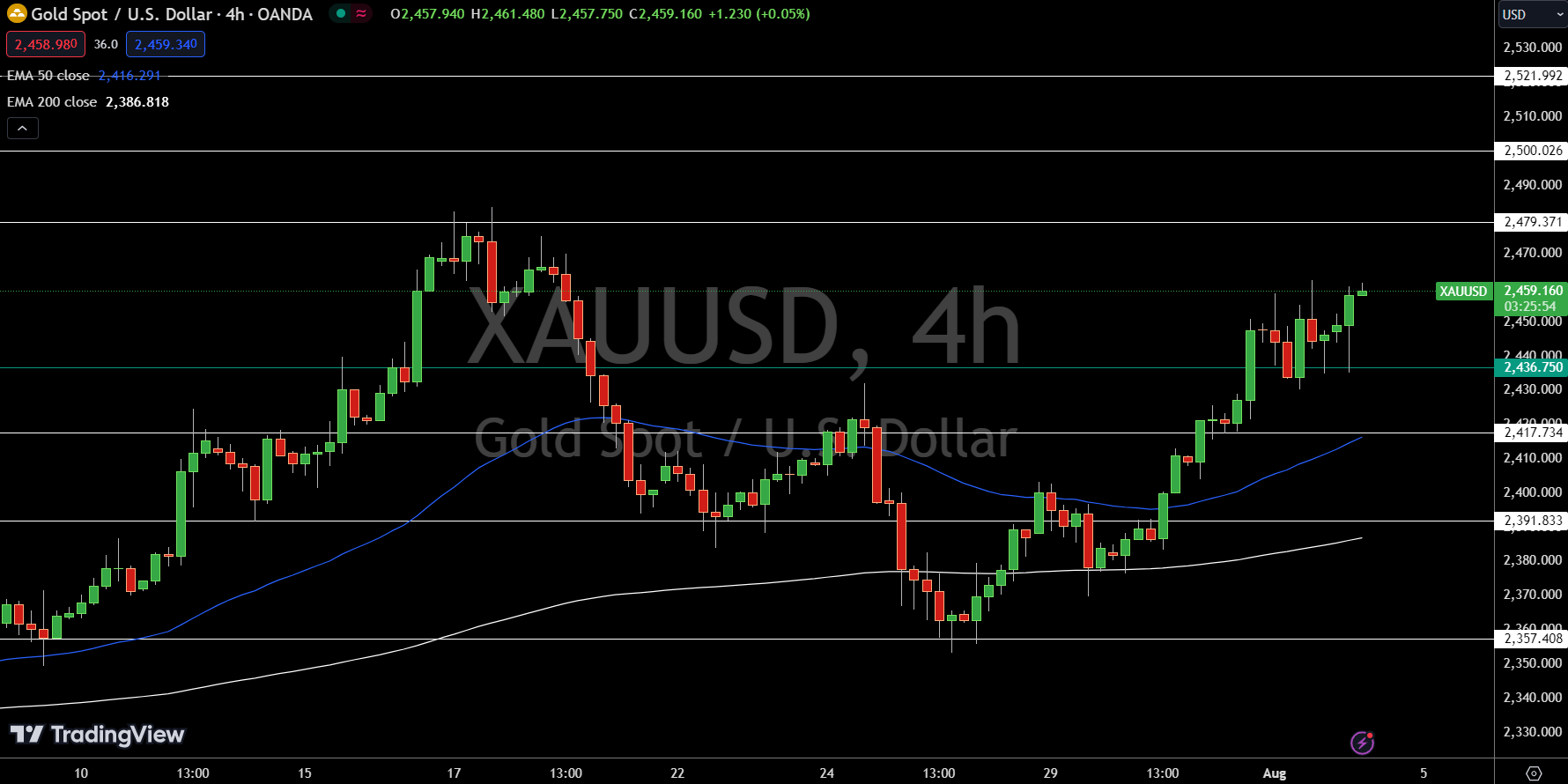
Gold (XAU/USD) is currently trading at $2,459.16, up 0.45% on the day. The 4-hour chart indicates a pivot point at $2,436.75, with immediate resistance at $2,479.37, followed by $2,500.02 and $2,521.99. Support levels are noted at $2,417.73, $2,391.83, and $2,357.40.
The 50-day EMA is positioned at $2,416.29, slightly above the 200-day EMA at $2,386.81, indicating a short-term bullish trend.

Gold’s outlook remains bullish above $2,436.75; however, a break below this pivot could trigger a significant sell-off, suggesting traders adjust strategies to manage potential downside risks.