Traders are cautious ahead of the Federal Open Market Committee (FOMC) meeting results on Wednesday. Key US macroeconomic data, including the Nonfarm Payrolls (NFP) report, may also influence gold’s direction.
This week, significant events include the Bank of Japan’s policy decision on Wednesday, the Bank of England’s meeting on Thursday, and various US economic data releases, all of which will impact gold prices.
Gold Prices Rise Amid Weakening Dollar and Easing Inflation
The US dollar continued to weaken as the Personal Consumption Expenditures (PCE) Price Index data showed modest inflation growth in June. This increased expectations for Federal Reserve interest rate cuts, leading to a decline in US Treasury bond yields. The 10-year note yield fell to a two-week low on Monday, further weakening the USD and benefiting XAU/USD.
The US Commerce Department reported a 0.1% increase in the PCE Price Index for June, with a year-over-year rise of 2.5%, down from 2.6% in May. The core PCE Index, excluding food and energy, rose 0.2% in June, maintaining a 2.6% annual increase.
The weakening dollar and easing inflation, as indicated by the PCE data, bolstered gold prices, driving investment towards the non-yielding metal amidst lower Treasury yields and anticipated Fed rate cuts.
Geopolitical Tensions Support Gold Prices Amidst Positive Global Equity Markets
On the geopolitical front, the ongoing conflicts in the Middle East are boosting safe-haven demand for gold. The Golan Heights attack on Saturday has raised fears of an all-out war between Israeli forces and Hezbollah in Lebanon, further supporting gold prices.
However, the upside is limited due to a positive mood in global equity markets, which reduces demand for traditional safe-haven assets like gold.
Short-Term Forecast
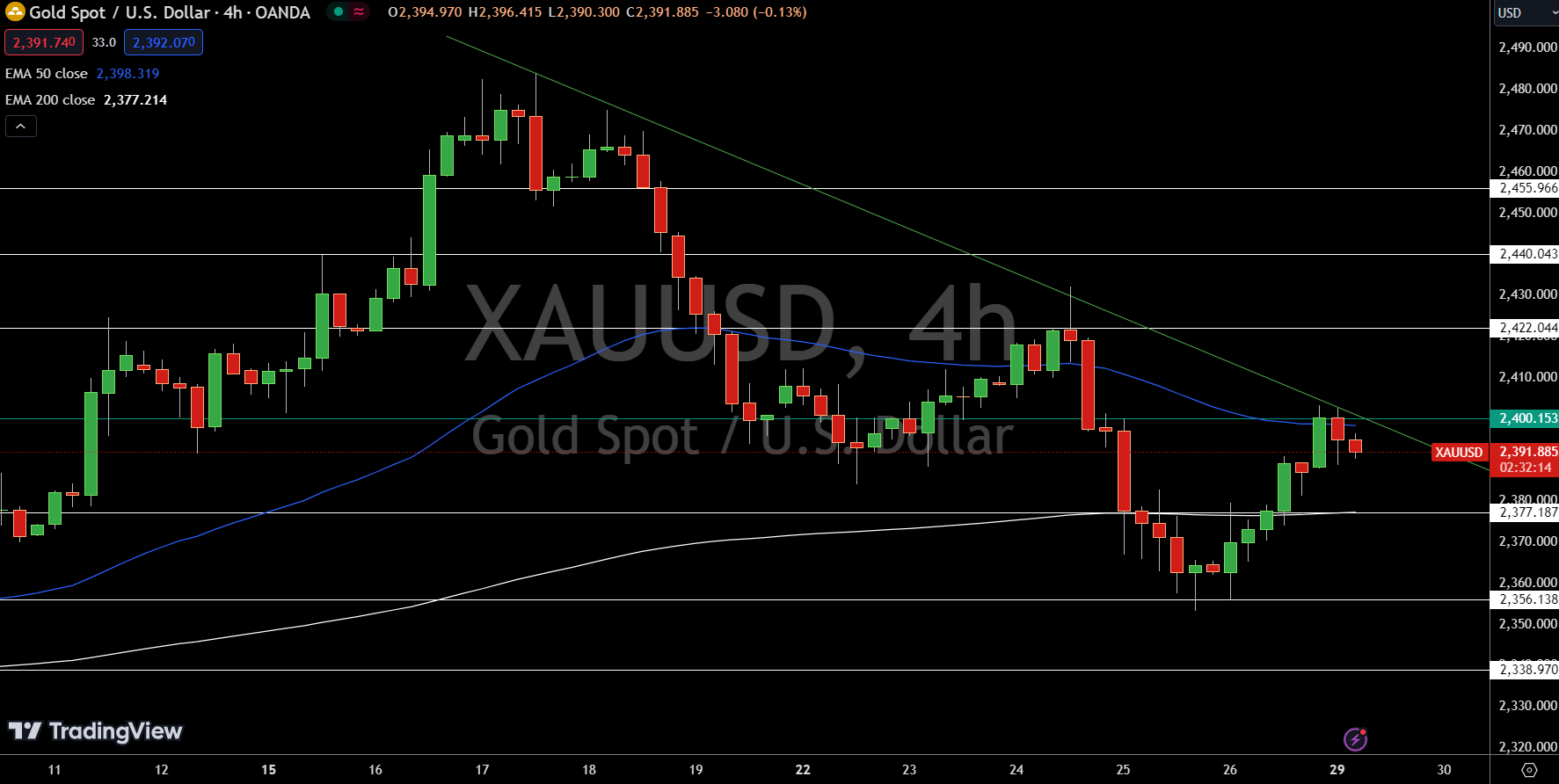
Gold (XAU/USD) is currently priced at $2,391.89, up 0.36%. The pivot point is at $2,400.15. Key resistance levels are $2,422.04, $2,440.04, and $2,455.97. Support levels are $2,377.19, $2,356.14, and $2,338.97. The 50-day Exponential Moving Average (EMA) stands at $2,398.32, and the 200-day EMA is at $2,377.21.

The downward trendline is extending resistance near the $2,400 level. The outlook remains bearish below $2,400. A break above this level could shift the sentiment to bullish, potentially driving prices higher. Conversely, maintaining below $2,400 reinforces the bearish outlook.