
Market Sentiment and Federal Reserve Policies
Despite the pullback, the environment remains favourable for gold due to ongoing expectations that the U.S. Federal Reserve will start reducing interest rates in September.
Such dovish Fed prospects have kept U.S. Treasury yields near multi-month lows, offering little support for a U.S. Dollar rebound from its recent three-month low.
This scenario underpins gold, which, as a non-yielding asset, benefits from these conditions. Thus, any dips might be viewed as attractive buying opportunities.
Economic Indicators and Gold’s Outlook
Investors are now eyeing U.S. Industrial Production data for more immediate trading cues. Moreover, the broader economic and monetary context supports investment flows into gold. Recent affirmations from Fed officials about an impending rate cut reinforce this sentiment.
Comments from Fed Chair Jerome Powell and other Federal Reserve leaders have highlighted a trajectory toward moderating inflation, aligning closely with the central bank’s targets.
Impact of Consumer Spending and Global Equities
Conversely, robust U.S. Retail Sales data has supported the dollar, suggesting resilient consumer spending, which could temper gold’s gains.
The unchanged retail sales in June, alongside positive revisions for May, reflect a potentially stronger U.S. economic outlook.
Meanwhile, the ongoing rally in global stock markets could restrain further bullish momentum in gold, keeping its price gains in check despite the favourable macroeconomic backdrop for the precious metal.
Short-Term Forecast
Gold (XAU/USD) could remain under pressure near $2,474.25. If it breaks below this level, a decline toward $2,459.00 is likely, while resistance at $2,482.70 may limit upside potential.
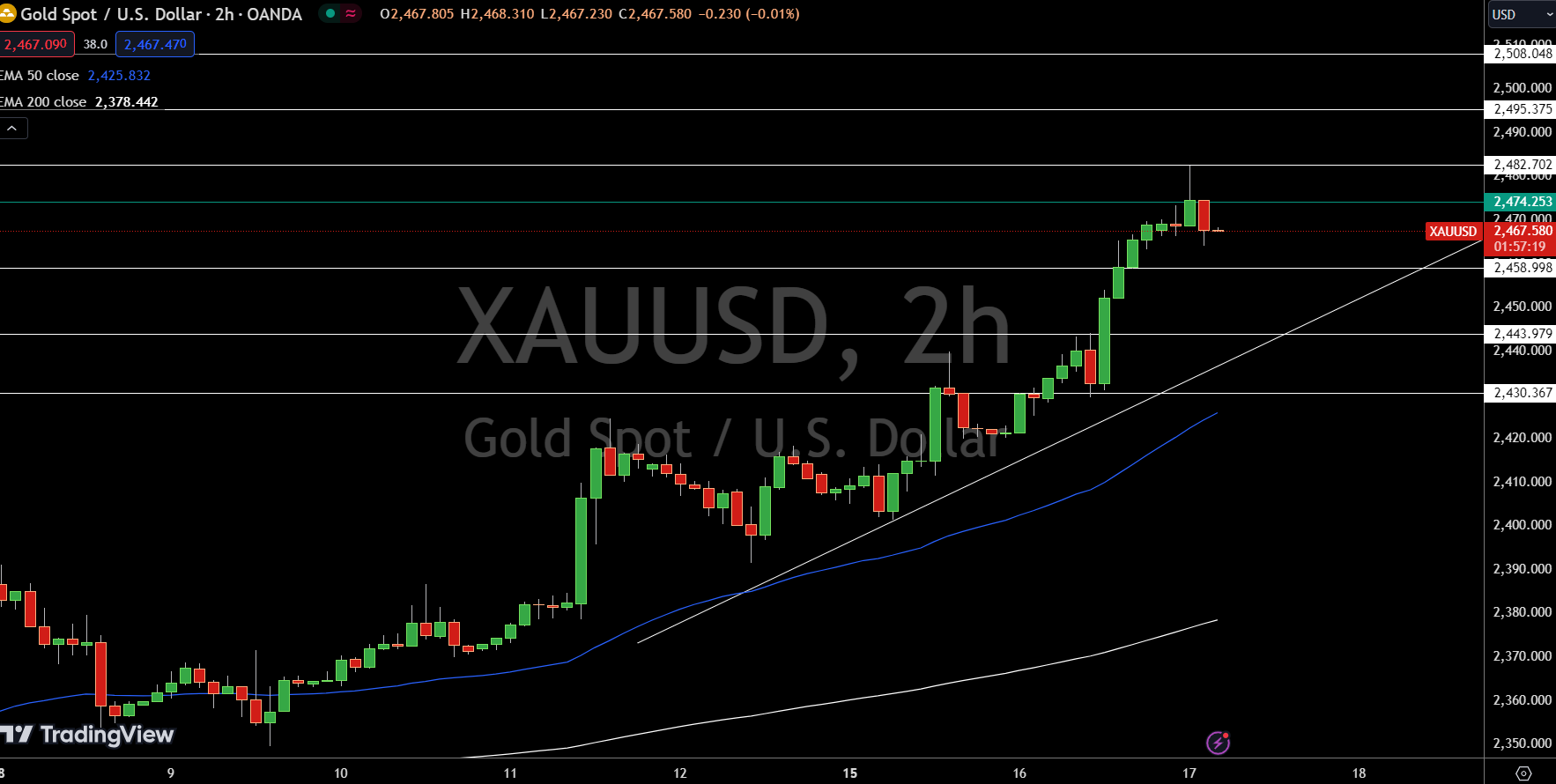
Gold (XAU/USD) currently trades at $2,467.58, reflecting a modest gain of 0.09%. The 2-hour chart highlights significant price levels that traders should monitor. The pivot point is set at $2,474.25, which is crucial for determining the next move.
Immediate resistance is observed at $2,482.70, with subsequent resistance levels at $2,495.38 and $2,508.05. If the price manages to break above the pivot point, these levels could act as targets.
On the downside, immediate support is $2,459.00, followed by $2,443.98 and $2,430.37. The technical indicators reinforce this outlook, with the 50-day Exponential Moving Average (EMA) at $2,425.83 and the 200-day EMA at $2,378.44, both suggesting a strong upward trend.

In conclusion, Gold remains bearish below the pivot point of $2,474.25. A break above this level could boost bullish momentum, targeting resistances at $2,482.70 and beyond. Conversely, a sustained move below $2,474.25 may lead to further declines, with immediate support at $2,459.00.