
US Economic Data and Rate Cut Speculation
Gold prices are influenced by recent US economic data. The US Bureau of Economic Analysis (BEA) reported a steady Personal Consumption Expenditures (PCE) Price Index at 2.7% annually, with the core gauge rising by 2.8%.
Additionally, the US Institute for Supply Management’s (ISM) Manufacturing PMI fell to 48.7 in May, marking the second consecutive month of contraction.
This led to a drop in US Treasury bond yields and pushed the USD to its lowest level since April 10. The weak economic indicators have heightened expectations for an imminent Federal Reserve rate cut, supporting gold prices.
Geopolitical Tensions and Market Sentiment
Persistent geopolitical risks, particularly in the Middle East, continue to support the near-term positive outlook for gold prices. The US is attempting to broker a ceasefire between Israel and Hamas, which could lead to more stable conditions.
However, traders are cautious, refraining from strong bullish bets on gold due to the optimism surrounding these developments.
Upcoming US and Global Economic Data
Traders are also awaiting significant US economic data, including JOLTS Job Openings and Factory Orders data on Tuesday, and the Nonfarm Payrolls (NFP) report on Friday.
Additionally, key central bank decisions from the Bank of Canada (BoC) on Wednesday and the European Central Bank (ECB) on Thursday will likely influence gold prices.
Rate cuts by these central banks are expected to benefit gold, given the lower opportunity cost of investing in non-yielding assets in a low-rate environment.
Short-Term Forecast
Gold (XAU/USD) may face continued downward pressure near $2,350, supported by expectations of a Federal Reserve rate cut later this year.
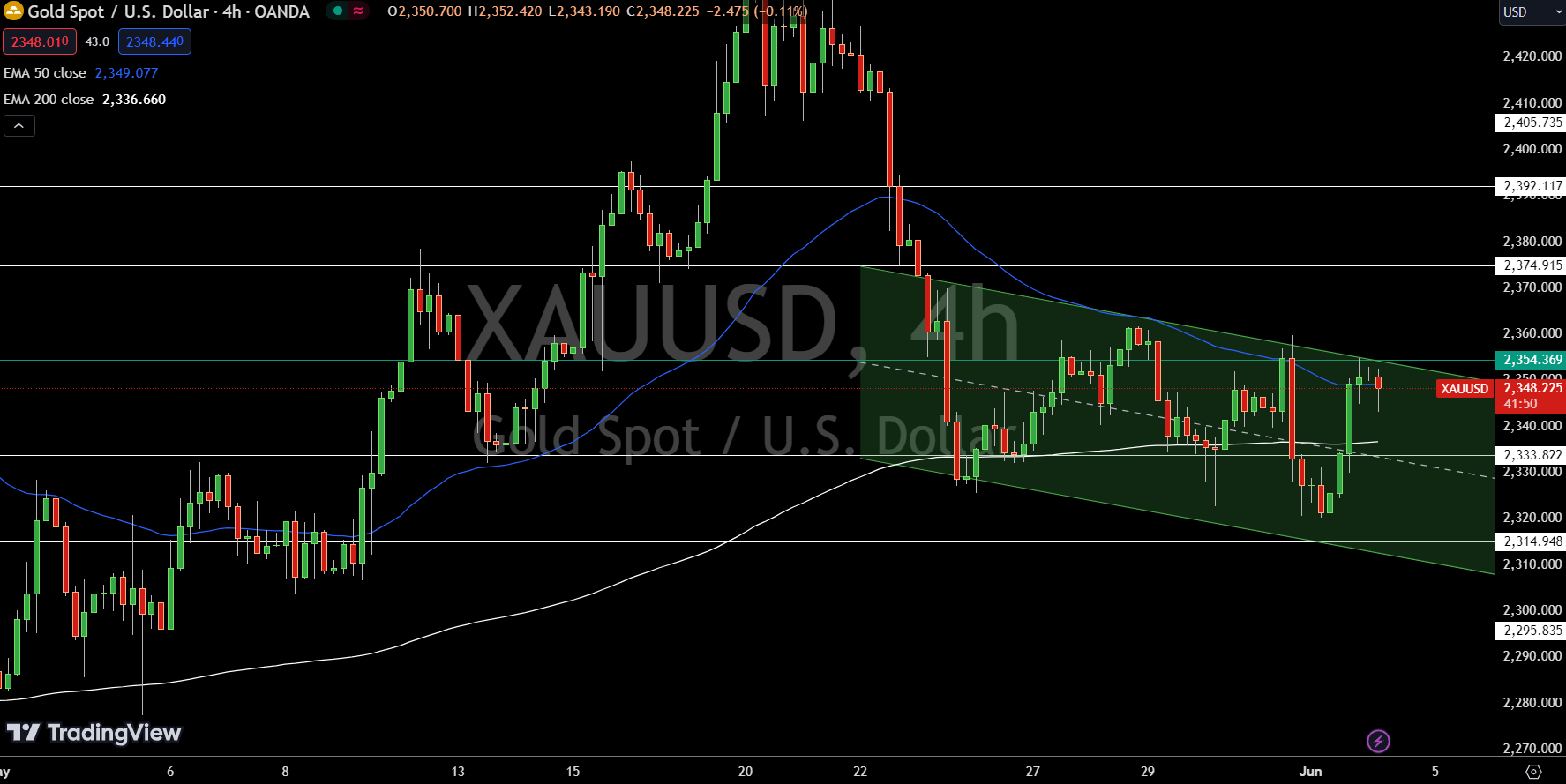
Technical indicators show the 50-day Exponential Moving Average (EMA) at $2349.08 and the 200-day EMA at $2336.66. The outlook remains bearish below $2355, but a break above this level could signal a bullish trend shift.