
Market Overview
Gold (XAU/USD) eased slightly from a fresh all-time high near $4,526 in the final session before the Christmas holiday, settling around $4,479 as trading activity thinned. Markets remain closed on Thursday for Christmas Day, leaving Wednesday’s close as the latest reference point.
Despite the modest pullback, downside pressure appears limited, with the broader backdrop still supportive and risk appetite cautious amid persistent global uncertainties.

Dollar Dynamics and Fed Outlook Remain Supportive
The US dollar staged a mild rebound from its weakest level since early October, though the move lacked follow-through. Expectations that the Federal Reserve will maintain a broadly accommodative policy stance continue to cap the dollar’s upside, reducing the appeal of yield-sensitive assets.
This environment remains constructive for gold, which benefits when real rates stay compressed and currency strength remains constrained. As a result, the metal has shown resilience despite short-term dollar firmness, with no signs of aggressive profit-taking emerging near recent highs.
Geopolitical Uncertainty Sustains Safe-Haven Demand
Ongoing geopolitical tensions continue to underpin safe-haven flows into bullion. Elevated uncertainty across multiple regions has encouraged investors to retain defensive exposure, reinforcing the view that the latest pullback reflects consolidation rather than a shift in trend.
Focus Turns to Key Japanese Data
With holiday-thinned markets reopening, attention will turn to upcoming Japanese economic releases on Friday. Tokyo core CPI is expected to slow to 2.5% year on year from 2.8%, while the unemployment rate is forecast to hold at 2.6%. Industrial production is seen falling 1.9% after a prior gain, and retail sales growth is projected to ease to 0.9%.
Gold Price Forecast
Every new Gold analysis as it publishes, today's technical signal and key levels, live price — on one page.
See all Gold forecastsWeaker-than-expected data could add to global growth concerns, potentially reinforcing gold’s appeal as a defensive asset.
Short-Term Forecast
Gold near $4,479 targets $4,520 while holding $4,450 support; silver at $71.85 eyes $73.80, with $70.20 support limiting downside as markets reopen amid holiday-thinned liquidity and steady safe-haven demand outlook.
Gold Prices Forecast: Technical Analysis
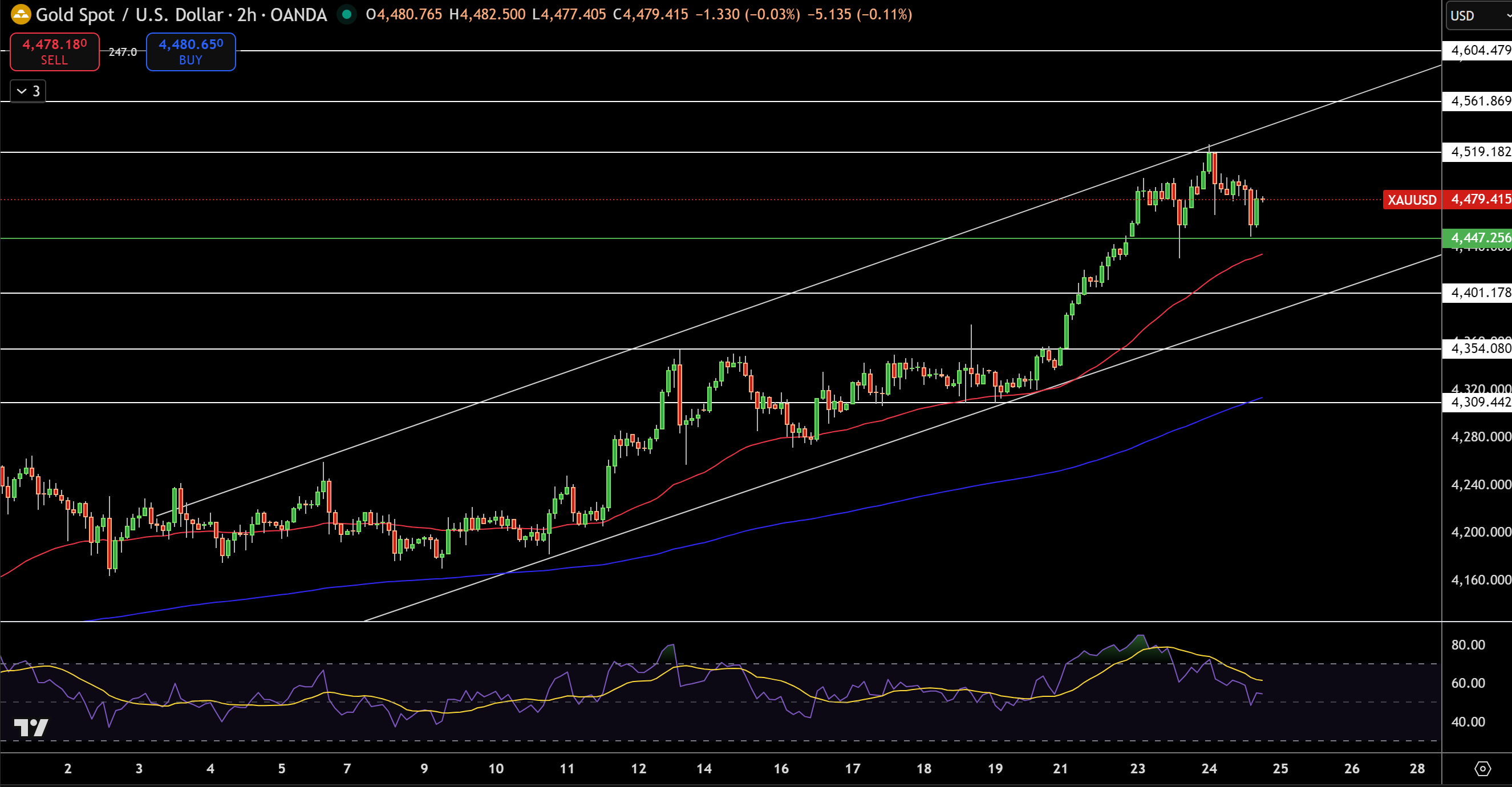
Gold on the 2-hour chart is holding near $4,479, reflecting Wednesday’s closing price ahead of the Dec 25 holiday, with the setup relevant for when markets reopen. Price remains within a well-defined ascending channel, following a strong rally from the early December base near $4,180.
The latest pullback came after rejection near $4,520, where multiple upper wicks point to short-term supply at channel resistance. Candlesticks are now stabilising above the $4,450–$4,445 support zone, which aligns with the channel midline and prior consolidation.
The 50-EMA continues to slope higher and provide dynamic support, while the 200-EMA remains well below, confirming the broader bullish structure. RSI has eased from near 70 toward 60, signalling consolidation rather than trend exhaustion, keeping the outlook constructive into the next session with a buy-on-dips bias near $4,450, stop below $4,400, and upside target around $4,520.
Silver (XAG/USD) Price Forecast: Technical Outlook
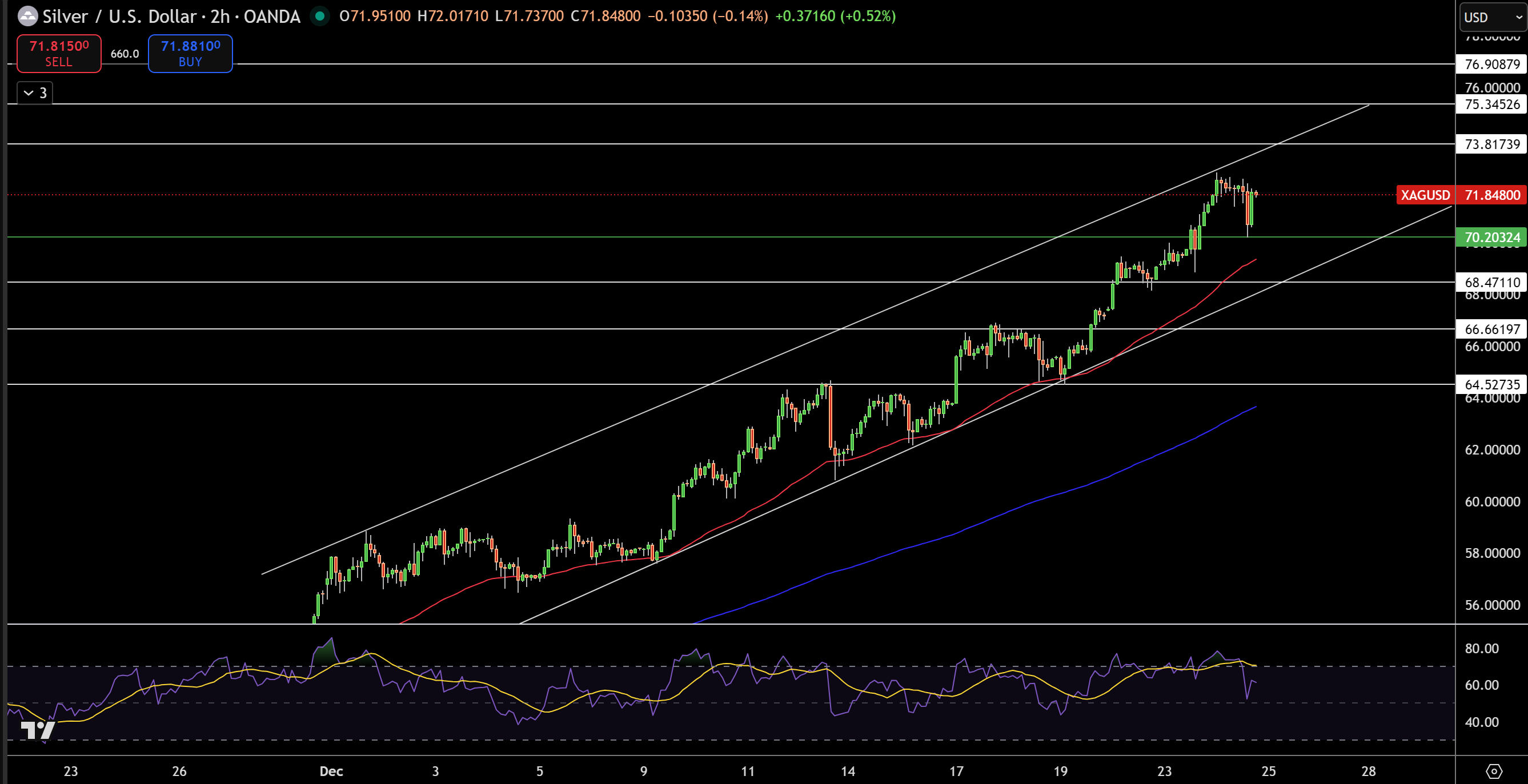
Silver on the 2-hour chart is holding near $71.85, reflecting Wednesday’s closing price ahead of the Dec 25 holiday, with the setup relevant for when markets reopen. Price remains in a well-defined ascending channel, supported by a sequence of higher highs and higher lows from the early December base near $56.00.
The latest pullback followed a rejection just below $73.80, where upper wicks signalled profit-taking near channel resistance. Candles are now stabilising above the $70.20 support zone, which aligns with the channel midline and prior breakout structure. The 50-EMA continues to track price closely, while the 200-EMA remains far below, confirming trend strength.
RSI has cooled from near 70 toward 60, suggesting consolidation rather than reversal, keeping the bias constructive into the next session with a buy-on-dips view near $70.20, stop at $69.20, and upside target at $73.80.