



Market Overview
Gold and silver are stepping into 2026 on a solid foundation of macroeconomic strength, even as the short term gets a bit bumpy. Precious metals had a record-breaking year in 2025, with gold posting its best 12 months since 1979, and silver beating it out of the water thanks to robust industrial demand and physical supply starting to get tight.
Monetary Policy and Real Yields Give a Lift to Gold and Silver
A big reason investors are turning to gold and silver is the way that monetary policy has been shaping up. Expectations of interest rate cuts by central banks, particularly the Fed, have really cranked down real yields.
When you get that situation, gold and silver become a lot more attractive as a hedge against a falling dollar and inflation worries, which is a pretty classic pattern.
Central banks keep buying gold, increasing their reserve holdings as part of a broader strategy to diversify their portfolios, sucking up supply and adding structural weight to the market.
Silver: The Dual Role Player
Silver’s story is different from gold’s, as it’s not driven solely by investment demand. Industrial consumption, especially from the solar, electronics, and EV sectors, accounts for a large share of silver demand, creating a structural shortage that might persist through 2026. That dual role adds some extra volatility to the picture, both up and down.
Gold Price Forecast
Every new Gold analysis as it publishes, today's technical signal and key levels, live price — on one page.
See all Gold forecastsLooking Ahead
Looking ahead, traders are closely watching upcoming US economic releases. The US ISM Services Purchasing Managers Index (PMI) is scheduled for release on Wednesday.
According to the economic calendar, the ISM Services PMI for December is forecasted to come in at 52.2, slightly lower than the 52.6 reading recorded in November, which showed continued expansion in the services sector. Moreover, attention will shift to the US December employment report due on Friday.
The economy is expected to add around 55,000 jobs, whereas the Unemployment Rate is projected to edge down to 4.5%. If the data comes in stronger than expected, this could support the US Dollar. Consequently, a firmer Dollar may put pressure on USD-denominated Gold prices in the near term.
Gold Prices Forecast: Technical Analysis
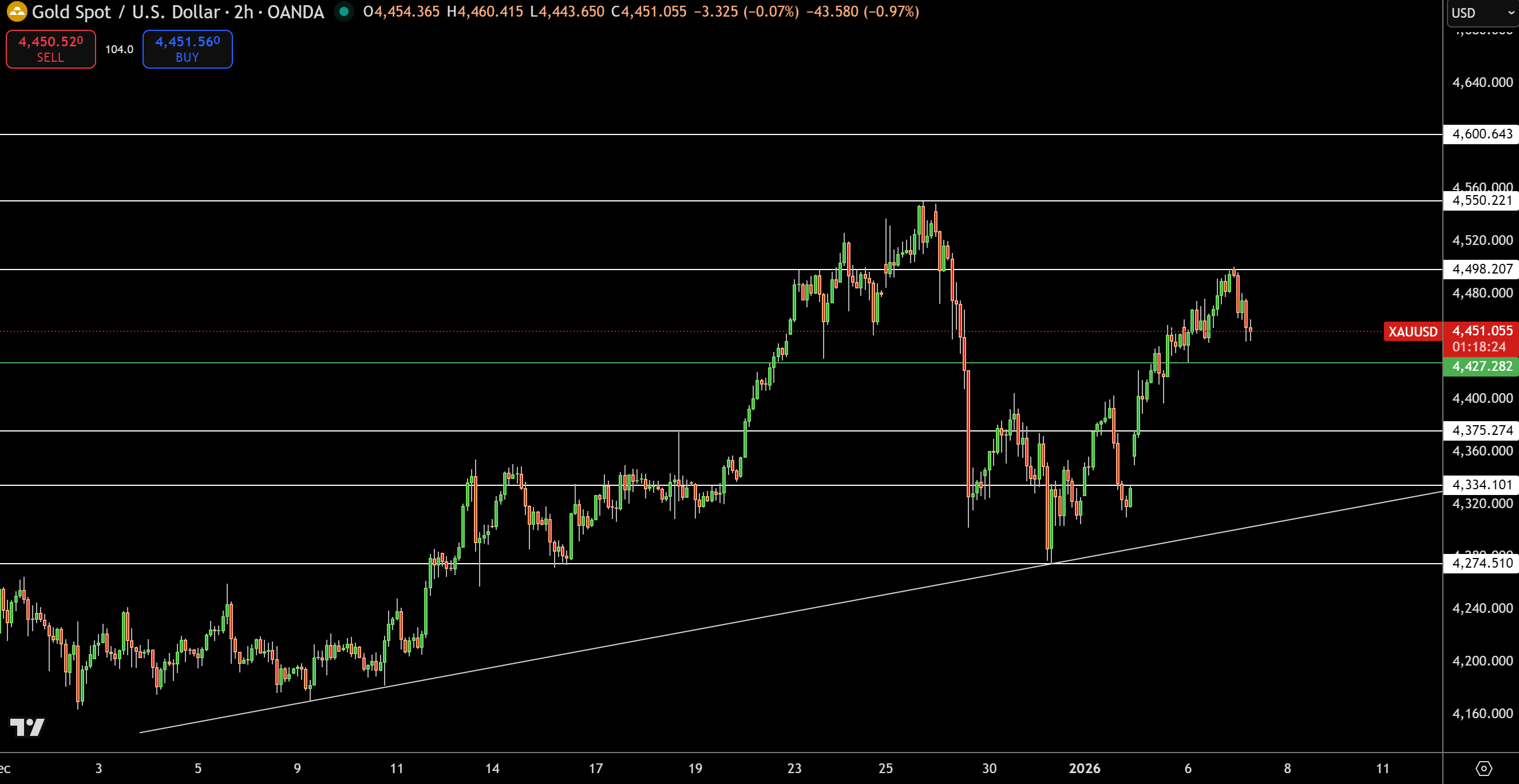
Gold (XAU/USD) is hovering just above $4,451 right now, taking a breather after failing to break through that $4,500 level. On a 2-hour chart, the price is still nestled within an ascending trend, a rising trendline from back in December has been providing some much-needed support around $4,275.
Lately, gold has been showing some candlesticks with a big upper wick – specifically around $4,498-$4,550. We’re looking at immediate support at $4,427, but then there’s also a previous buying area around $4,375, which is a key one to watch if things start to get a bit hairy. On the resistance side, we have $4,498 and $4,550, and the next real upside target is $4,600.
Silver (XAG/USD) Price Forecast: Technical Outlook
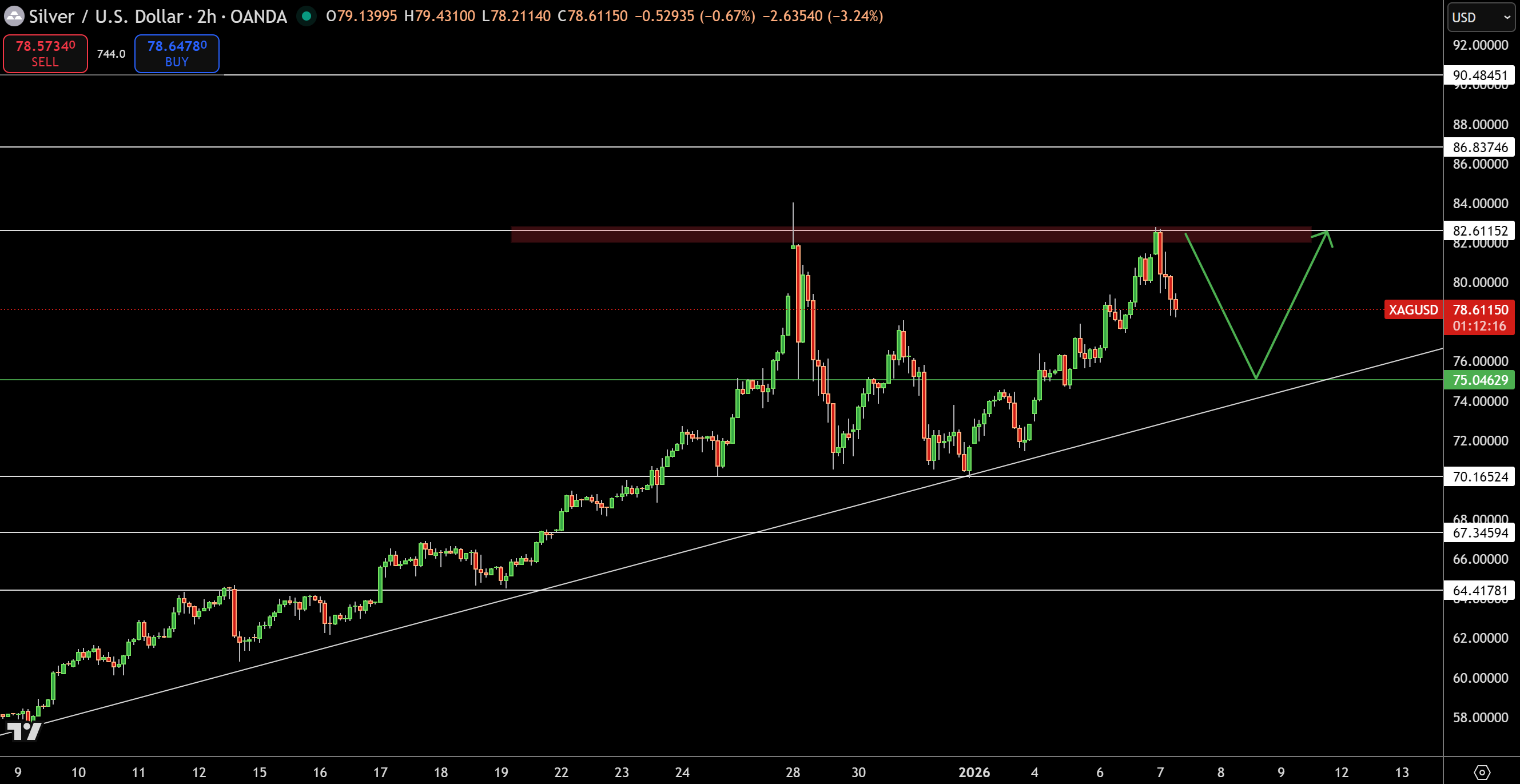
Silver (XAG/USD) is hovering around $78.61 after stepping back from the stubborn resistance zone of $82.60-$83.00, where it has repeatedly run into selling pressure.
The recent slide looks like a correction, rather than anything that’s going to blow the whole trend apart, and as long as we keep seeing higher lows above that key support at $75.05, we can breathe easier. But if we break below $75.05, the $70.15 level becomes the next line of defense.
Meanwhile, that resistance at $82.60 is still solid as a rock – a clean break through there, and we may even see some real upside towards $86.80. The trade idea is to look for buying opportunities when the price dips down towards $75.20, and then target the $82.50 level. If things don’t go our way, the stop loss is set just below $70.00.