
Market Overview
During the European trading session, Gold (XAU/USD) struggled to maintain its recent upward momentum, dropping slightly but holding above the 4,800 level. However, the latest weakness is attributed to waning safe-haven demand amid easing trade war concerns. In the meantime, the small rebound in the US dollar, driven by a slowdown in recent “Sell America” flows, added pressure on gold.
Moving on, traders remained cautious ahead of key US data, particularly the Personal Consumption Expenditures (PCE) inflation report. This will give the hints about the Federal Reserve’s rate-cut outlook.

Gold Retreats as Market Optimism Grows on Trump’s Greenland Move and Easing Trade Fears
The global market sentiment has started to improve after US President Donald Trump changed his stance on Greenland. At the World Economic Forum in Davos, he said the US had reached an agreement framework with NATO for Greenland, so there’s no need to impose new tariffs on European countries.
He also dropped his plan to take Greenland by force and canceled threats of extra tariffs on eight European nations. After this, the market sentiment improved and put some pressure on safe-haven gold price. At the same time, the “Sell America” trade has eased because fears of a larger trade war are fading.
Gold Slips as Ukraine Peace Hopes Rise and Fed Rate Outlook Steadies
On the other hand, US Special Envoy Steve Witkoff announced a new meeting with Russian President Vladimir Putin on Thursday, as talks on a US-led 20-point Ukraine peace plan make progress. Meanwhile, former President Trump said on Wednesday that Ukrainian President Zelensky and Putin are now close to reaching a deal to end the war. This news also eased safe-haven demand, putting pressure on gold as investors moved to riskier assets.
At the same time, a Reuters poll showed most economists think the US Federal Reserve will keep interest rates unchanged until at least the end of this quarter. Traders still expect two more rate cuts in 2026, but worries about political interference in the Fed are limiting gains in the US dollar.
Gold Price Forecast
Every new Gold analysis as it publishes, today's technical signal and key levels, live price — on one page.
See all Gold forecastsGold Prices Forecast: XAU/USD Holds $4,825 as Buyers Defend Trendline After Sharp Pullback
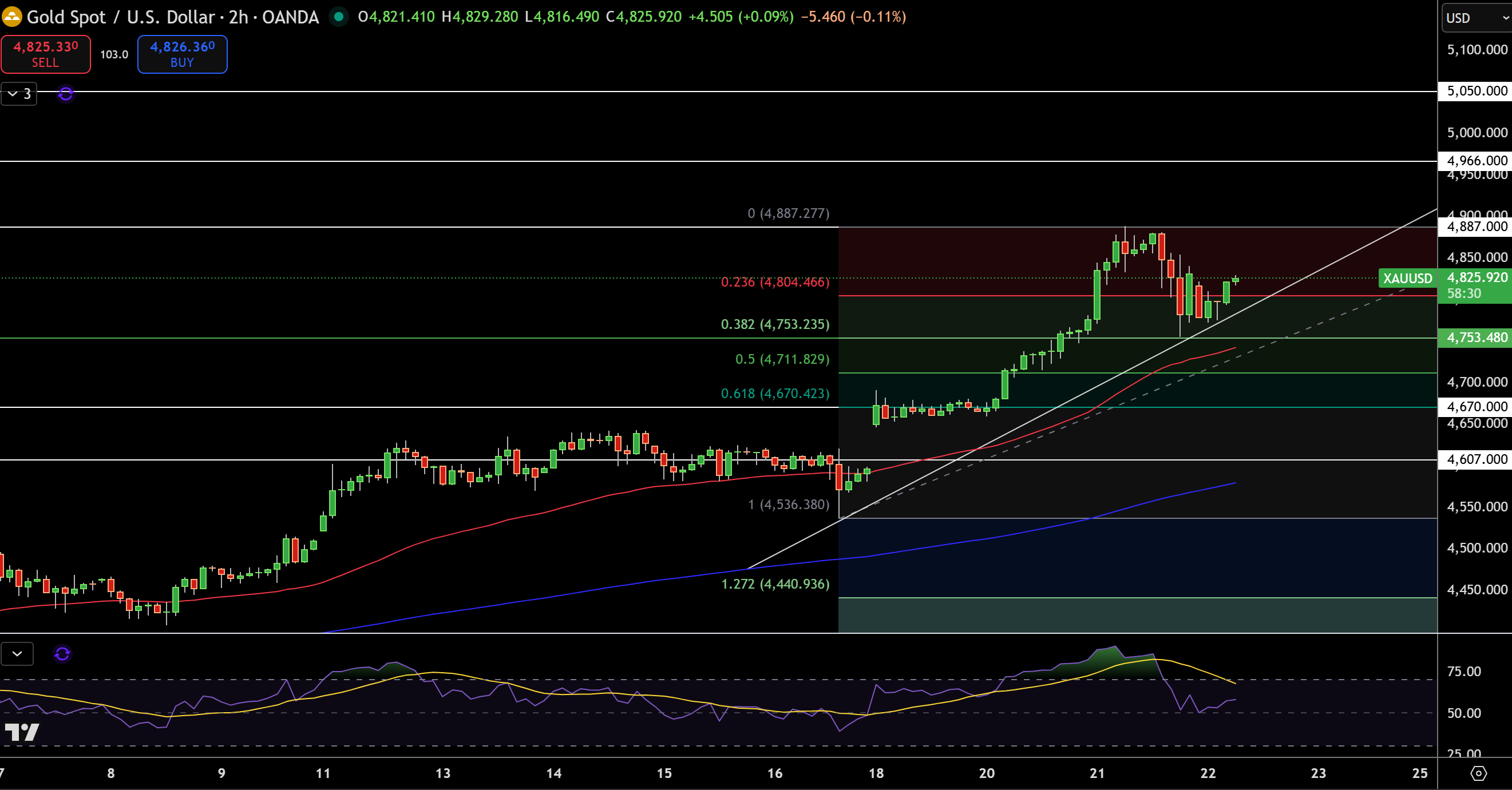
Gold is trading near $4,825, stabilizing after a strong rally that stalled below the $4,887 swing high. On the 2-hour chart, recent candlesticks show smaller bodies and upper wicks, pointing to hesitation rather than aggressive selling. Price remains above a rising trendline drawn from the January low, keeping the short-term structure constructive.
The pullback has respected key Fibonacci levels. The 0.236 retracement near $4,804 capped the initial dip, while deeper support aligns around the 0.382 level at $4,753 and the 0.5 level near $4,712. The 50-EMA is trending higher and continues to act as dynamic support, with the 200-EMA well below, reinforcing the broader bullish bias.
Trade idea: Buy dips near $4,760, target $4,890, stop below $4,710.
Silver Price Forecast: XAG/USD Holds $94.30 as Rising Channel Keeps the Bullish Structure Intact
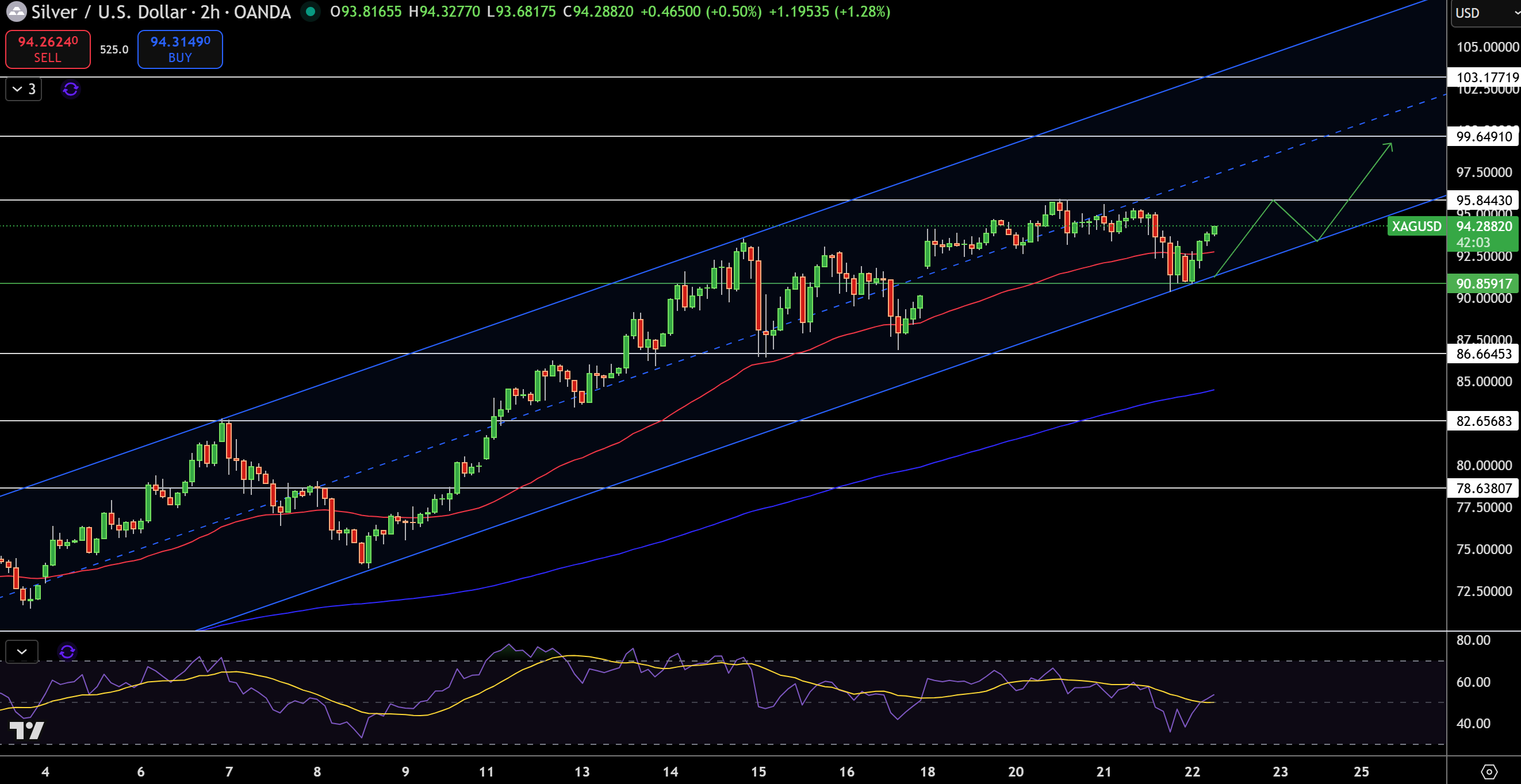
Silver is trading near $94.30, rebounding after a brief pullback toward the lower boundary of a rising price channel. On the 2-hour chart, recent candlesticks show long lower wicks near $90.85, signaling buyers stepping in on dips rather than aggressive selling. Price remains above the rising trendline and the channel midline, keeping the broader structure constructive.
The 50-EMA continues to slope higher and has acted as dynamic support during recent consolidations, while the wider channel projects higher levels ahead. Immediate resistance sits near $95.85, followed by the upper channel zone toward $99.60. On the downside, $90.85 remains key support, with deeper demand closer to $86.65.
Trade idea: Buy pullbacks near $91.00, target $99.50, stop below $86.60.