
Market Overview
Gold and silver traded softer in early European hours as investors adjusted positions following the latest US inflation data. The move reflected profit-taking in futures markets rather than a shift in the underlying macro backdrop, which remains supportive for precious metals.
US inflation cooled more than expected in November, reinforcing the view that monetary conditions are gradually easing. Headline consumer inflation slowed to 2.7%, while core inflation eased to 2.6%, both below consensus forecasts, according to data from the US Bureau of Labor Statistics. The figures mark one of the clearest signs yet that price pressures are moderating across the broader economy.
Lower inflation strengthens the case for easier policy over time, even if near-term rate cuts remain uncertain. Futures markets currently assign a 26.6% probability of a rate reduction at the next Federal Reserve meeting, based on CME FedWatch data.
Economists argue that direction matters more than timing. “The inflation trend improves the outlook for policy easing beyond the near term,” said Sal Guatieri, senior economist at BMO Capital Markets.

Demand and Risk Considerations Keep Downside Contained
Beyond interest rates, demand dynamics continue to underpin both metals. Central banks have maintained elevated gold purchases compared with historical averages, while investment demand remains resilient amid uncertainty around global growth and fiscal policy.
Silver, meanwhile, continues to draw support from its industrial role, particularly in energy transition applications, alongside its monetary characteristics. This dual demand profile has helped limit downside volatility during periods of shifting macro expectations.
Geopolitical tensions tied to energy markets and global supply routes have also sustained interest in defensive assets, even as broader risk sentiment stabilizes. Investors are now turning to forward-looking indicators, including consumer confidence data, to assess whether easing inflation is feeding into economic expectations.
For now, gold and silver appear anchored by fundamentals, with macro forces continuing to shape medium-term demand rather than short-term market noise.
Gold Price Forecast
Every new Gold analysis as it publishes, today's technical signal and key levels, live price — on one page.
See all Gold forecastsShort-Term Forecast
Gold holds near $4,325, supported above $4,305, with upside toward $4,390. Silver trades near $65.85, holding $65.00 support, while a break higher targets $68.70.
Gold Prices Forecast: Technical Analysis
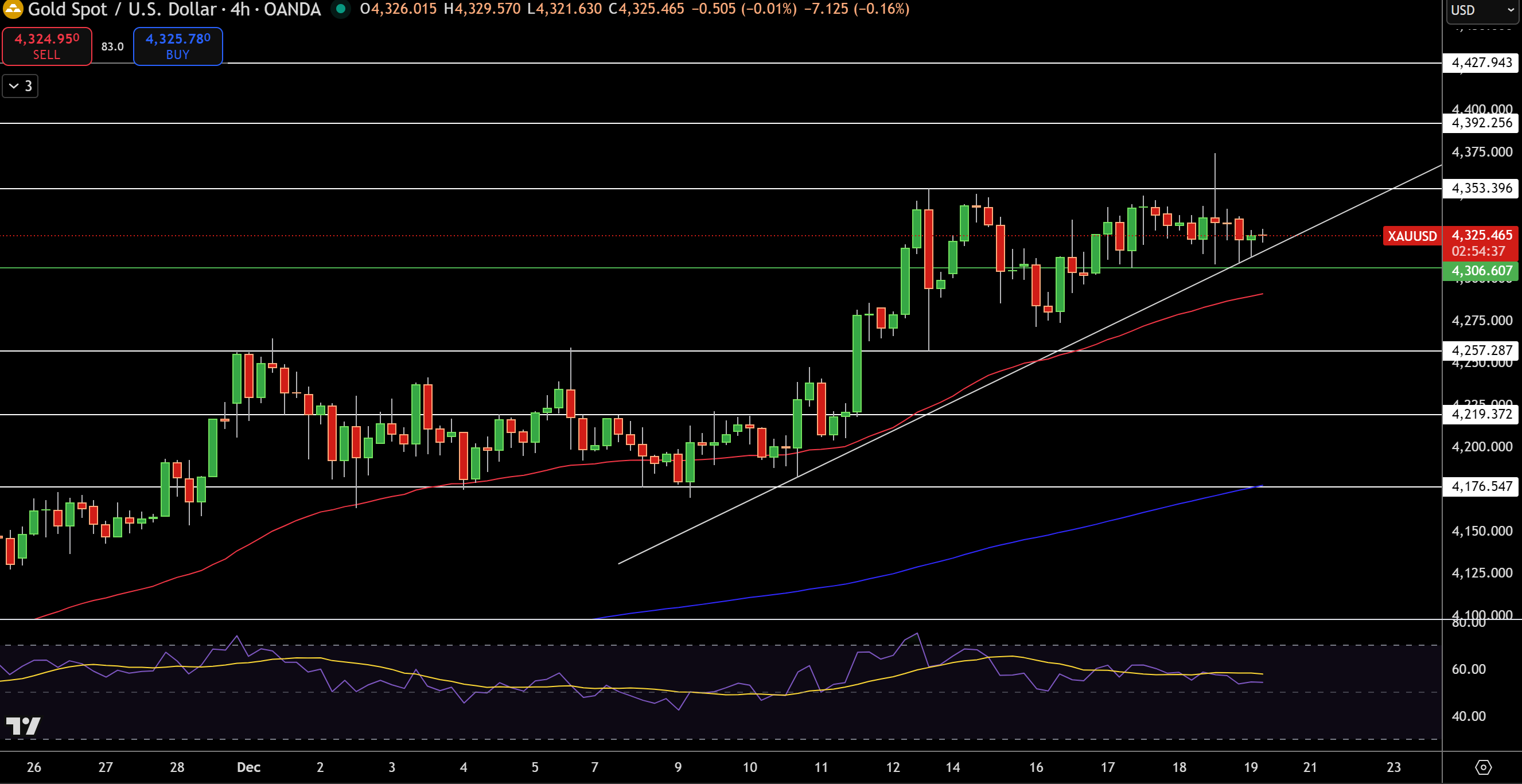
Gold (XAU/USD) is trading near $4,325, consolidating after a strong impulsive rally earlier this month. Price is holding above the rising trendline and the 50-EMA near $4,307, keeping the short-term structure constructive. Recent small-bodied candles with upper wicks show hesitation near resistance rather than aggressive selling.
The market is capped below $4,353, a key horizontal resistance aligned with prior highs. On the downside, immediate support sits at $4,306, followed by $4,257, where previous demand emerged.
The RSI around 56 signals steady momentum but no overbought pressure, suggesting room for continuation if support holds. A clean break above $4,353 would open a path toward $4,390–$4,425. Trade idea is to buy pullbacks above $4,305, target $4,390, stop below $4,255.
Silver (XAG/USD) Price Forecast: Technical Outlook
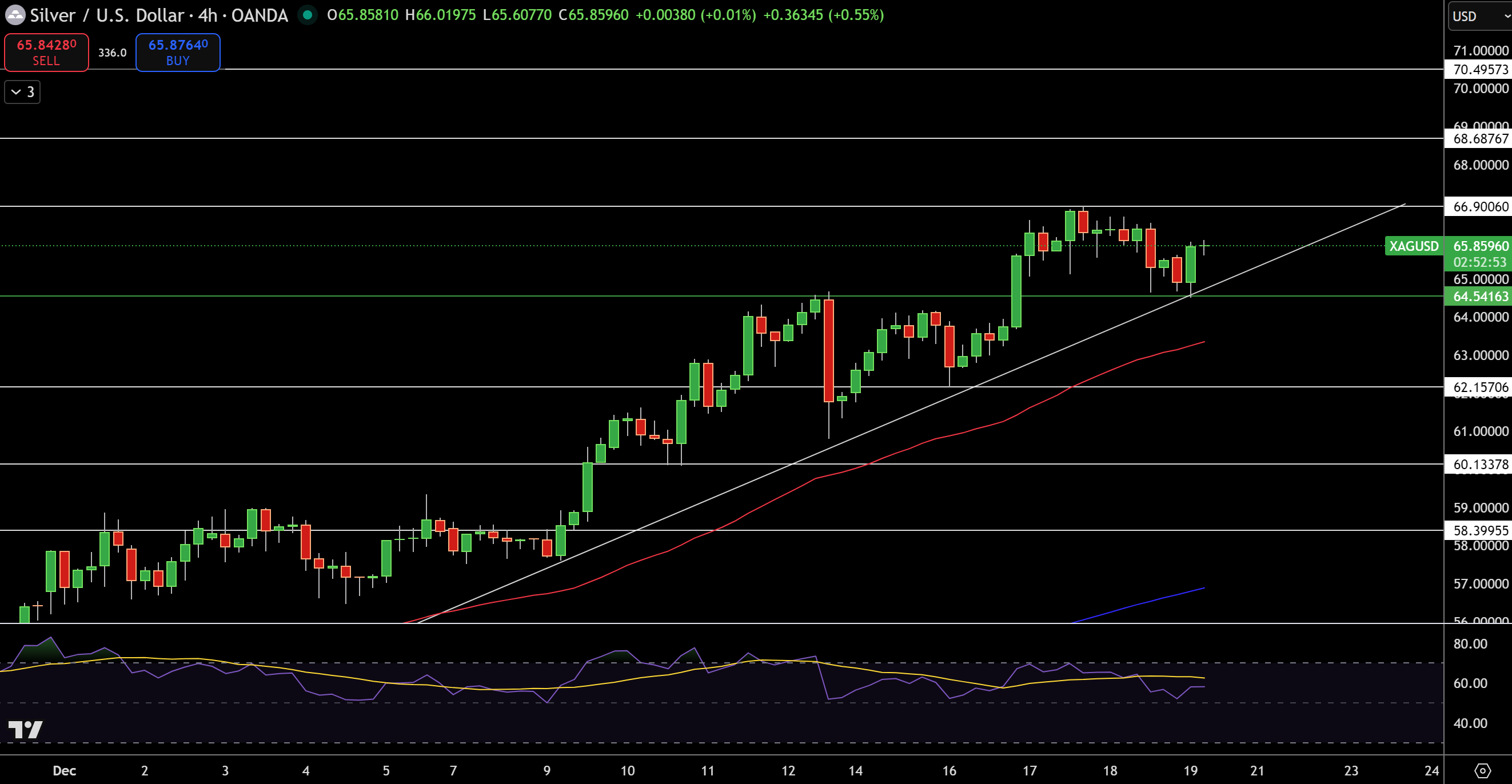
Silver (XAG/USD) is trading near $65.85, consolidating after a strong upside move earlier in the month. Price remains above the rising trendline and the 50-EMA near $64.50, preserving a bullish short-term structure. Recent small-bodied candles with mixed wicks signal consolidation rather than distribution, suggesting buyers are pausing, not exiting.
Immediate resistance sits near $66.90, a prior swing high, while a break above could open room toward $68.70. On the downside, key support is seen at $65.00, followed by $64.55, where trendline and horizontal support converge.
The RSI around 55 reflects steady momentum without overbought conditions, leaving scope for continuation if support holds. Trade idea is to buy dips above $65.00, target $68.70, stop below $64.50.