
Market Overview
Gold and silver held firm in early European trading Friday as investors positioned ahead of the U.S. Personal Consumption Expenditures (PCE) Price Index, the Federal Reserve’s preferred inflation measure. Economists expect headline PCE to edge up to 2.8%, with core inflation projected to hold at 2.9%, a reading that may influence interest-rate expectations and short-term market sentiment.
The metals complex has spent the past week navigating subdued volatility and inconsistent flows, reflecting a market waiting for confirmation rather than committing to a decisive trend.
Without a significant deviation in the PCE report, analysts note that precious metals may struggle to break from their current consolidation.

Rate-Cut Expectations Anchor Precious Metals
As per Fedwatch, market continue to assign an 85% probability to a 25-basis-point Fed rate cut at the central bank’s next meeting, according to market-based pricing. These expectations have limited the U.S. dollar’s ability to extend a modest rebound and helped support non-yielding assets such as gold and silver.
Labor data added to the complex backdrop. U.S. job cuts fell 53% in November, based on Challenger’s monthly report, while Initial Jobless Claims declined to 191,000, the lowest reading in more than three years.
Typically, such data would strengthen the dollar, but the reaction has been muted as markets prioritize the inflation outlook over near-term labor performance.
Geopolitical Risk Sustains Safe-Haven Demand
Geopolitical tensions continue to influence flows into precious metals. Statements from Russian President Vladimir Putin rejecting parts of a U.S. proposal to end the conflict in Ukraine have reinforced risk-averse behavior among global investors.
Gold Price Forecast
Every new Gold analysis as it publishes, today's technical signal and key levels, live price — on one page.
See all Gold forecastsPersistent uncertainty in the region, combined with broader geopolitical flashpoints, has maintained steady safe-haven interest in both gold and silver.
Safe-haven inflows may continue in the near term, particularly if geopolitical developments escalate or if future U.S. data suggest slowing disinflation.
With investors balancing inflation uncertainty, interest-rate expectations, and geopolitical risks, gold and silver remain anchored by a combination of caution and resilience.
Short-Term Forecast
Gold holds above $4,227 and may retest $4,257, while silver steadies near $58.23 with scope for $58.95. Momentum favors mild upside unless PCE data disrupts sentiment.
Gold Prices Forecast: Technical Analysis
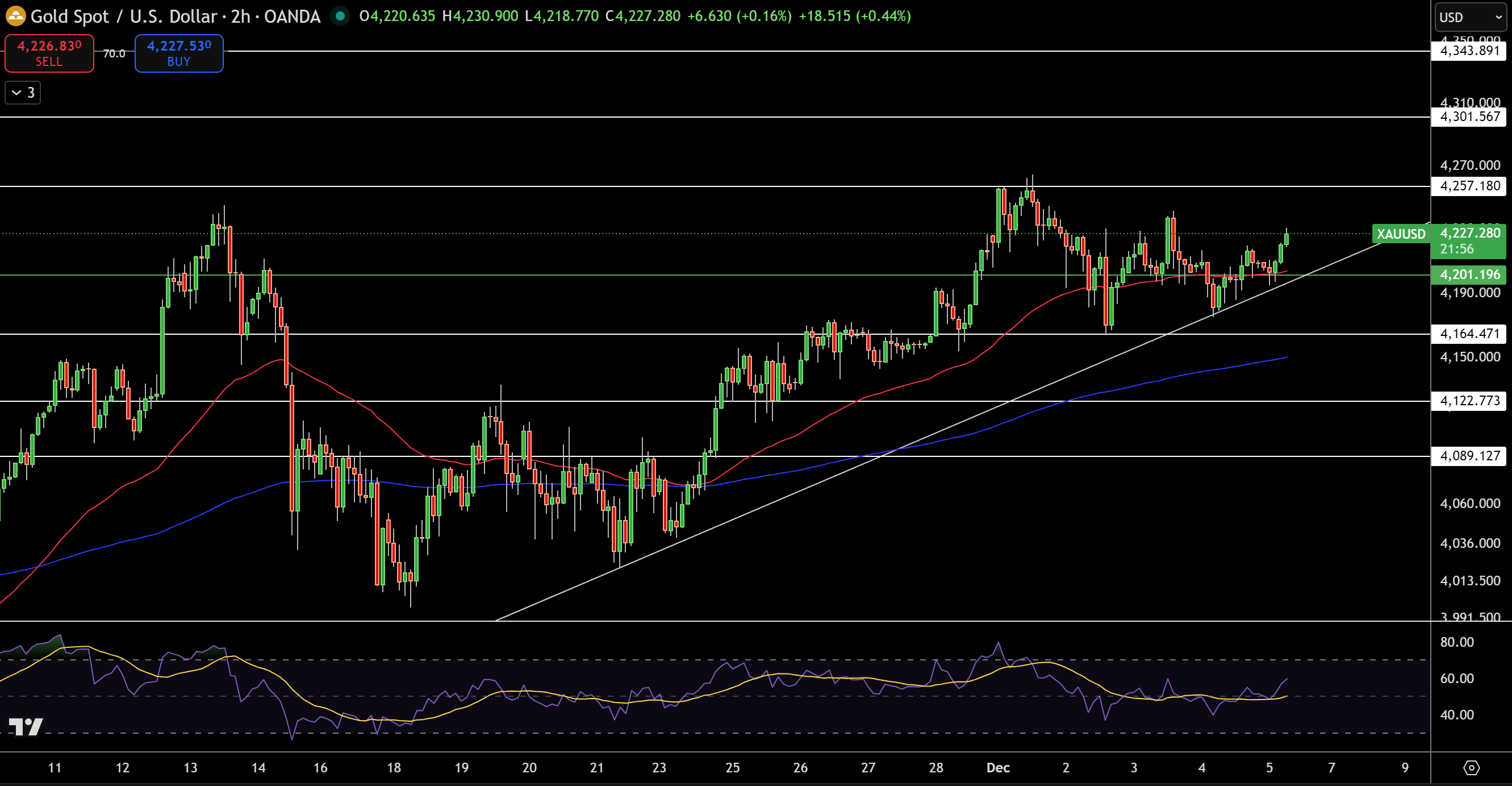
Gold is trading near $4,227, holding above an ascending trendline that has supported price since late November. The recent 2H candles show steady higher lows, confirming buyers are defending the structure. Immediate resistance sits at $4,257, followed by stronger levels at $4,301 and $4,343.
On the downside, initial support is at $4,201, with deeper support at $4,164 and $4,122 if sellers gain momentum. Price remains above the 50-EMA, while the 200-EMA below signals broader trend strength.
RSI is rising from mid-range toward 60, indicating improving bullish momentum without overextension. A close above $4,257 could trigger a move toward $4,300+, while losing the trendline risks a shift back toward $4,164.
Silver (XAG/USD) Price Forecast: Technical Outlook
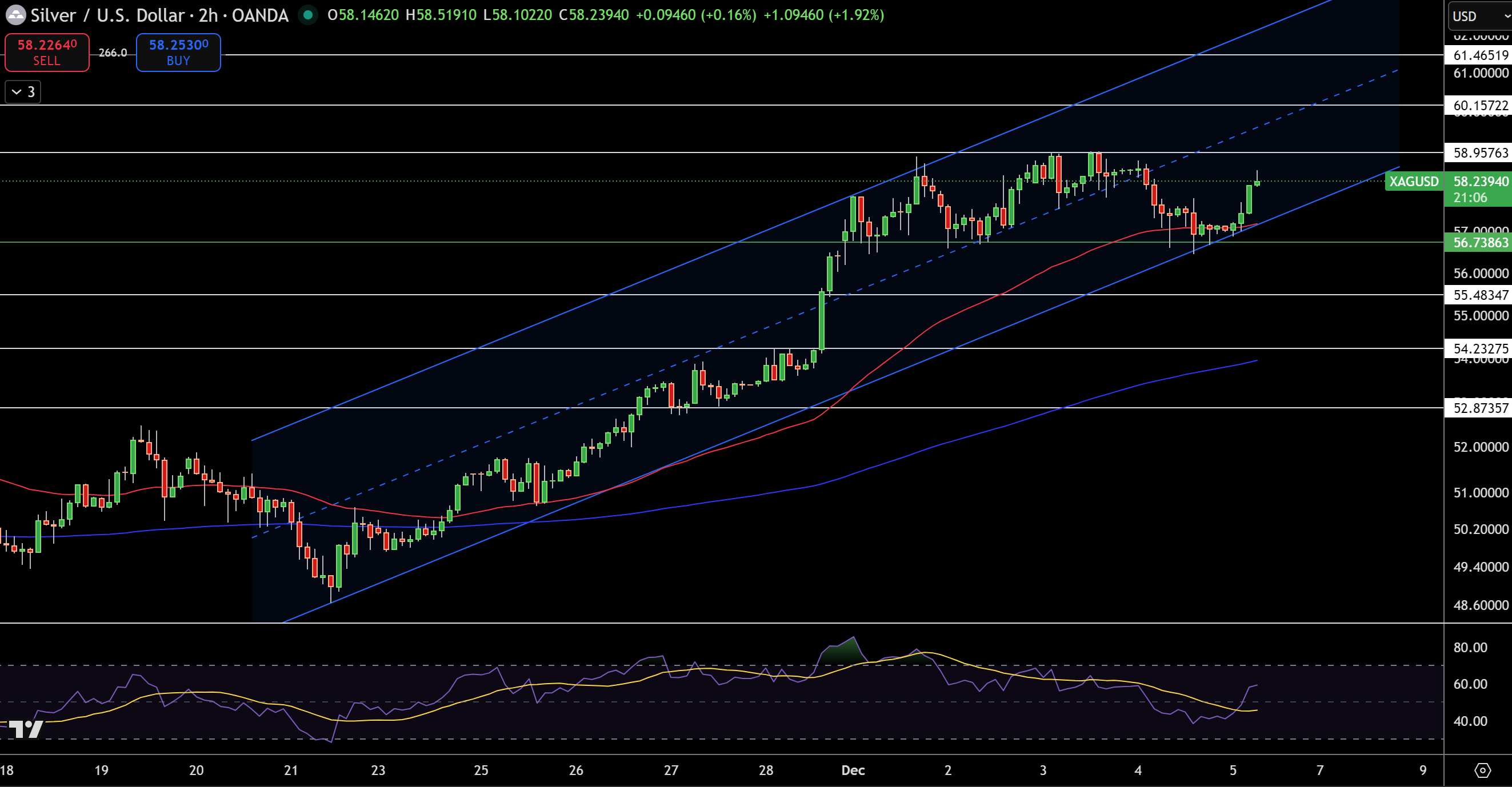
Silver trades near $58.23, moving within a rising channel that has supported the trend since late November. Price recently bounced off the lower boundary near $56.74, forming higher lows and reclaiming the 20-EMA, which is turning upward again.
The immediate resistance sits at $58.95, where previous candles printed rejection wicks, signaling supply.
A break above this level opens the path toward $60.15 and $61.46. Support remains firm at $57.00, followed by $55.48 if the channel floor fails. The 200-EMA near $54.23 provides a deeper anchor for the broader uptrend.