
Market Overview
Gold and silver enter the week supported by growing expectations that the Federal Reserve will deliver a rate cut at its December meeting, a move traders have now priced above 90% probability according to futures data. A quarter-point reduction would mark the Fed’s first shift toward easing since inflation began its post-pandemic run-up.
Despite inflation still sitting above the 2% target, recent labor indicator, including a 32,000 drop in private payrolls and a decline in job openings—signal softening economic momentum.
Weaker employment conditions may push the Fed to act pre-emptively to avoid a sharper slowdown. For precious metals, the implications are clear: lower rates reduce the opportunity cost of holding non-yielding assets, historically providing upward pressure on gold and silver.
Central Banks Extend Global Diversification Into Gold
Structural demand from central banks—one of the strongest long-term drivers of bullion, continues to expand. The People’s Bank of China reported its 13th consecutive monthly gold purchase, adding 30,000 troy ounces in November and lifting total reserves to 74.12 million troy ounces. C
hina remains the largest official-sector buyer this year, contributing to what the World Gold Council describes as record-breaking central bank accumulation.
The sustained diversification away from US Treasuries and into hard assets signals a broader reassessment of reserve strategy. Persistent geopolitical frictions and currency volatility are driving institutions toward metals perceived as more insulated from policy shocks.
Mixed US Data Creates a Tug-of-War for Precious Metals
Economic data released last week delivered a mixed picture for metals traders. The University of Michigan’s consumer sentiment index climbed to 53.3, beating expectations and reflecting modest improvement in household outlooks. Stronger sentiment, combined with stable services activity, provided support for the US Dollar.
Gold Price Forecast
Every new Gold analysis as it publishes, today's technical signal and key levels, live price — on one page.
See all Gold forecastsA firmer dollar typically pressures gold and silver because they become more expensive for holders of other currencies. This dollar-strength effect has moderated some of the bullish energy from rate-cut expectations, creating a more balanced short-term landscape.
Market Outlook
Investors will be watching Wednesday’s Fed decision, updated economic projections, and Chair Powell’s comments for signals on the pace of easing into 2026. With central bank buying elevated and macro conditions shifting toward slower growth, gold and silver remain positioned at the center of the broader recalibration of global risk sentiment.
Short-Term Forecast
Gold near $4,208 and silver around $57.98 may stay firm ahead of the Fed’s expected rate cut, with central bank demand and softer US data supporting near-term stability.
Gold Prices Forecast: Technical Analysis
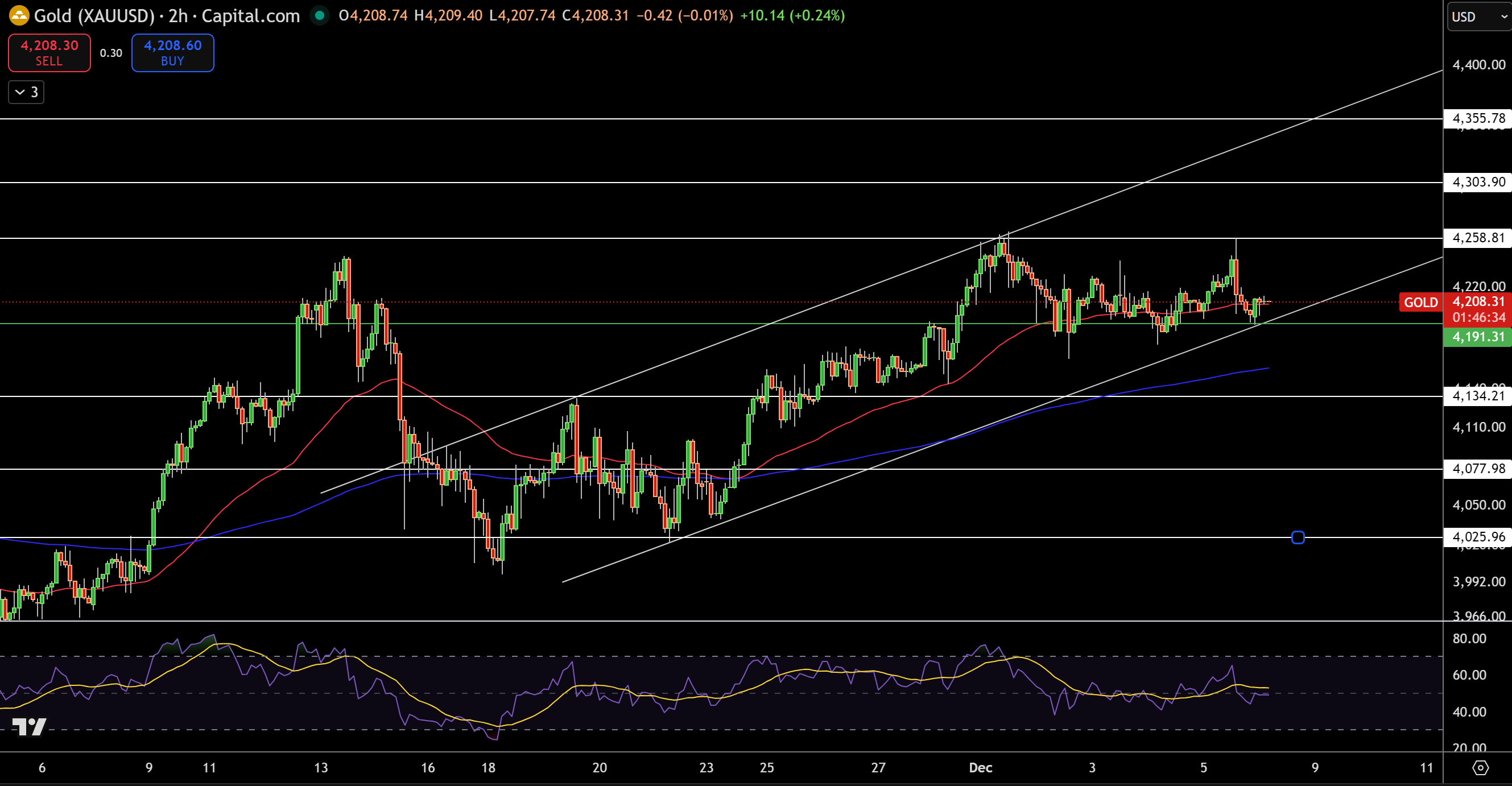
Gold is holding near $4,208, sitting right on a rising trendline that has guided price higher since mid-November. Recent 2H candles show tight bodies around $4,200–$4,220, reflecting indecision but still respecting the channel support. The 20-EMA is flattening, while the 50-EMA remains below price, keeping the broader structure mildly constructive.
Immediate support sits at $4,191, aligned with the trendline. A breakdown here could expose $4,134 and the deeper pivot near $4,078, where buyers stepped in last week. On the upside, resistance stands at $4,258, then $4,303, the upper channel zone.
Silver (XAG/USD) Price Forecast: Technical Outlook
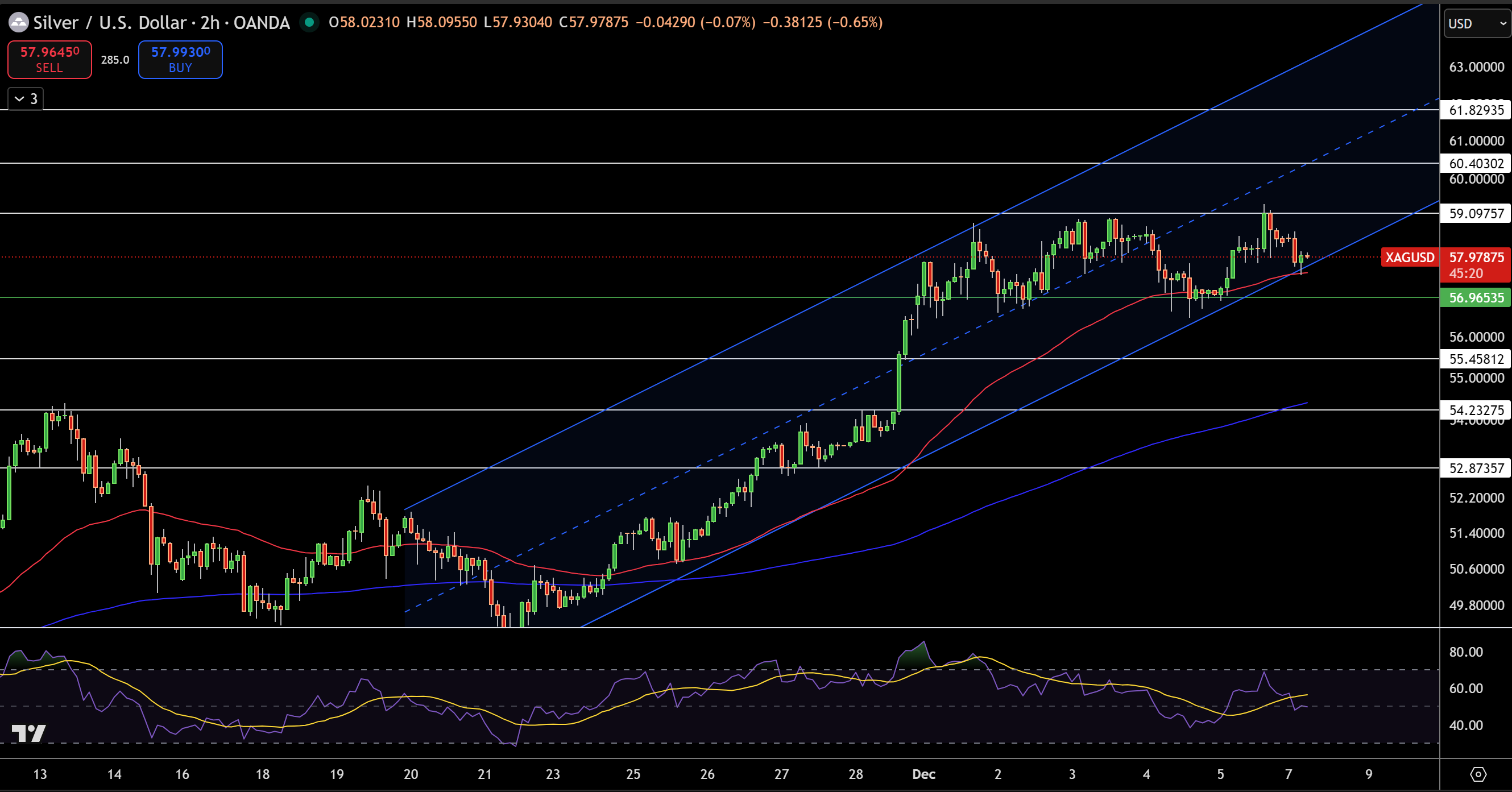
Silver is trading near $57.98, holding within a well-defined rising channel but testing its mid-line after losing momentum around $59.07. Recent 2H candles show long upper wicks between $58.80–$59.00, indicating steady supply at the upper boundary. Price is now hovering just above the 20-EMA, with the 50-EMA offering additional support at $56.96.
Immediate support sits at $56.96, aligning with the channel mid-line. A break below this area could pull silver toward $55.45, followed by $54.23, where the 200-EMA also sits. On the upside, resistance stands at $59.07, then $60.40 and the channel top near $61.82.