



Key Insights
- WTI oil nears $78 amid Red Sea attack and US-Iran tensions, eyes on OPEC+ meeting.
- Natural Gas prices decline to $2.12, pivotal resistance and support levels in focus.
- Brent Oil edges up to $83.11, market anticipates potential moves amid geopolitical risks.
Geopolitical Tensions and OPEC+ Decisions Influence WTI Oil Price Movements
Adding to the geopolitical tensions, a drone attack in Jordan killed three US service members, prompting discussions of possible US strikes in Iran, potentially escalating regional tensions and impacting crude oil prices.
OPEC+ is set to meet on February 1, with current agreements on output cuts of about 2.2 million barrels per day, led by Saudi Arabia’s voluntary reduction. However, Gazprom Neft sees no need for further cuts. Meanwhile, Russian refined product exports face a decline due to refinery repairs.
The strong US GDP data and speculations of a rate cut by China’s PBoC also provide support to oil prices. These developments have a notable impact on both oil and natural gas market analyses, with the potential to influence future price movements in these commodities.
Natural Gas Price Forecast
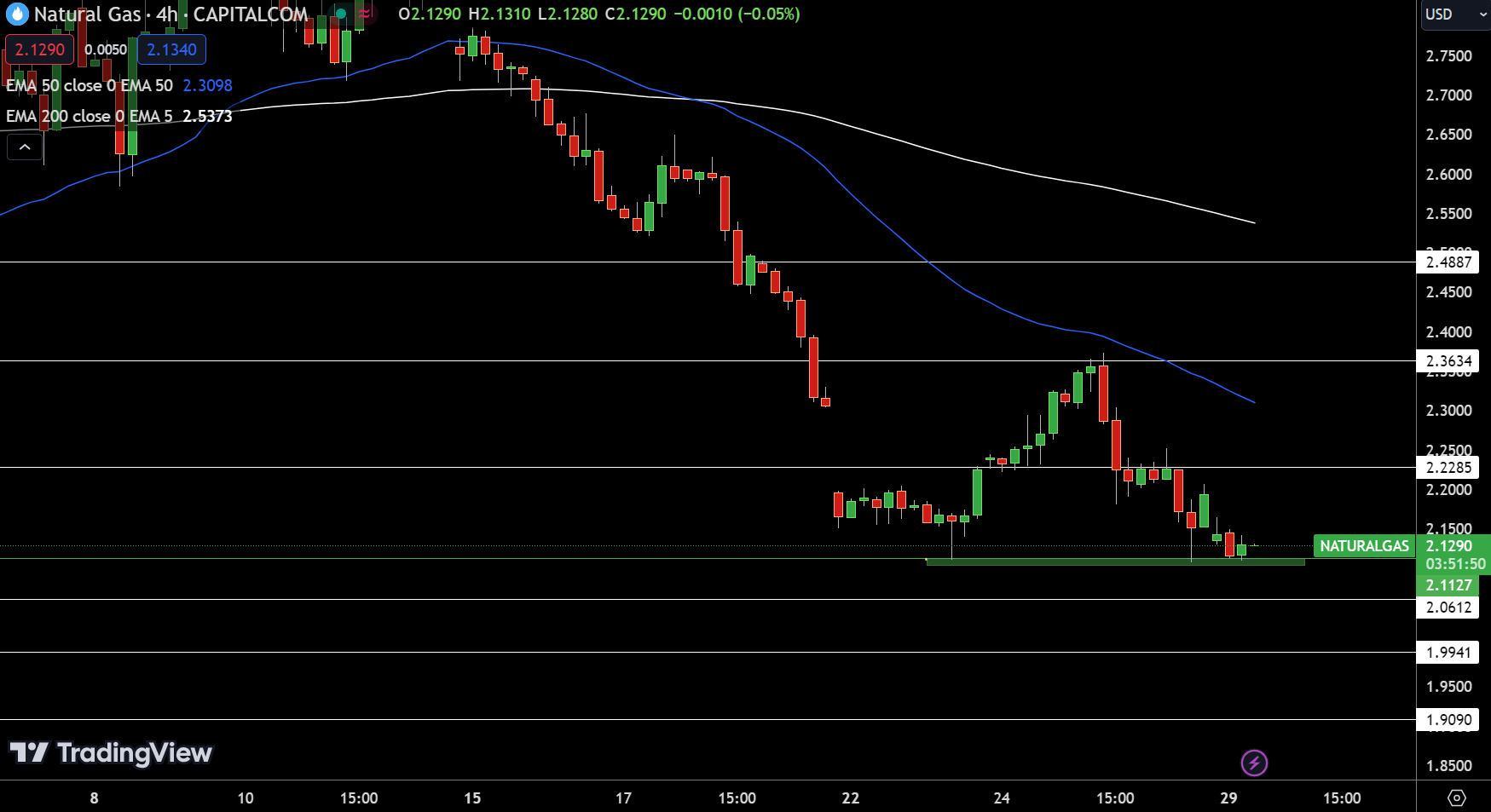
As of January 29, Natural Gas (NG) experiences a notable decline, trading at $2.1240 with a significant drop of 3.19%. The technical landscape indicates a pivot point at $2.1127, crucial for upcoming market movements.
Resistance levels are mapped at $2.2285, $2.3634, and $2.4887, which could impede upward trends. Support levels are identified at $2.0612, $1.9941, and $1.9090, potentially offering a buffer against further declines.
The 50-day and 200-day Exponential Moving Averages (EMAs) stand at $2.30980 and $2.53730, respectively, pointing to a broader bearish trend in the market. Despite the current downturn, if NG prices stabilize above the pivot point of $2.1127, it could indicate a shift towards a bullish trajectory.
However, the market remains cautious, with the potential for volatility as it navigates these key technical levels.
WTI Oil Price Forecast
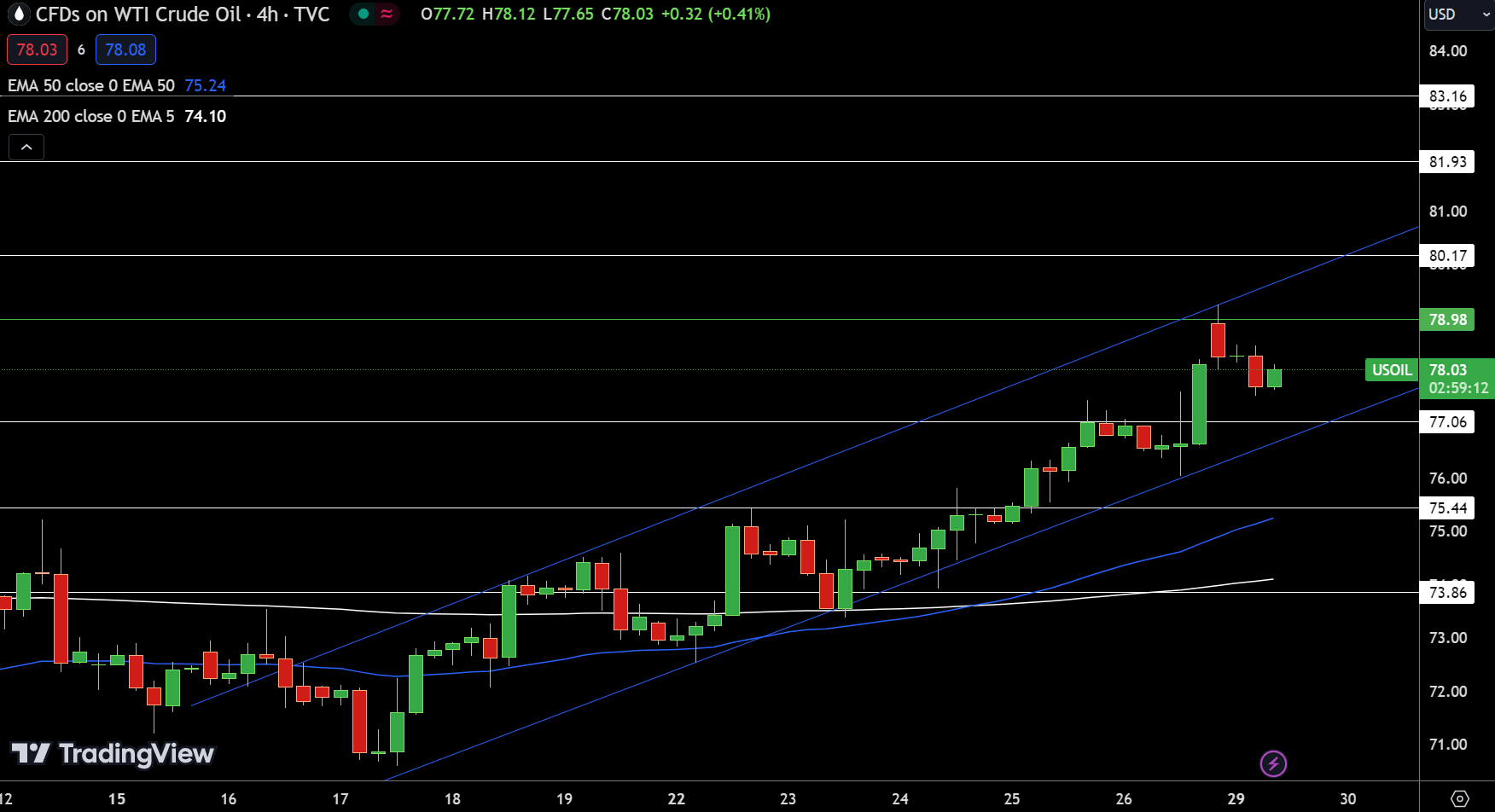
U.S. Oil is experiencing a slight uptick, currently trading at $78.03 with a minor increase of 0.09%. The market is near a critical juncture with a pivot point at $78.98. Resistance levels at $80.17, $81.93, and $83.16 pose potential barriers to further gains.
Support levels are found at $77.06, $75.44, and $73.86, which may stabilize prices in case of a downturn. The 50-day and 200-day Exponential Moving Averages (EMAs), positioned at $75.24 and $74.10, respectively, indicate a generally bullish sentiment.
An upward trendline suggests a supportive environment for a buying trend around $77.05. If prices remain above this level, it could signal a continuation of the upward momentum.
In summary, U.S. Oil maintains a bullish trend above the $77.05 threshold, pointing towards potential price increases in the near future.
Brent Oil Price Forecast
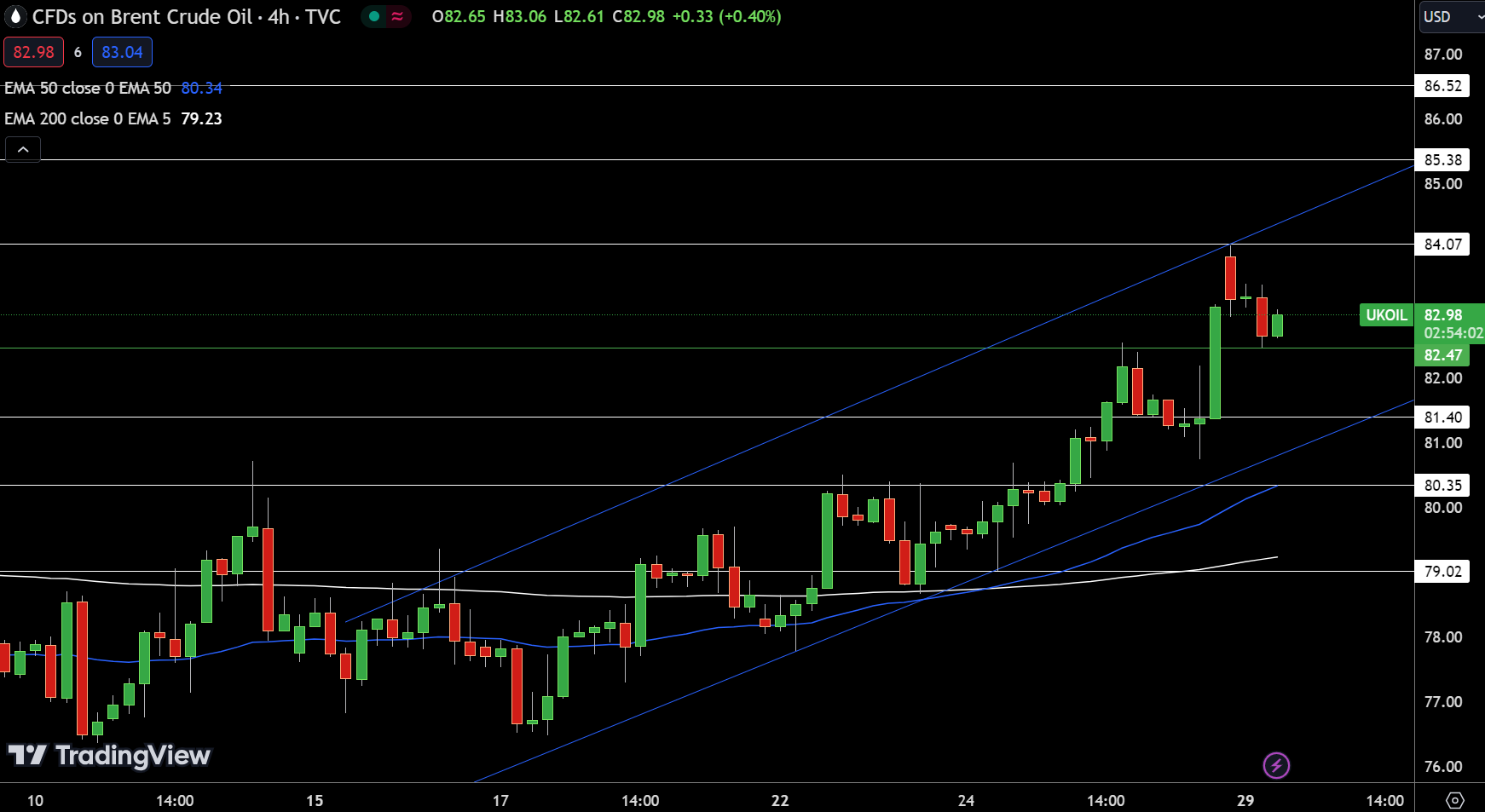
On January 29, UK Oil marginally increased, trading at $83.11, reflecting a 0.01% uptick. The market is near a critical point, with the pivot set at $82.47. Resistance levels at $84.07, $85.38, and $86.52 may restrict upward movement, while supports at $81.40, $80.35, and $79.02 offer potential fallbacks.
The 50-day and 200-day EMAs, at $80.34 and $79.23, suggest a bullish trend. An upward trendline around $82.47 indicates a buying inclination. However, as UK Oil is in an overbought territory, a minor bearish correction towards the pivot might ensue.
Breaking below this pivot point could lead to a sell-off towards $80.50. Overall, UK Oil’s trend is bullish above $82.40, signaling a possible continuation of the upward trajectory in the near term.


