



Oil fell on Monday, adding to its three-week losing streak, as a wider selloff in financial markets over doubts about whether the AI sector can boost economic growth spilled into commodities, Reuters reported. Attacks on shipping in the Gulf limited the losses. Brent traded near $92.29 a barrel at 0216 GMT, while WTI traded near $83.26.
Brent: Equity Selloff Outweighs Gulf Attacks
The Nasdaq fell 10% last week, and Asian stocks opened lower on Monday, with South Korea’s tech-heavy market down 4%, Reuters said. The supply risks have not gone away. The Houthis claimed on Sunday that they attacked a Saudi oil refinery, and multiple attacks on shipping in the Gulf and near the Strait of Hormuz were reported over the weekend. In my view, oil is trading with stocks for now, so the Gulf attacks are slowing the decline rather than reversing it.
“It’s momentum carrying (oil) down,” said Mukesh Sahdev, chief oil analyst at XAnalysts. He added that “ballast (empty) vessels counts are building in crude while laden vessels are not,” meaning fewer loaded tankers are on the water, and warned that “this risk to flows will start to price soon.”
WTI: OPEC+ Meeting and US Rigs in Focus
OPEC+ ministers will hold a series of meetings on November 29 to decide their 2027 output policy, Reuters said. Separately, COP31 climate talks in Turkiye collapsed on Sunday, the first such collapse since 2009, after nations could not agree on including a fossil fuel phase-out statement in the final text. Saudi Arabia and other large oil producers lobbied to keep fossil fuel mentions out, according to observers cited by Reuters.
In the US, the total rig count rose by 6 to 607 in the week to November 20, according to Baker Hughes. More rigs usually point to more drilling activity, which can add to US supply over time.
Natural Gas Price Forecast
Every new Natural Gas analysis as it publishes, today's technical signal and key levels, live price — on one page.
See all Natural Gas forecastsNatural Gas: Winter Demand Hopes Meet Ample Supply
US natural gas futures touched their highest since June 26 on Thursday, as traders weighed hopes for heavier winter heating demand against ample supply and ongoing storage additions, Reuters reported. On Friday, LSEG forecast Lower 48 demand, including exports, would rise from 121.6bn cubic feet per day (bcfd) last week to 128.1 bcfd this week.
Gas demand “could increase dramatically based off changing weather temperatures” at this time of year, said Thomas Saal, senior vice president at StoneX. He added that “the industry is still injecting gas” and that “there appears to be enough supply to cover the kind of weather we’re seeing now.” The December contract expires on Wednesday, after which January becomes the front month. For more on gas, see FXEmpire’s natural gas forecasts.
Brent Crude Oil Technical Analysis: Oil Tests Falling Trendline Above $92.04 Pivot
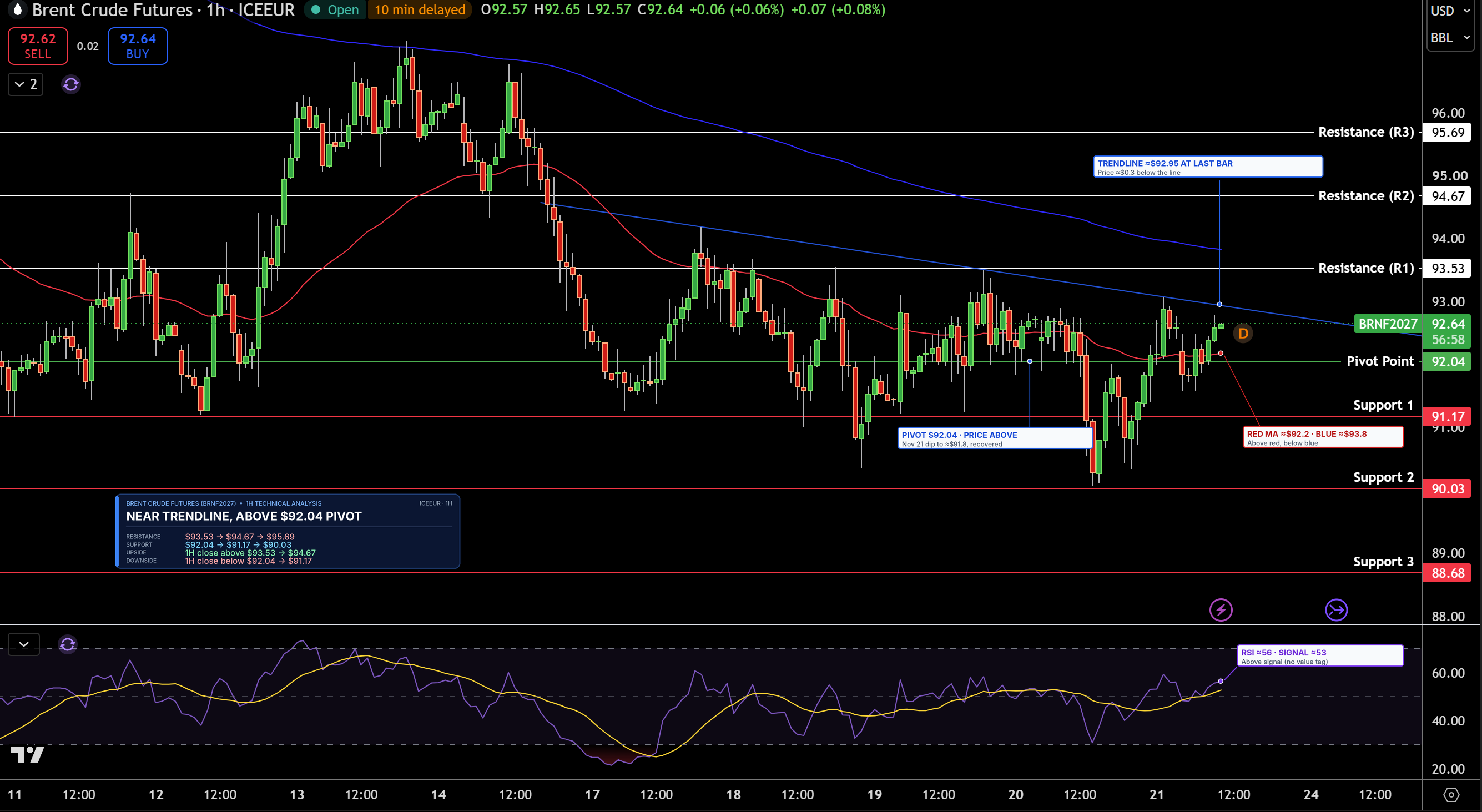
On the 1-hour chart, January Brent futures are trading near $92.64. Buyers have held $92.04, the pivot point, a level calculated from the previous period’s high, low and close that traders use to judge direction. Prices are now pressing against a falling trendline, a line connecting lower highs. Brent is above its faster moving average, which tracks average prices over time, but below the slower one.
A close above $93.53, the first resistance, where sellers may return, would confirm a trendline breakout and open the way for $94.67. On the downside, $92.04 is the support to watch, where buyers may step in, and a drop below it would point to $91.17. RSI, a 0 to 100 gauge of buying and selling strength, is near 56 and above its signal line, a slower average of RSI. I see a slight bullish lean while Brent holds $92.04.
Natural Gas Technical Analysis: NG Falls Back to $3.26 Pivot After $3.41 Breakout Fails
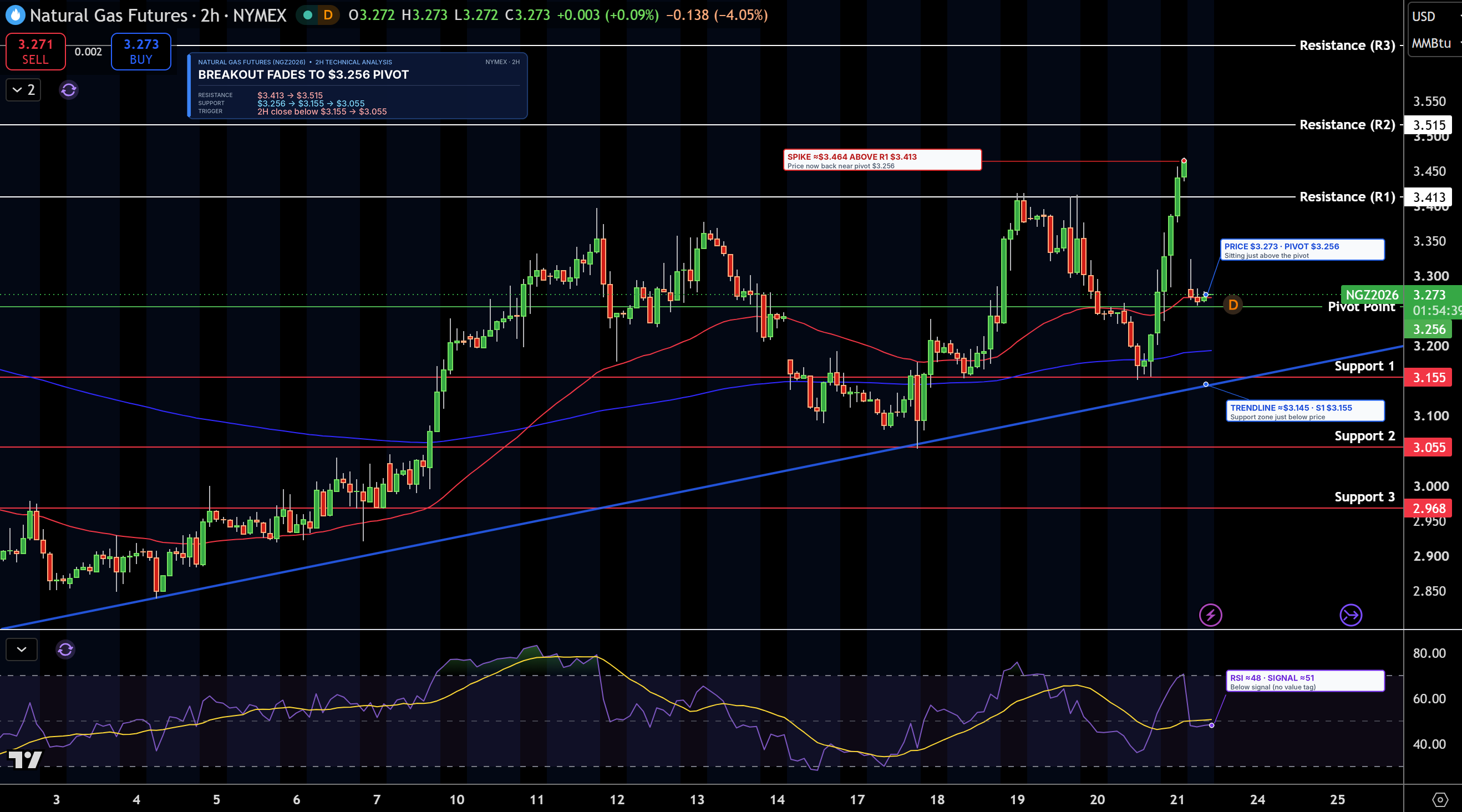
December natural gas futures are trading near $3.27/MMBtu, or per million British thermal units, on the 2-hour chart. Prices briefly broke above $3.41, but sellers quickly pushed them back to the $3.26 pivot. A rising trendline, connecting higher lows since early November, still supports the broader structure.
RSI has dropped to about 48 and is below its signal line, so the push higher has lost steam. I stay neutral while gas holds $3.26. A move back above $3.41 would favor buyers and open the way for $3.52. A close below $3.16 would favor sellers.
WTI Crude Oil Technical Analysis: Oil Rejected at $83.69 Pivot and Falling Trendline
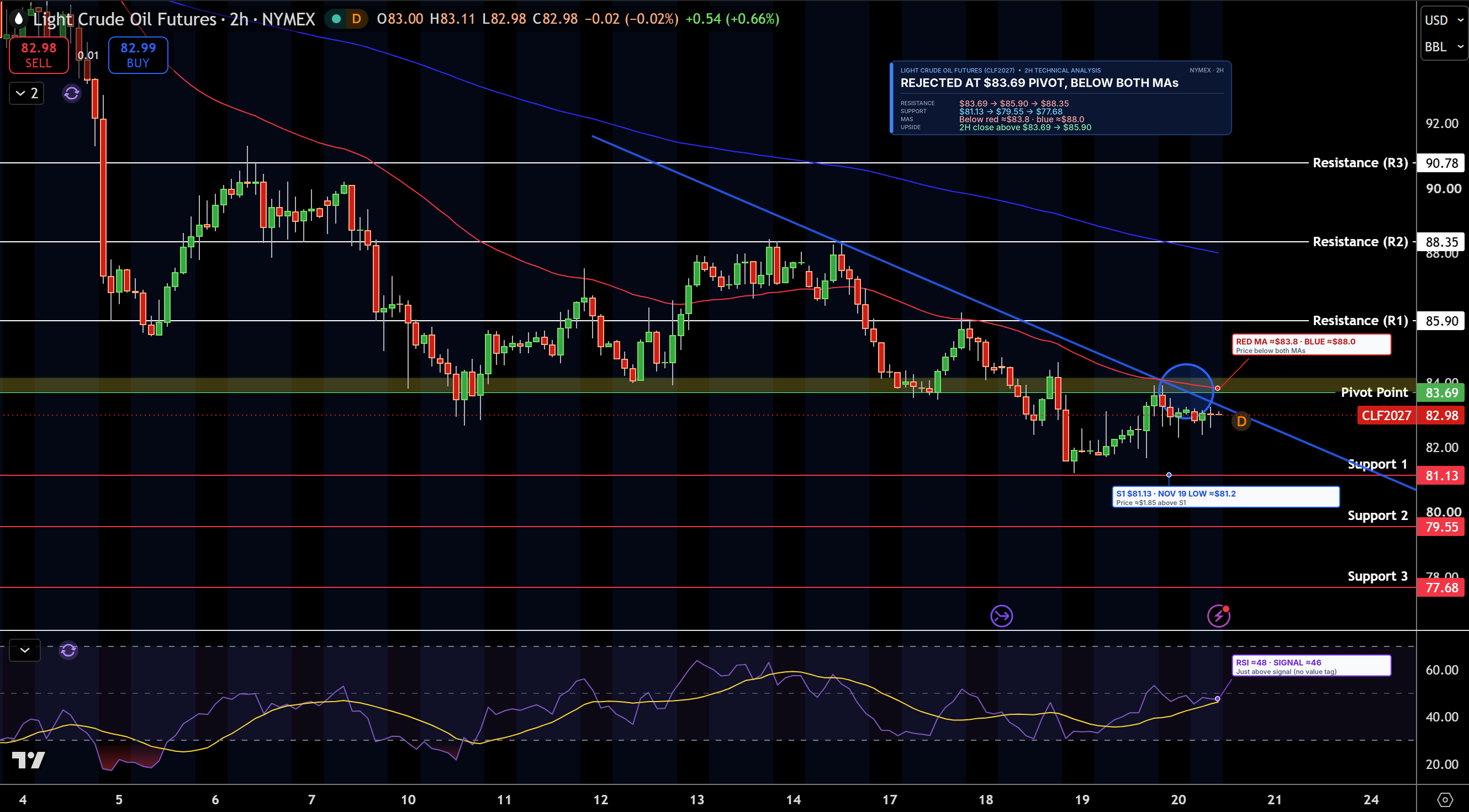
January WTI futures are trading near $82.98 on the 2-hour chart. Prices were turned back where a falling trendline from November 12 meets the $83.69 pivot, and WTI remains below both moving averages.
WTI needs a close above $83.69 to confirm a trendline breakout, which would open the way for $85.90. If sellers keep control, $81.13 is the first support, and a drop below it would point to $79.55. RSI is near 48 and just above its signal line, so selling is easing, but WTI keeps a slight bearish lean while it stays below $83.69.