
Market Overview
Energy markets opened the week firmer as renewed geopolitical tensions supported crude oil and natural gas prices, offsetting lingering oversupply concerns. Brent and WTI rebounded after falling roughly 1% last week and nearly 4% the week before, as traders reassessed downside risks.
Disruptions linked to tanker movements and broader security risks in key shipping corridors have tightened near-term sentiment, helping prices recover from a false downside break.
Fading optimism around diplomatic progress has shifted risk perception, with supply-side uncertainty now playing a larger role in price forecasts. The balance of risks is gradually tilting back toward the upside for energy markets.

Natural Gas Price Forecast
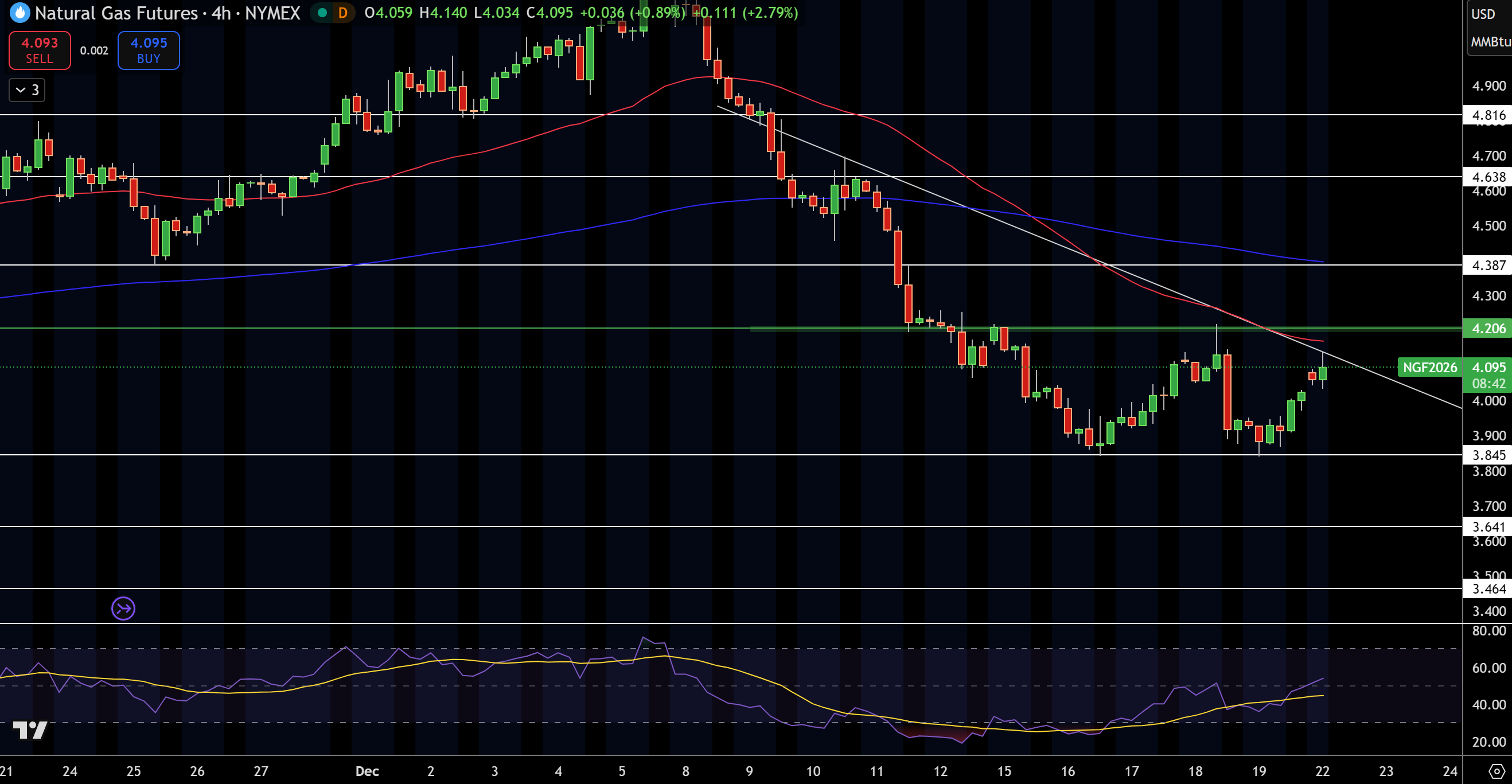
Natural gas is trading near $4.10, attempting to stabilise after a sharp sell-off earlier this month. On the 4-hour chart, price has rebounded from the $3.85–$3.90 support zone, where multiple candles printed long lower wicks, signaling demand absorption rather than panic selling. The broader structure remains corrective, but short-term momentum is improving.
Price is still capped by a descending trendline and the 50-EMA near $4.20, which aligns with a prior breakdown level and now acts as resistance. The 100-EMA around $4.38 remains a higher barrier, reinforcing the broader bearish bias. Candlestick behaviour shows higher lows forming, suggesting an early basing attempt. RSI has climbed toward 50, reflecting recovering momentum but not yet confirming trend reversal.
Key resistance sits at $4.20, followed by $4.38, while support holds at $3.85 and $3.64. Trade idea to buy on a clean break above $4.20, targeting $4.38, with a stop below $3.85.
WTI Oil Price Forecast
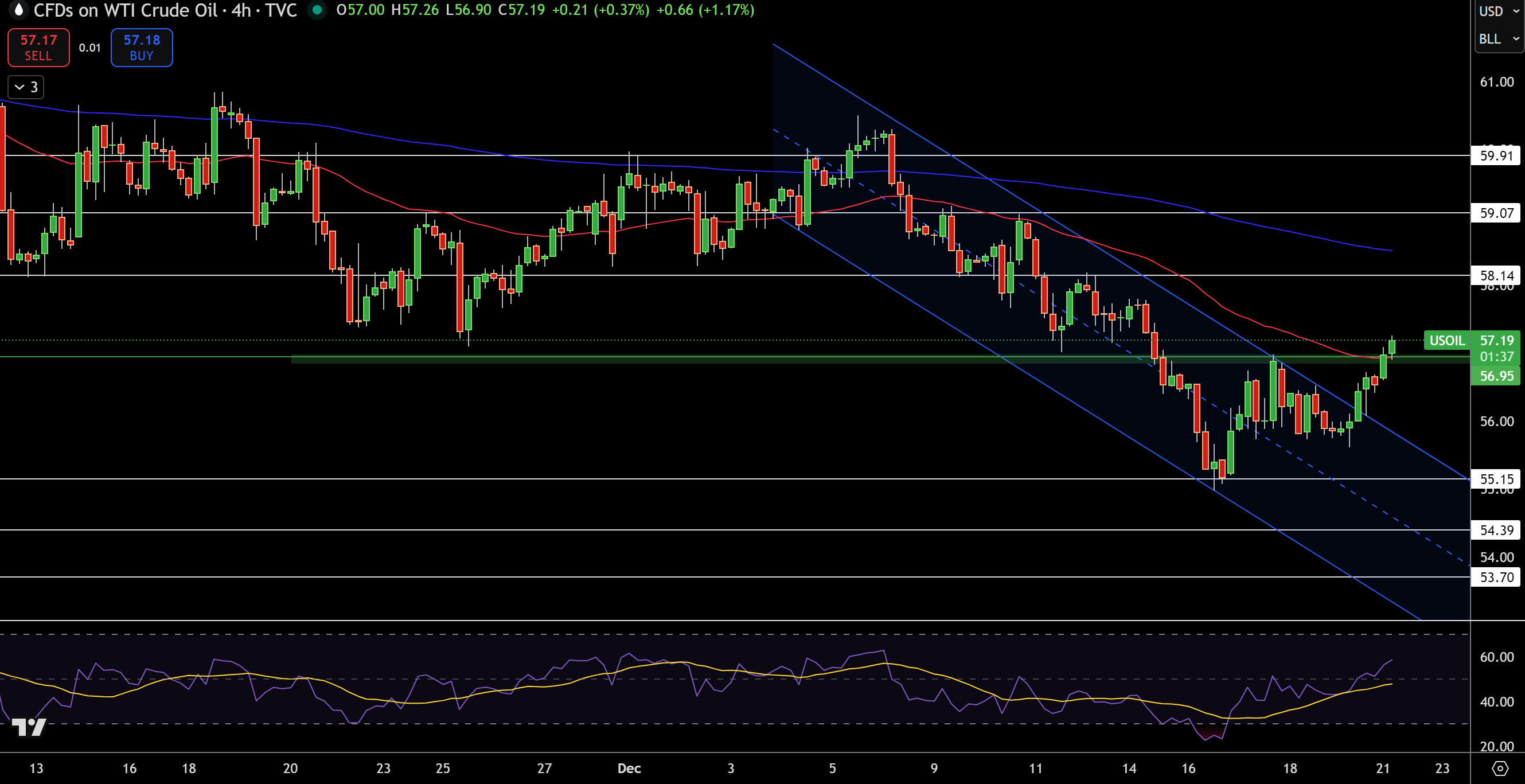
WTI crude oil is trading near $57.20, rebounding after defending the lower boundary of a clearly defined descending channel on the 4-hour chart. The recent candles show long lower wicks near $55.15, signaling rejection of lower prices and active dip-buying rather than panic selling. Price has now pushed back above the $56.95–$57.00 support zone, which aligns with a minor horizontal level and the channel midline.
Natural Gas Price Forecast
Every new Natural Gas analysis as it publishes, today's technical signal and key levels, live price — on one page.
See all Natural Gas forecastsFrom a trend perspective, WTI remains below the broader descending trendline and the 50-EMA near $58.10, keeping the medium-term bias cautious. However, short-term momentum is improving. The RSI has climbed toward 55, breaking out of oversold territory and suggesting recovering buying pressure.
Key resistance sits at $58.15, followed by $59.90, while support holds at $56.95 and $55.15. Trade idea is to buy on a pullback near $57.00, targeting $58.15, with a stop below $55.15.
Brent Oil Price Forecast

Brent crude is trading near $61.15, extending a rebound after breaking above the upper boundary of a descending channel on the 4-hour chart. Recent bullish candles closed near their highs, signaling follow-through buying rather than a short-lived bounce. Price has reclaimed the $60.70–$60.80 zone, which now acts as near-term support after capping price earlier this month.
From a trend perspective, Brent is attempting to base above the channel breakout while still facing overhead resistance from the 50-EMA near $61.80 and a broader descending trendline. A sustained hold above current levels would strengthen the recovery case. The RSI has lifted toward 55, reflecting improving momentum after emerging from oversold territory.
Key resistance sits at $61.75, followed by $62.65, while support remains firm at $60.70 and $59.55. Trade idea is to buy pullbacks above $60.70, targeting $61.75, with a stop below $59.55.