



Oil eased on Tuesday, hovering near its lowest levels since late August, as rising crude supplies and growing signs of a surplus weighed on prices, Reuters reported. Brent traded near $88.97 a barrel at 0147 GMT after posting its lowest close since August 31 on Monday, while WTI traded near $79.94. Shipping risks in the Strait of Hormuz offered some support.
Brent: Surplus Builds, Strait Stays Dangerous
Global observed liquids inventories rose by 52mn barrels in October, implying an oversupply of 1.7mn barrels per day, Deutsche Bank said. “Evidence is accumulating that the global market is rebalancing and turning into surplus,” the bank wrote, though it warned that setbacks could delay that progress.
The danger at sea has not faded. Iran’s Revolutionary Guards navy said three oil tankers caught fire after hitting naval mines in the Strait of Hormuz on Monday, according to Press TV, and the Wall Street Journal reported that the US is investigating whether Iran was behind cyberattacks on as many as 50 energy tankers. “Despite some improvement in inventories and product availability, the oil market remains under severe strain,” wrote Daniel Hynes, senior commodity strategist at ANZ, in a client note. He added that “the oil system therefore appears to be moving from acute scarcity towards persistent vulnerability” rather than returning to normal. In my view, that is why the attacks are slowing the slide but not reversing it.
WTI: Libya Back, US Stocks Seen Rising
Libya’s Sharara oil pipeline has reopened, and crude has begun flowing into storage tanks at the Akakus facility in Zawiya, the chairperson of the National Oil Corporation told Reuters on Monday. In the US, a preliminary Reuters poll showed crude and product inventories likely rose last week.
OPEC+ ministers meet on November 29 to set their 2027 output policy. For more on US crude, see FXEmpire’s WTI crude oil forecasts.
Natural Gas Price Forecast
Every new Natural Gas analysis as it publishes, today's technical signal and key levels, live price — on one page.
See all Natural Gas forecastsNatural Gas: Milder Winter Outlook Wipes Out Gains
US natural gas futures for December settled 6.7% lower at $3.184 per million British thermal units (MMBtu) on Monday, after hitting more than an eight-month high in the previous session, as expectations of a milder winter and ample supply weighed, Reuters said. The contract had been on track for its worst daily drop since February. “Today’s sharply lower trade should not be surprising given little change in the short-term temperature forecasts,” Ritterbusch and Associates wrote, pointing to an 80bn cubic feet (Bcf) storage surplus against the averages.
Analysts in a Reuters poll expect a 4 Bcf storage build for the week ended November 20, against a withdrawal of 11 Bcf in the same week last year and a five-year average withdrawal of 24 Bcf. The EIA moves its storage report to Wednesday at 12:00 p.m. ET because of Thanksgiving, the same day the December contract expires. “Short-term volatility is probable to continue into December options expiry,” wrote Eli Rubin, energy analyst at EBW Analytics Group, in a report.
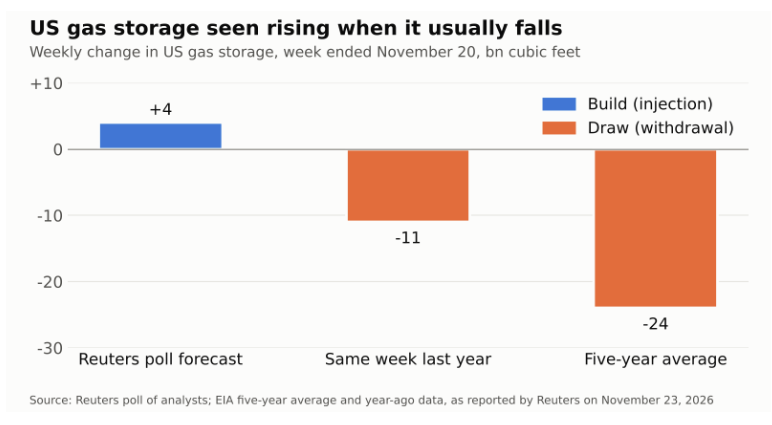
Chart: Expected US gas storage change for the week ended November 20 vs last year and the five-year average. Source: Reuters poll, EIA data
Brent Crude Oil Technical Analysis: Oil Slips Below $87.39 Pivot as $85.57 Comes Into Focus
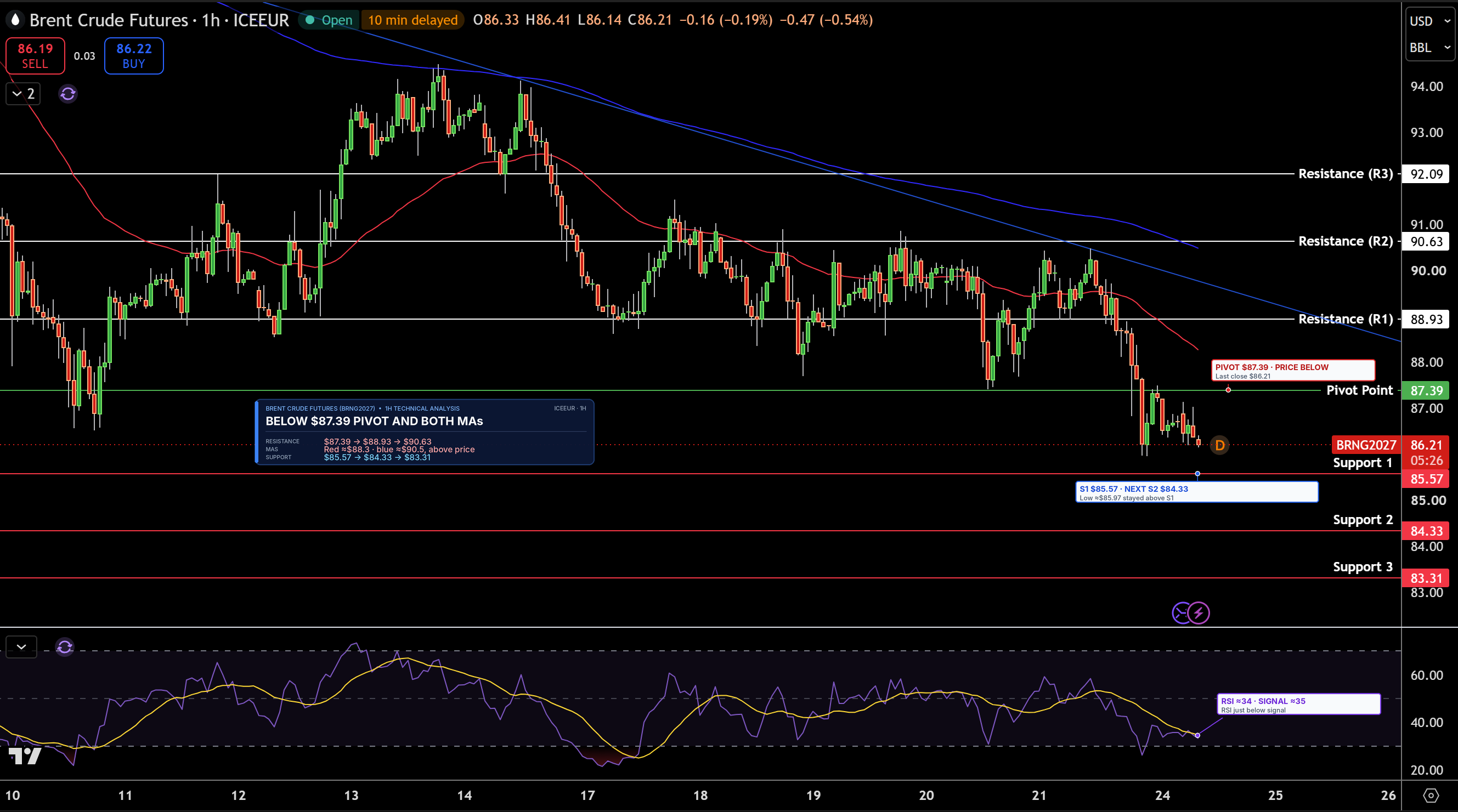
February Brent futures, which take over as the front month after the January contract expires on November 30, are trading near $86.21 on the 1-hour chart. Prices have dropped below $87.39, the pivot point, a level calculated from the previous period’s high, low and close that traders use to judge direction. Brent is still capped by a falling trendline, a line connecting lower highs since November 13, and sits below both moving averages, which track average prices over time.
The first support, where buyers may step in, is $85.57, and a close below it would open the way for $84.33. On the upside, Brent needs to win back $87.39, the resistance where sellers may return, before $88.93 comes into view. RSI, a 0 to 100 gauge of buying and selling strength, is near 34 and below its signal line, a slower average of RSI, so sellers have the edge. I stay bearish while Brent trades below $87.39.
Natural Gas Technical Analysis: NG Recovers Above Trendline Below $3.23 Pivot
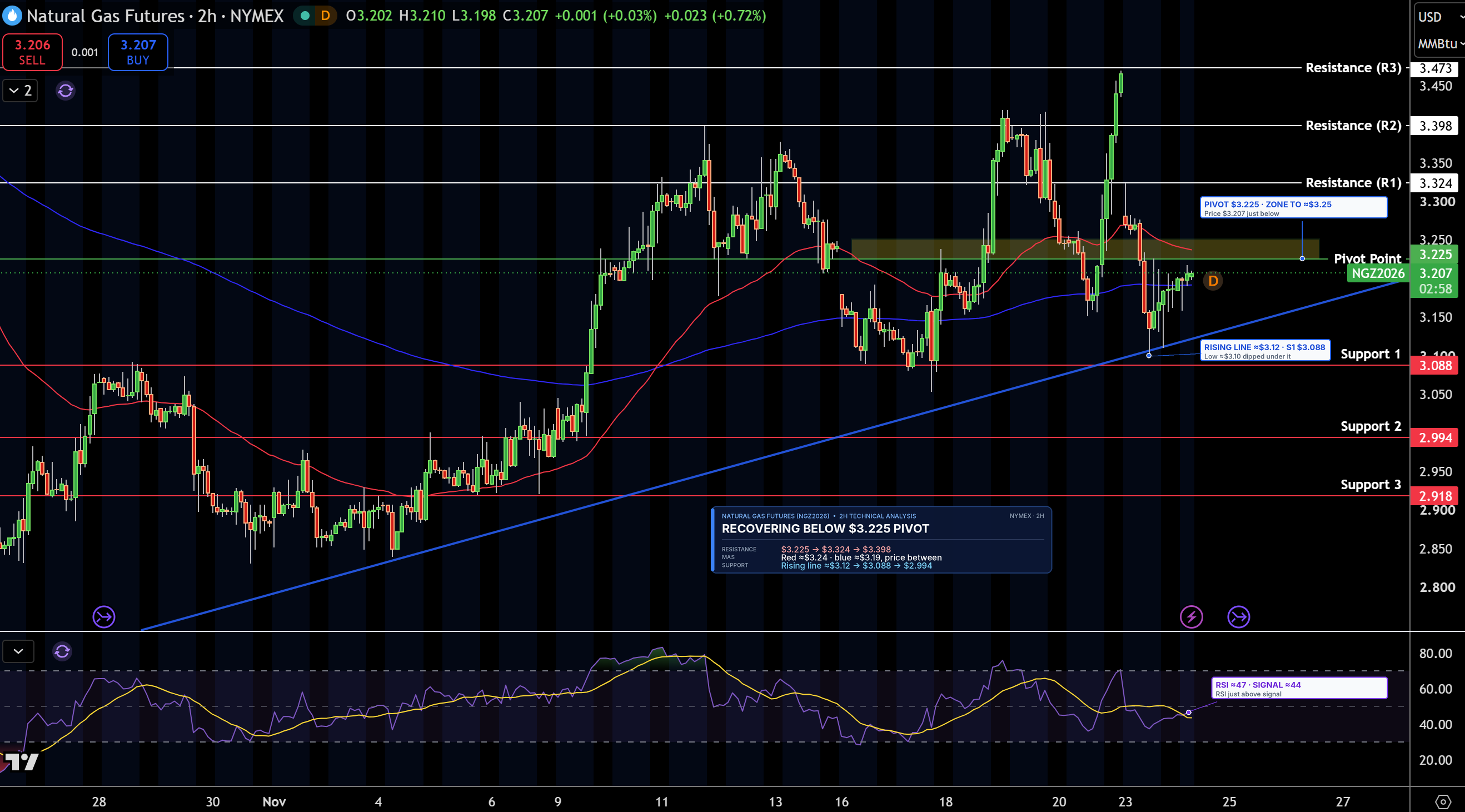
December natural gas futures, which expire on November 25, are trading near $3.21/MMBtu on the 2-hour chart. Prices briefly dipped under a rising trendline that has connected higher lows since early November, then recovered above it. Gas remains just below the $3.23 to $3.25 pivot zone.
A close above $3.23 would favor buyers and open the way for $3.32. On the downside, the rising trendline near $3.12 is the first support, then $3.09. RSI is near 47 and just above its signal line, so momentum is balanced. My view is neutral while gas trades between $3.09 and $3.23.
WTI Crude Oil Technical Analysis: Oil Breaks Below $81.18 Pivot as $78.16 Comes Into Focus
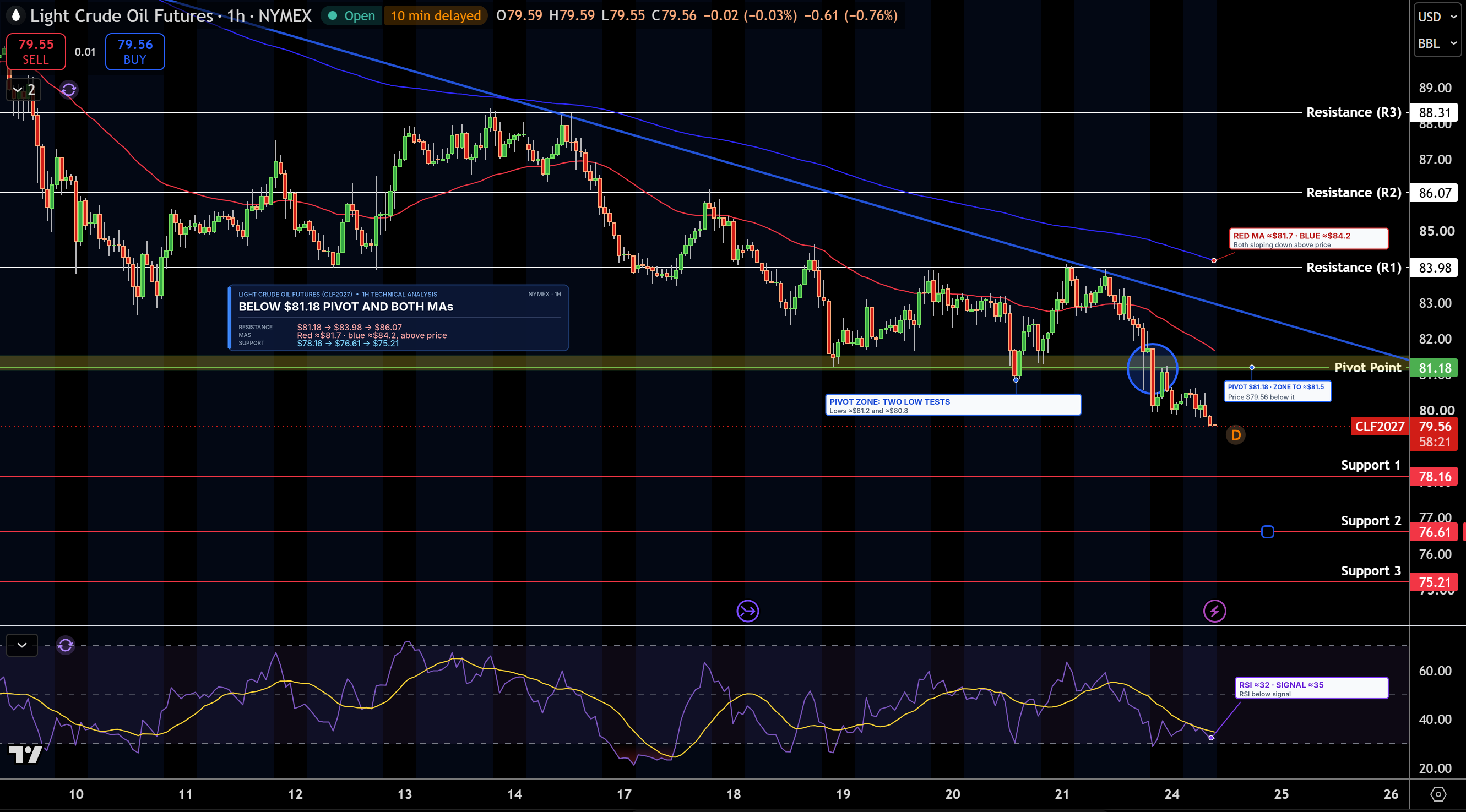
January WTI futures are trading near $79.56 on the 1-hour chart. Prices have broken below the $81.18 pivot zone, which held as a floor twice last week. WTI is still capped by a falling trendline from November 14, and both moving averages are sloping down above price.
The next support is $78.16, and a close below it would open the way for $76.61. WTI would need to win back $81.18 before $83.98 comes into play. RSI is near 32 and below its signal line, close to oversold, meaning prices have fallen fast and a short bounce is possible. The bias stays bearish while WTI holds below $81.18.