



Brent edged up to $96.61 a barrel at 0450 GMT on Friday, Reuters reported, after gaining nearly $2 on Thursday to settle at its highest since November 6. Ongoing attacks on tankers in the Strait of Hormuz and on Saudi energy infrastructure have heightened supply concerns, Reuters said. The next test comes on Sunday, when OPEC+ meets to set its output policy for 2027.
Brent: Iraq and Kazakhstan Want Higher Capacity Ratings
Ahead of that meeting, Iraq and Kazakhstan are pressing OPEC+ to raise its estimates of their production capacity, Reuters reported. The group plans to use members’ maximum capacity to set output quotas from 2027 and beyond, so a higher rating can mean a bigger quota later. OPEC’s first capacity review, carried out by US consultancy DeGolyer and MacNaughton, put Iraq’s capacity at 4.9mn barrels per day (bpd) in a preliminary finding. Iraq’s quota is 4.431mn bpd and the IEA estimates its sustainable capacity at 4.87mn bpd, but Baghdad wants a higher capacity figure recognized.
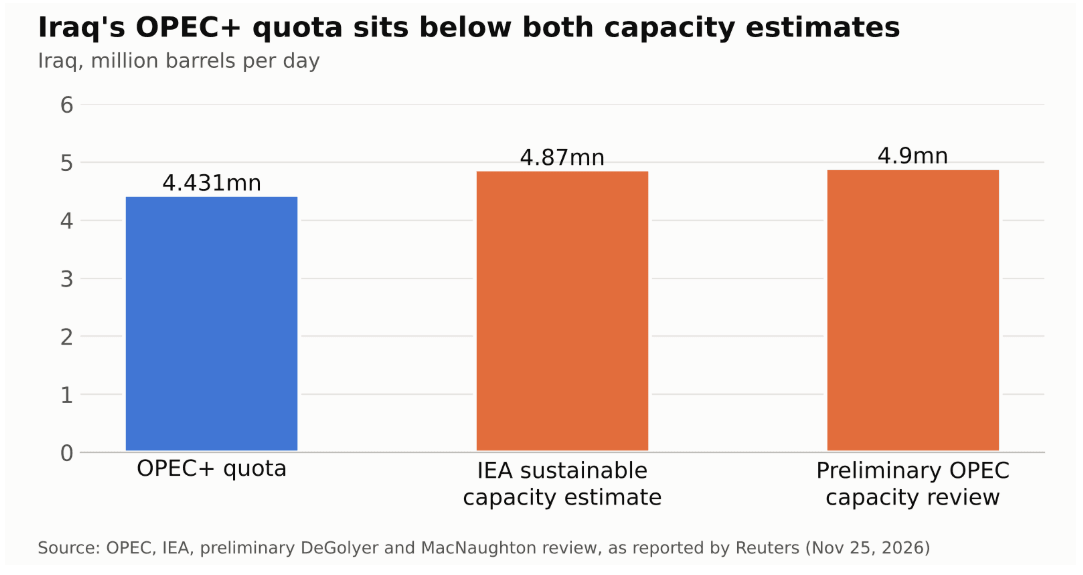
Chart: Iraq’s OPEC+ quota versus capacity estimates, million barrels per day. Source: OPEC, IEA, preliminary DeGolyer and MacNaughton review, via Reuters
Kazakhstan has joined the push, and the IEA put its October output at 1.76mn bpd, about 8% above its quota of 1.628mn bpd for November and December. Two sources told Reuters that OPEC+ may roll over its current output targets for at least the first quarter of 2027. OCBC analyst Sim Moh Siong said recovering Gulf exports and easing geopolitical risk support lower prices in 2027, though depleted inventories, shipping risks and slow refinery repairs leave the market exposed, Reuters reported. ANZ analysts were more upbeat: “We think Brent can still push above USD100/bbl without another major escalation in the Middle East,” they wrote in a note. In my view, a rollover only delays the capacity fight, and higher baselines would mean more barrels once Gulf flows recover.
WTI: Refiners Run at 97.5% as Crude Stocks Build
US commercial crude stocks rose 1.1mn barrels to 418.9mn in the week ended November 20, the EIA said, less than the 1.5mn-barrel build analysts expected in a Reuters poll. Stocks at Cushing, Oklahoma, the delivery point for US crude futures, fell 534,000 barrels. Refinery utilization, the share of refining capacity in use, rose 1.8 percentage points to 97.5%.
Natural Gas Price Forecast
Every new Natural Gas analysis as it publishes, today's technical signal and key levels, live price — on one page.
See all Natural Gas forecastsEven with the build, WTI kept rising: US crude traded at $85.78 on Friday, up $2.10 from Wednesday’s close, with no settlement on Thursday because of the Thanksgiving holiday, Reuters said. The EIA’s Weekly Petroleum Status Report normally comes out on Wednesdays at 10:30 a.m. ET.
Natural Gas: World Bank Sees a Tight Winter in Europe
US gas storage posted its first withdrawal of the season, a 24bn cubic feet (Bcf) draw in the week ended November 20, which left inventories at 3,858 Bcf, according to the EIA’s storage report. The draw matched the five-year average decrease for this time of year, NGI said.
Overseas, the World Bank sees a tighter market: EU gas inventories remain near the bottom of their range over the past decade and could fall below 10% of working capacity by end-March 2027 if colder-than-average weather and Strait of Hormuz disruptions continue, World Bank economists Paolo Agnolucci and Nikita Makarenko wrote in a November 24 blog. They estimate that about 30% of US liquefied natural gas (LNG) exports have shifted from Europe toward East Asia, and they forecast the US benchmark price flat in 2026 before a rise of about 6% in 2027, driven mainly by growing LNG export demand. For more on gas, see FXEmpire’s natural gas forecasts.
Brent Crude Oil Technical Analysis: Brent Reclaims $91.79 Pivot, Eyes $95.55
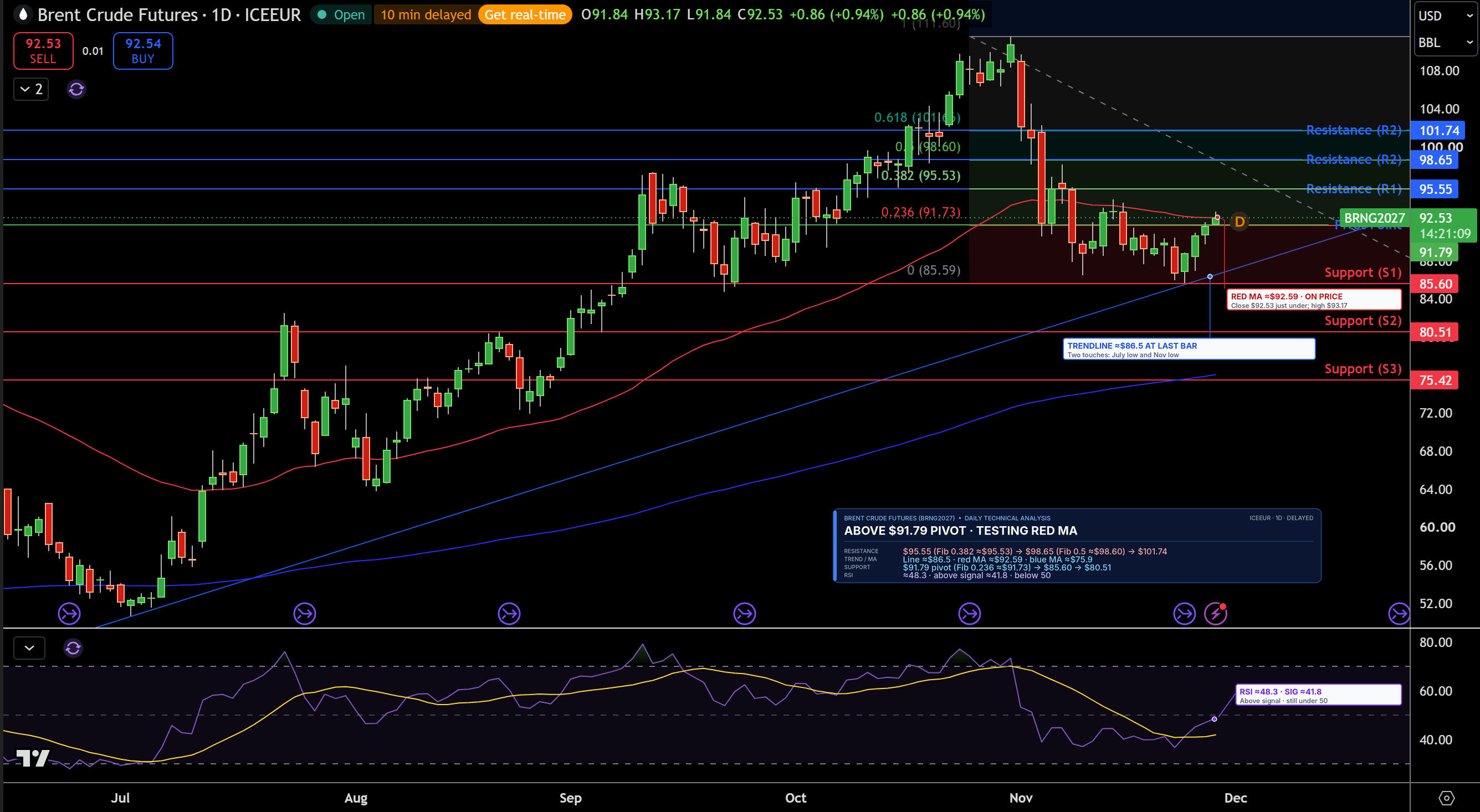
Those supply worries show on the daily chart. February Brent futures, which become the front month after January expires on Monday, November 30, are trading near $92.53. Buyers stepped in at a rising trendline, a line connecting higher lows since July, and Brent is back above $91.79, the pivot point, a level calculated from the previous period’s high, low and close that traders use to judge direction. Prices are now testing the faster moving average, which tracks average prices over time.
A close above $95.55, the first resistance, where sellers may return, would open the way for $98.65. On the downside, the pivot is the first support, where buyers may step in, and a drop below it would expose $85.60. RSI, a 0 to 100 gauge of buying and selling strength, is near 48 and above its signal line, a slower average of RSI. I see a slight bullish lean while Brent holds above the pivot.
Natural Gas Technical Analysis: NG Holds $3.57 Pivot as $3.68 Caps Prices
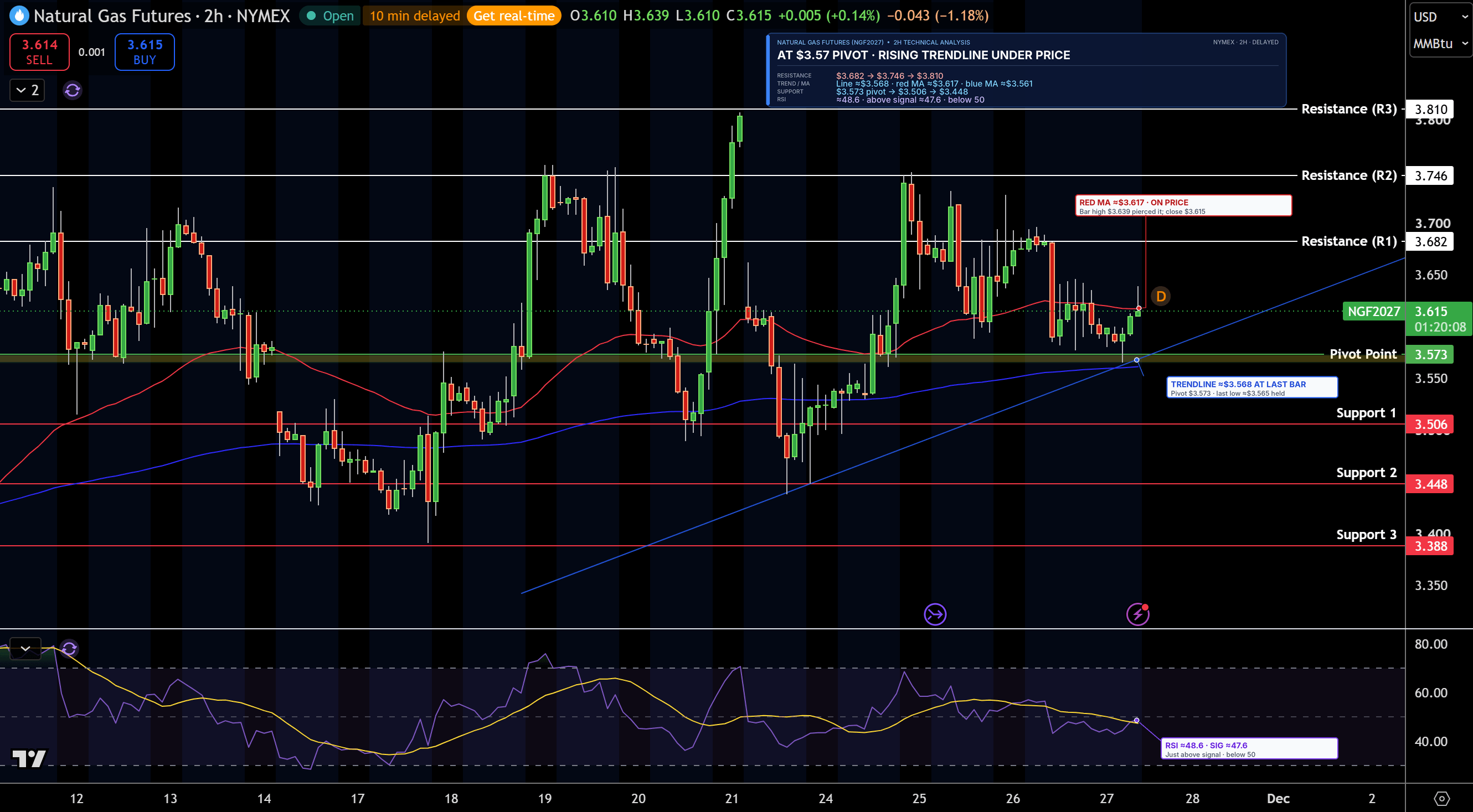
January natural gas futures are trading near $3.62/MMBtu, or per million British thermal units, on the 2-hour chart. Buyers defended a rising trendline, which meets the $3.57 pivot, and prices are pressing against the faster moving average.
A move above $3.68 would favor buyers and open the way for $3.75. A drop below the pivot would point to $3.51. RSI is near 49 and edging above its signal line. Until one side breaks, my bias stays neutral.
WTI Crude Oil Technical Analysis: WTI Breaks Above $85.11 Pivot, Tests Resistance
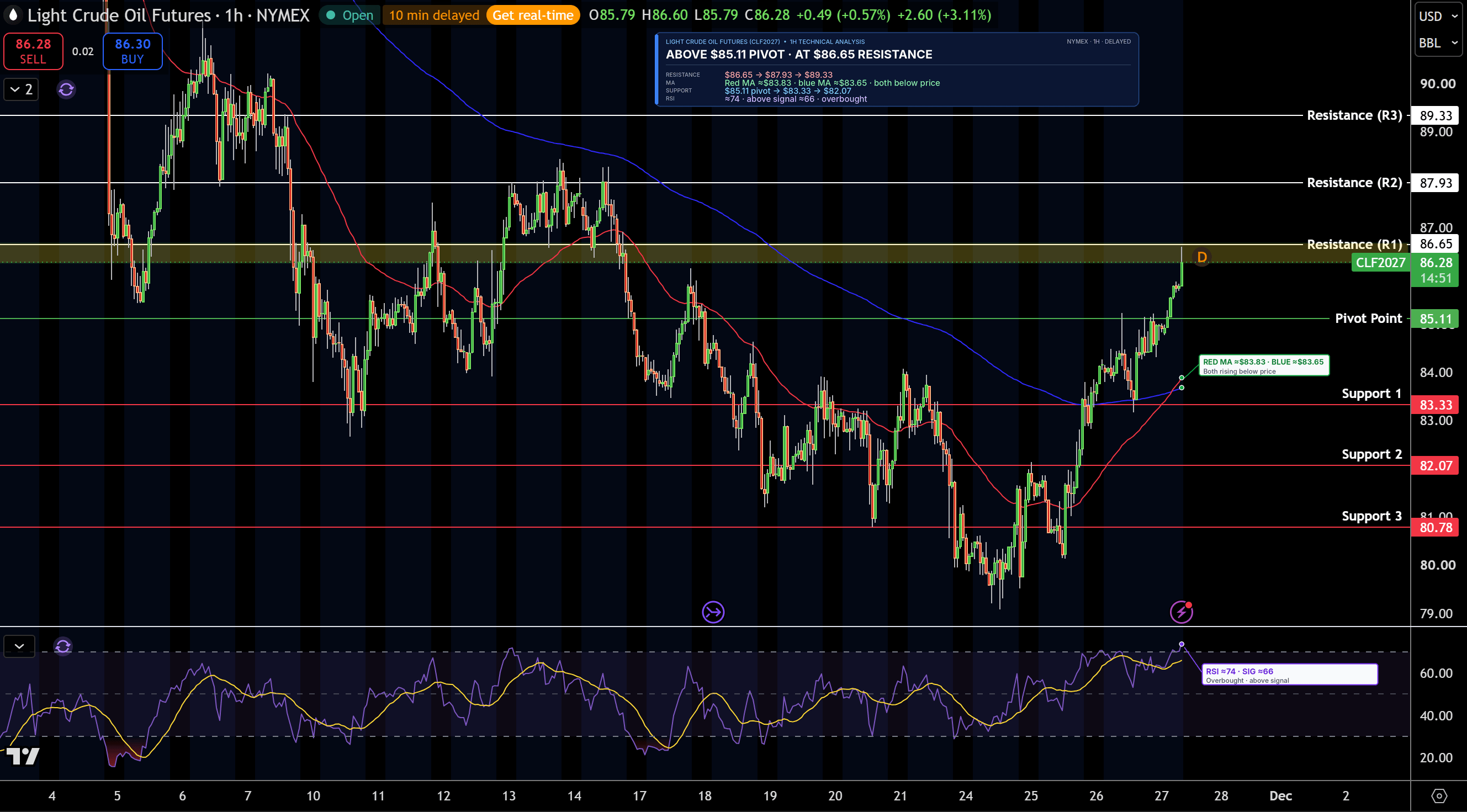
January WTI futures are trading near $86.28 on the 1-hour chart. WTI has climbed from Monday’s lows, broken above the $85.11 pivot and is now testing resistance. Both moving averages are rising below price, and the faster one has crossed above the slower one.
A close above $86.65 would open the way for $87.93. A drop back below the pivot would point to $83.33. RSI is near 74, which is overbought, meaning prices rose very fast, so a pause would not be a surprise. WTI stays bullish while it holds above $85.11.