Platinum (XPL) prices have broken above the key level of $2,300, as years of hidden supply stress are now showing up in price action. At the same time, platinum’s demand base is growing due to stricter emissions standards and increased use of clean energy. In my view, this convergence indicates that platinum will be one of the most important metals in the next phase of the commodities cycle. This article presents macro drivers, technical confirmation, and related market signals that support the case for a continued surge in platinum prices.

Macro Drivers—Platinum Deficits and Investment Demand
Aboveground Stocks Collapse Triggers Price Breakout
Platinum was structurally short for the last three years. However, the prices broke record levels in 2025. The earlier deficits failed to spark a strong rally because there were still plenty of stocks above ground to feed the difference. That case is no longer valid as inventories are falling while supply lags demand. In 2025, the stocks had fallen to low levels. This fundamental change favours the bullish price trend for platinum.
On the other hand, investment demand is supporting the platinum prices in 2025. The US was displaced by China in 2025 as the largest investor market for platinum. The physical purchases of platinum have surged. In addition, strong market momentum and positive price action drove positive ETF flows.
According to the WPIC Q3 2025 report, there has been a dramatic change in the market dynamics. The data below shows that the overall demand for platinum increased by 28% YoY to 1,982 koz in Q3 2025. However, this growth covers up weaknesses in key industrial areas. Jewellery demand dropped 29% QoQ, while automotive demand declined 2% YoY and 8% QoQ. Moreover, the industrial use dropped 8% YoY, with the glass-related use declining by 30%.
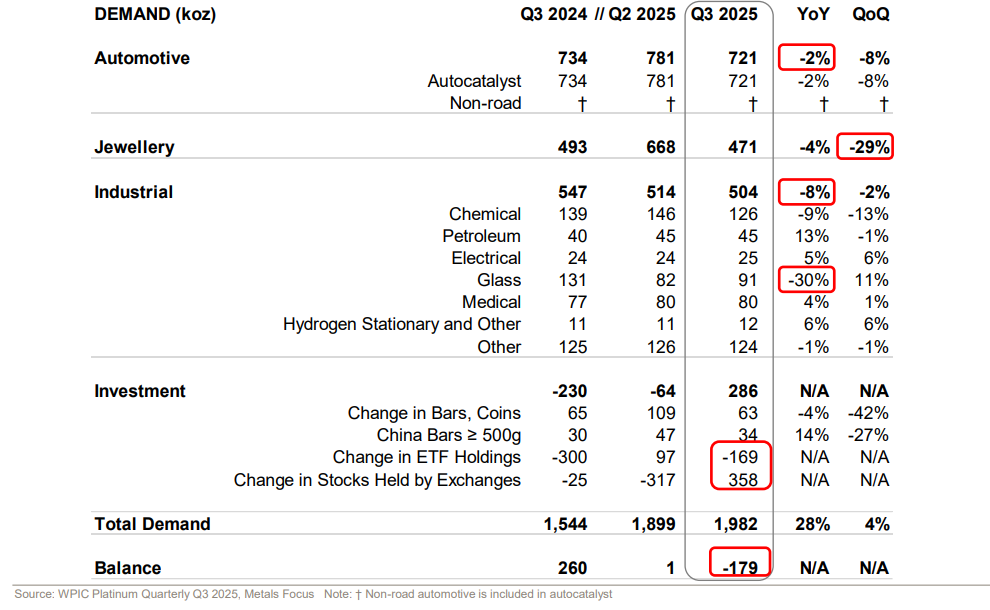
Despite the weakness in the industrial and jewellery demand, the total investment demand bounced back dramatically from -64 koz in Q2 to +286 koz in Q3. This demand is due to new ETF purchases and heavy Chinese retail buying. Since the industrial demand is weak, investors are now driving platinum’s upside to sustain the rally.
Auto Sector Holds While Clean Energy Expands
The largest user of platinum is from the motor vehicle industry, which has been aided by the tightening of emission control laws in major markets. The engines require improved loadings of PGM. In the meantime, the rhythm of electrification is slower than its expectations as a consequence of the deficiency of even distribution of consumer uptake and weaker policy backing.
Consequently, combined platinum and palladium (XPD) demand will be broadly stable until 2030, according to WPIC. Platinum is also more flexible than palladium, as auto makers have used platinum in the past instead of palladium when the palladium price goes high. However, the current price trends and the supply chain risks limit the forceful short-term changes.
Platinum also benefits from new energy technologies that allow it to have valuable long-duration optionality. Platinum catalysts are critical to the production of green hydrogen and fuels. This importance aligns more with long-term decarbonization plans than with short-term cycles in vehicle demand. The chart below shows that the market size for green hydrogen will grow exponentially during the next few years.
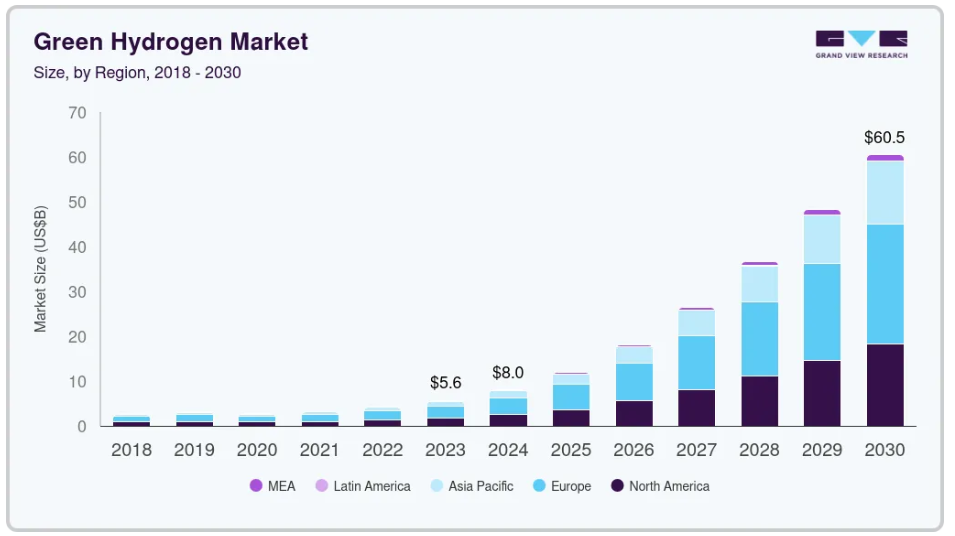
Due to stabilised catalytic demand and strong emerging clean energy applications, platinum has numerous avenues of demand. All these factors narrow the risks of downside and strengthen its long-term macro position.
Platinum Technical Analysis – Phase 3 Super-Cycle Targets $3,000+
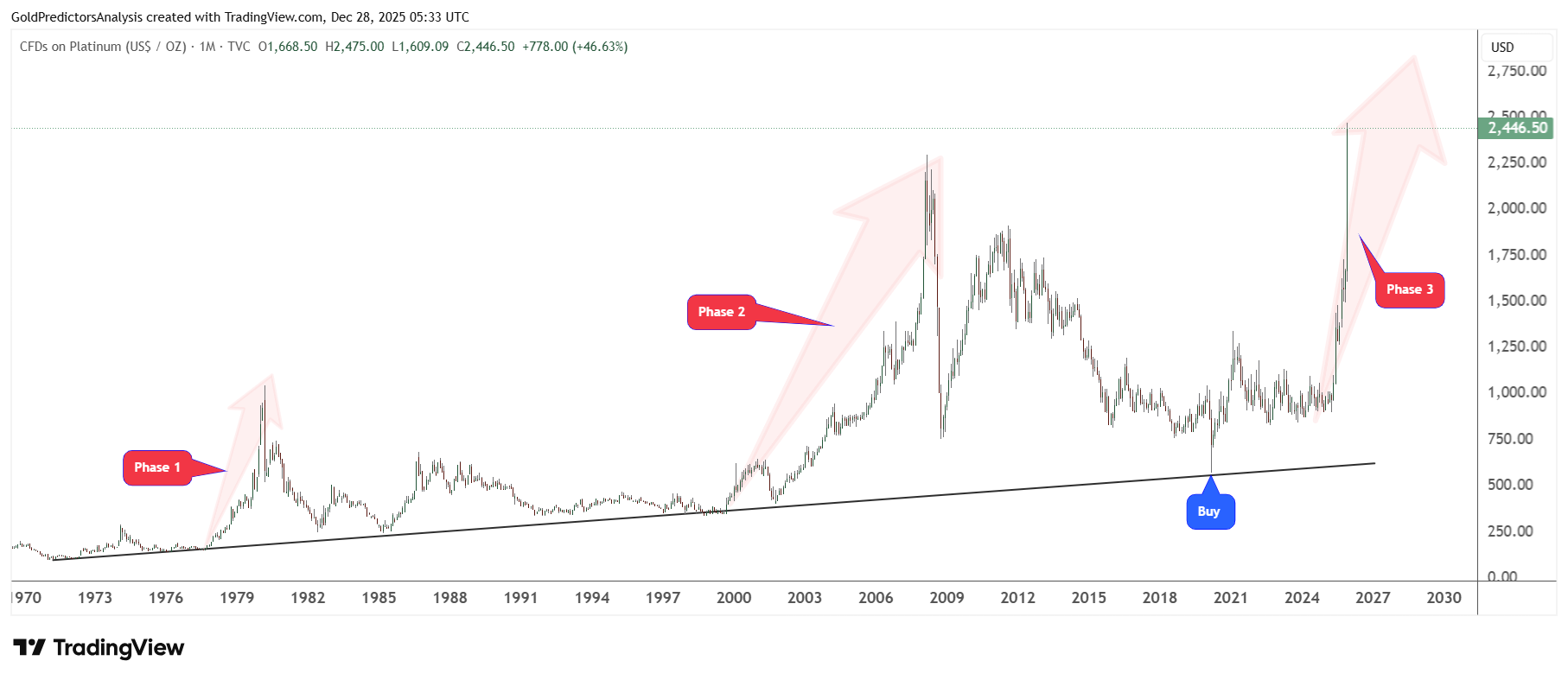
Platinum has confirmed a long-term breakout, which has started a new parabolic phase. According to the monthly chart, the price increased by more than 46% in December 2025 and became the first month to close above the historical level of $2,300. This breakout wraps up the consolidation, which started following the high of 2008 and validates the market in Phase 3 in the super-cycle.
Historically, platinum has traded in three-phase rallies. The first phase was formed in the late 1970s. The second phase shot the prices into 2008. The third phase is currently underway. This surge is supported by the significant breakout from the long-term cup and handle patterns and indicates further upside.
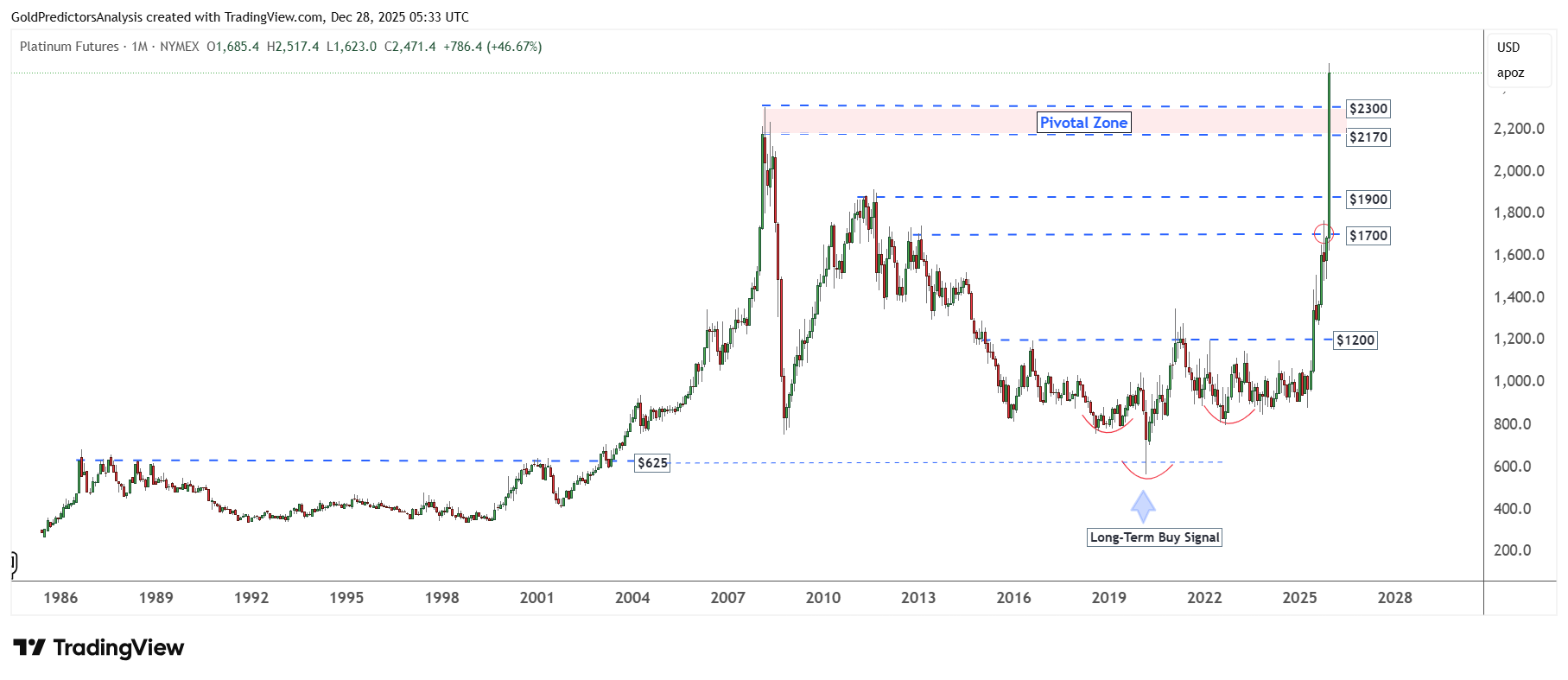
The chart below shows that the price has clearly broken out of the major resistance range of $1,700. This breakout triggered a bullish measured movement to aim at $2,300. However, the price shot more than $2300, which means that Platinum is on a parabolic trend. This parabolic trend was triggered in silver when the silver price broke the historic $50 ceiling.
The breakout from $2,300 indicates the immediate target of $3,000. However, depending on the current price action, platinum can continue to surge above $3,000 in 2026.
The major resistance of $2,300 has now become the support level. A successful retest of this level would open the door to a sustained increase in platinum prices.
The price action is supported by tight physical supply, backwardation on forward markets and ETF accumulation. The performance of platinum has been superior to that of palladium and has been leading the pack among the industrial metals. Therefore, the technical structure points to even higher levels in 2026.
Cross-Metal Signals from Gold, Silver, and the US Dollar
US Dollar Roll-Over Signals Strong Tailwind for Platinum
The chart below shows the correlation between the long-term trend in the US dollar index and platinum. The data shows significant inflection points in 1985, 2002 and 2022 that marked peaks in the US dollar index.
These peaks coincide with significant platinum bottoms. Platinum entered a major uptrend after every dollar peak. The recent platinum breakout is technically sound and macro supported, as evidenced by this cyclical correlation.
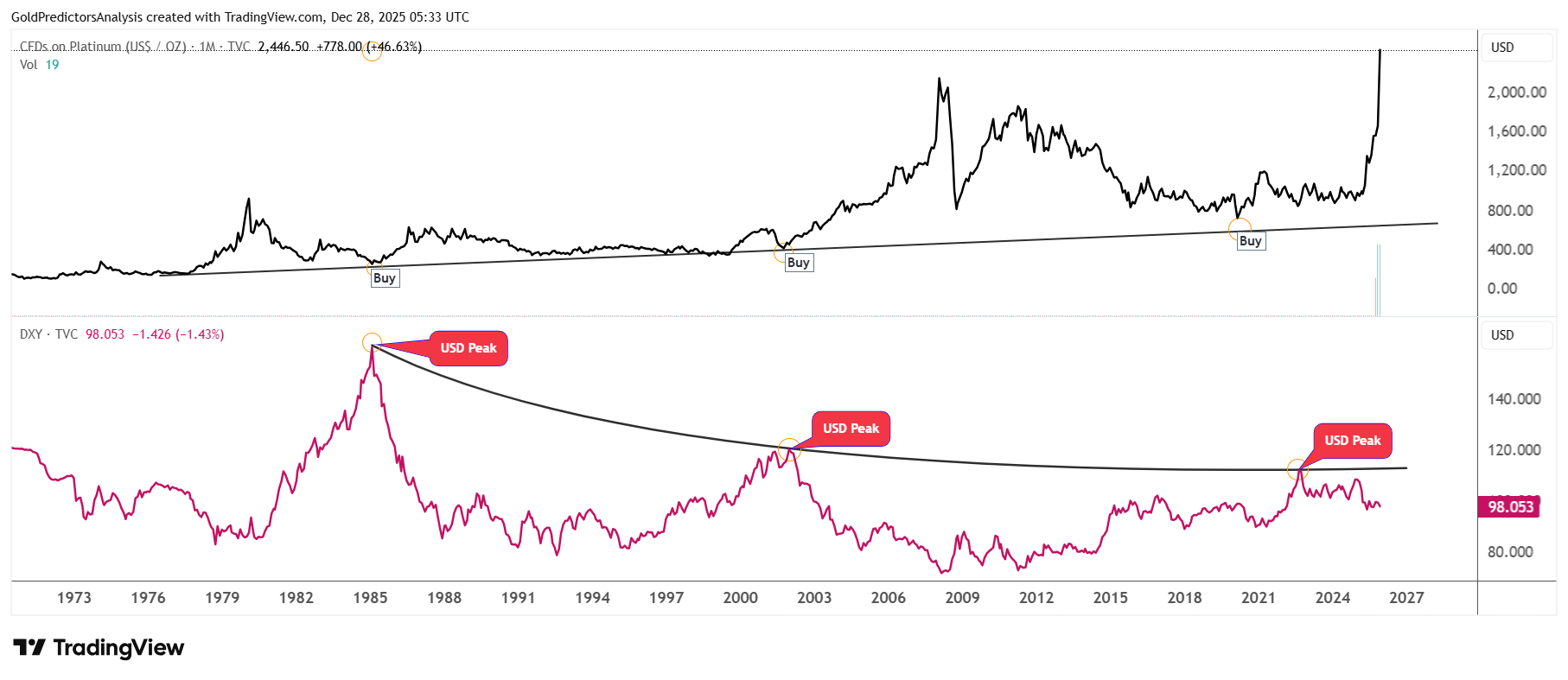
The platinum market shot up in 2025 when the dollar rolled over its long-term resistance. The movement of the prices validates a long-term breakout of the trendline support. Platinum has passed into a new bullish cycle as the dollar moves out of its cyclical high. The thesis is supported by the past three technically supported US dollar peaks. Moreover, the sharp increase in the prices of gold (XAU), silver (XAG), and platinum above historical levels indicates that the US dollar will likely drop in the next few weeks.
Platinum-to-Gold Ratio Breakout Signals Leadership Rotation
The platinum/gold ratio has come out of a 15-year downward trend channel. This is a significant change in market structure. Since 2008, resistance trapped the ratio, and every attempt to break the channel failed. However, the latest action above 0.50 proves a definite breakout. This breakout indicates that platinum may perform better than gold in the next cycle.
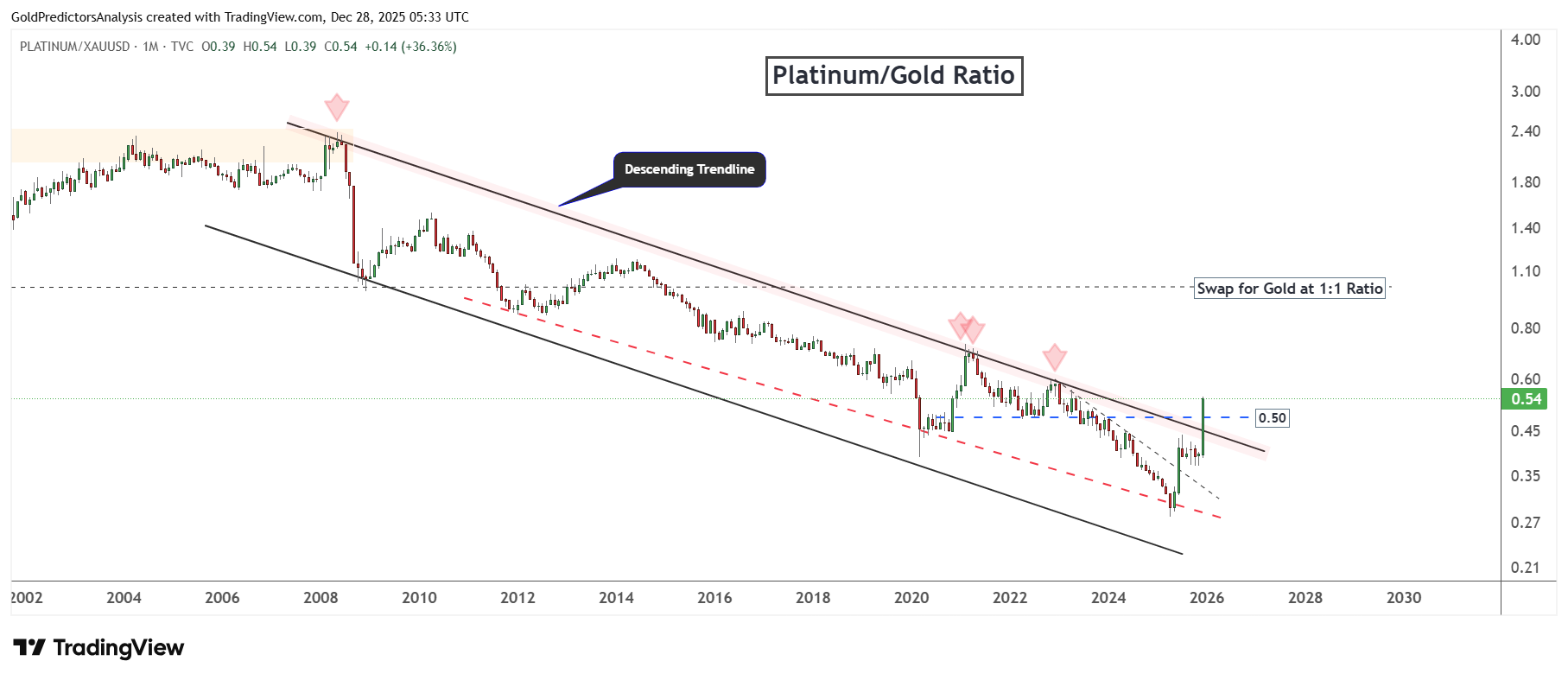
The ratio still remains significantly below parity, and the chances of mean reversion to the 1.0 level are still high. Traditionally, platinum was more valuable than gold; the existing change could be the first step towards returning to the old tradition.
Conclusion – Technical and Macro Forces Align for Higher Platinum in 2026
Platinum is now at phase 3 and is likely to skyrocket in 2026. The important drivers for this rally are structural deficits and tight physical supply. I think it is more than supply-demand imbalances that the 2025 parabolic trend represents. It is symptomatic of a greater change in the way the market is structured. The flow of investors and changes in global inventory are changing the price discovery.
The breakout of the $2,300 level in December 2025 was the final step in a multi-year base and triggered Phase 3 of the platinum super-cycle. The technical roadmap is pointing to a target level of $3,000 or higher. This bullish outlook remains valid as long as platinum holds above the key support levels at $2,170 and $2,300.