


Developed international stocks, think the MSCI EAFE index, were hammered by the looming energy crisis that followed the closure of the Strait of Hormuz. The selloff was sharp and fast. But it looks like the floor is in. Momentum is rolling over, and the index is holding a key technical level, supported by news of potential U.S.-Iran peace talks on the 31st. Markets are starting to price in an endgame, and that’s a bullish signal. Macro uncertainty around a Middle East peace deal still warrants some caution, but the technicals are giving a clear read: it’s time to buy international.
EAFE’s Oil Pain Is Overstated
Fundamentally, international stocks have been hit the hardest because they largely lack domestic oil supply. The United States is the exception, one of the only net oil exporters in the developed world—see also Norway and Australia, although Australia has had a tough time getting gas. So when global oil supply is threatened, there is no domestic production fallback to cushion the blow like in the U.S., so it makes sense that there would be a sell-off.
Consider that Japan gets nearly all of its oil supply from the Middle East as an example of how deep the reliance is. The decision for most developed nations to cut off Russian supply has only made reliance on Hormuzian oil worse. But that’s all in the past and now has been priced in.
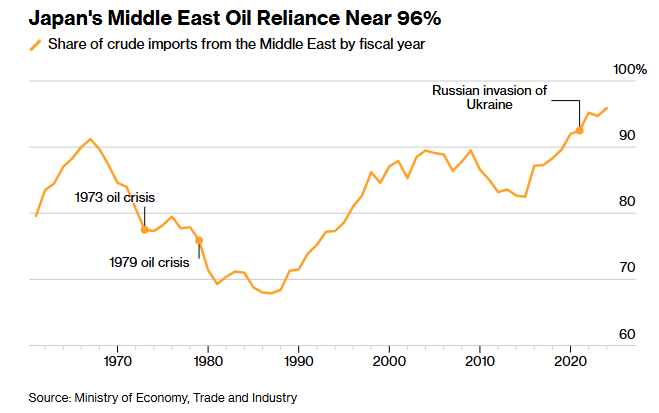
While this discusses incoming oil, it should be noted that the countries most reliant on these have been stockpiling for this reason, and Japan has one of the largest stockpiles in the world. It’s got the largest stockpile in the IEA and has a larger stockpile in China by days, though not by barrels.
So what I’m watching are oil stockpiles, and the EAFE nations have the largest stockpiles; some can run the whole country at full output for over six months. Don’t watch the number of barrels, but the number of days that the stockpiles will last.
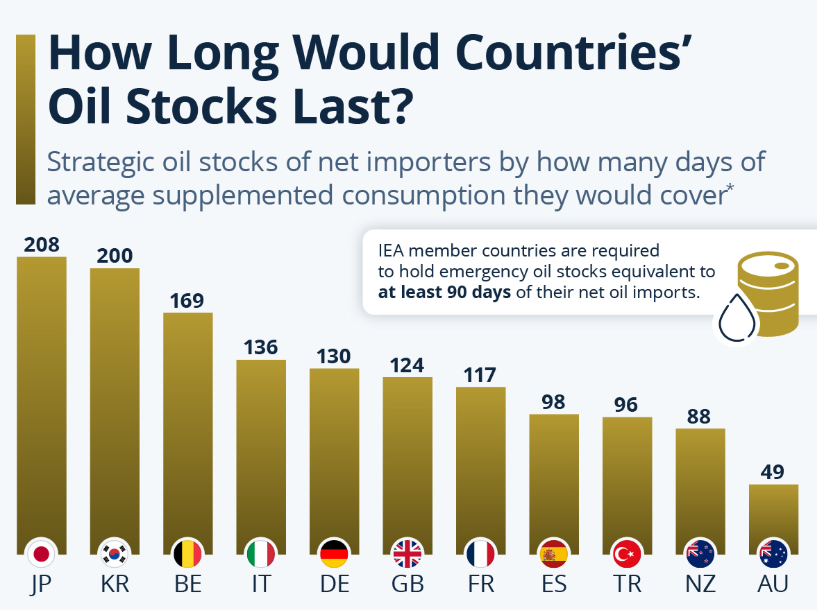
These countries have also been some of the largest contributors to the IEA release to help assuage crude prices, alongside Canada and the U.S. That process is still ongoing, and so far it looks like higher prices are the only consequence for now. Shortages have not, and it seems like they will not, hit the developed world, given the timeline that the U.S. government is now giving for their withdrawal from Iran: 2-3 weeks.
Between the more than ample reserves that are flowing and keeping up with demand and the progress being made to reopen the strait (even if that means tolls are being paid, that is still oil flowing), I am not a believer that EAFE nations are in as much fundamental trouble as the market has priced in.
Of course, my take relies on some general optimism, and those who do not see a U.S. withdrawal as conditional for reopening the strait—or who believe that the conflict will drag out and keep the strait closed indefinitely—have their own right to be bearish here. Disagreements make a market, after all.
So let’s get to the technical picture, because it’s looking even better than the state of oil reserves.
Technical Bliss: The 200-EMA Held
There are a dozen ways to trade developed international markets, but my preference is the iShares MSCI EAFE ETF (EFA), though there are direct index futures as well that should chart all the same. Here is the 1-year chart with daily candles:
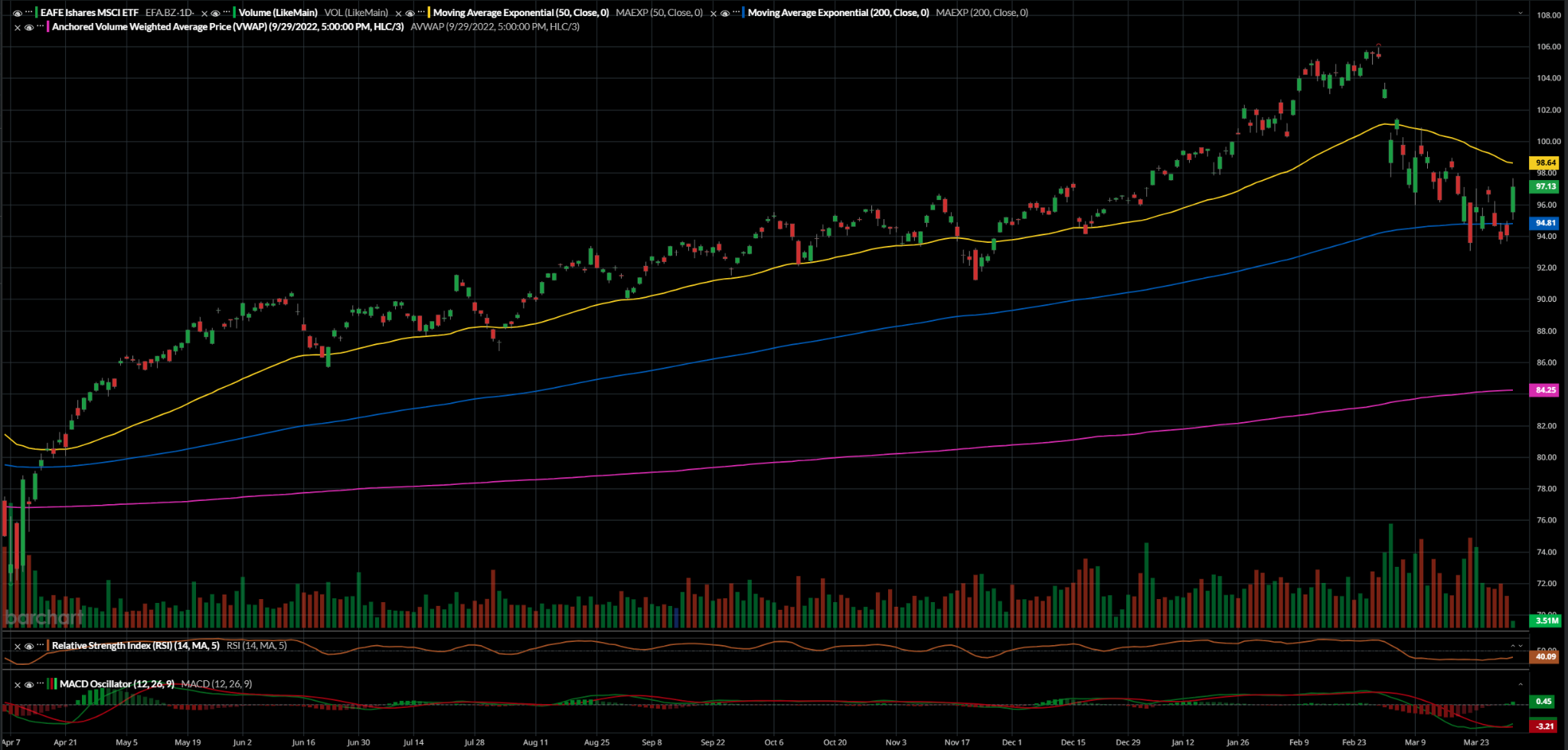
EFA had been grinding up ever since the Liberation Day lows, but even those were higher lows overall—its VWAP anchors all the way back to late September 2022—and has recently come off its high during this macro shock. That breakdown on the news caused the fund to rip down through the 50-EMA, dropping below 100.
Throughout March, EFA ground down toward the 200-EMA, sitting at ~95. Its price fell below the level but stayed in the zone, and no candle opened and closed fully below the line itself; the level was respected. The positive news was the catalyst for the break higher, but what’s important here is how far it moved. The 31st opened and closed above the 200-EMA. That is validation for bulls, and while macro news could still trump technicals, it’s unlikely that we break below this line anytime soon. The news would need to be worse than what has already been priced in as the worst-case scenario to push EFA below ~95. That technical level holding provides us a clean downside level to operate off.
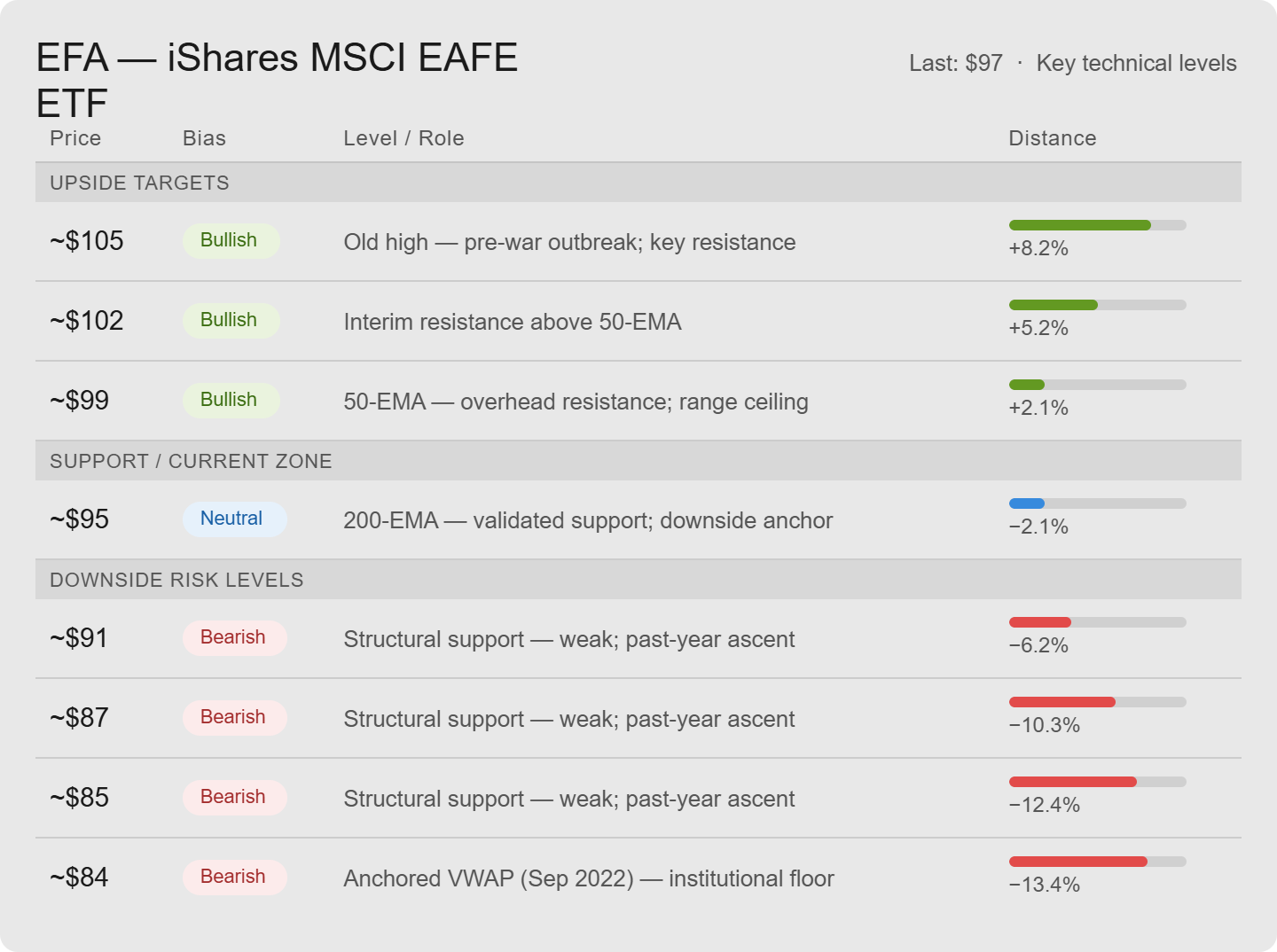
For bulls: the next challenge, apart from the potential for choppy trading in the range between the 50-EMA at ~99 and the 200-EMA at ~95, is the 50-EMA itself. It will act as resistance, making this band very tight and not giving EFA much room to chop. If that resistance is broken, and EFA moves above ~99, the next resistance is at ~102, and from there ~105, where the old high sits—just before the outbreak of the war.
For bears: the biggest risk for bulls here, apart from a further breakdown in the macro picture for oil flows, is that the timeline set for the end of the conflict is wrong and the U.S. stays engaged in conflict in the Persian Gulf throughout April. That could send EFA below the 200-EMA. Were it to be breached—and after this retest I imagine it would need to be a very negative catalyst like one I just described—there is little room to go before we hit support again. The levels to watch are ~91, ~87, and ~85 to start, but those are weaker structural supports from the past year’s ascent. The anchored VWAP sits at ~84, which is where I would expect the next level of institutional support to sit at.
Conclusion
The key takeaway is that good news can drive us up quickly, and a breakout is likely given how tight the range is, but no news or bad news could send us lower without a floor for a significant movement—I’m talking nearly 15% lower.
But I am optimistic about the macro situation, given how ample the oil reserves are for the largest constituents of the EAFE index, that they will be able to keep the economies chugging without significant shortages through the end of the conflict.
The technicals told the story before the headlines because the 200-EMA held and printed a confirming candle on the 31st. It gave bulls exactly what they needed: a clean level to validate the bounce.
That doesn’t mean the trade is risk-free; it means the trade is defined. International has been hated on because of the all trade, but now the preparation that these countries have made is playing out, and the market seems to respect this. The bounce is on its way, and a confirmation above the 50-EMA would be a buy signal for even the most reticent traders.