


Platinum Eyes $1,900: Why Its Deficit Keeps Widening
Key Takeaways
- Platinum trades near $1,620 after a 44.6% retreat from its January high, with $1,540-$1,675 defining the range ahead of the July 29 FOMC decision.
- WPIC widened its 2026 deficit forecast to 297,000 ounces despite roughly 700,000 ounces of H1 ETF liquidation, pointing to persistent supply tightness.
- A break above $1,675 could target $1,800-$1,950, while renewed ETF outflows and a close below $1,540 would expose $1,348.20.
Platinum has round tripped hard in 2026. $2,924 in January, $1,539.60 by July 1, roughly $1,620 today. My read is that the crash was funded by the largest platinum ETF liquidation on record, and the deficit that selling was supposed to fix has widened for the three straight quarters anyway. The revision trend explains why. One level decides which way this breaks.
Platinum Price Holds Near $1,620 Ahead of the July FOMC Decision
Platinum last traded near $1,620 an ounce (July 27, 2026, 11:51 PM EDT). That is a recovery off the $1,539.60 low from July 1, still 44.6% below the January 26 all time high of $2,924. The crash tracked a Fed pivot. New chair Kevin Warsh, confirmed 54-45 by the Senate on May 13, 2026, held rates at 3.50%-3.75% on June 17, the fourth straight hold. The surprise sat in the projections i.e. nine of 18 participants now pencil in a 2026 hike. Oil has not helped. Brent traded at $90.43 a barrel on July 27, down 2.39% on the day but still elevated on 2026’s Hormuz linked shipping disruption. The July 29 FOMC decision walks straight into all of it.
Why Platinum’s 2026 Supply Deficit Keeps Widening
The broader trend is a boom and a bust playing out as one continuous cycle. Consensus reads the 44.6% drawdown as a speculative overshoot correcting itself i.e. a 2026 deficit of 297,000 oz, against 2025’s 1,082,000 oz actual shortfall, looks like normalization. I think that misses what is moving inside WPIC’s own numbers. 2026 is the fourth consecutive deficit year, and 297,000 oz is the third straight quarterly revision, each one deeper into deficit. More on that walk below. Above ground inventories now cover three to four months of demand (sources vary slightly on the exact figure) after a 42% cumulative drawdown since 2023. WPIC CEO Trevor Raymond put it plainly in May: “The market continues to be undersupplied.” The Fed’s own FOMC calendar has the exact decision time.
Platinum Supply and Positioning Analysis
WPIC Forecast Revisions Signal Persistent Supply Tightness
The 297,000 oz headline is the third consecutive quarterly revision, and the walk there is short. December 2025’s Q3 2025 Platinum Quarterly called 2026 roughly balanced, a 20,000 oz surplus, contingent on 170,000 oz of ETF profit taking and 150,000 oz of CME exchange stock outflows. Head of research Edward Sterck warned that absent those flows the market would run “a quite substantial deficit of approaching 400,000 ounces,”. By March 2026, after an actual 1,082,000 oz deficit in 2025, the call was already 240,000 oz. May 2026 deepened it again, to today’s 297,000 oz.
I think that walk kept going even as liquidation ran at a record pace, and that is the tell. Q1 2026 alone saw roughly 374,000 oz of combined ETF and exchange stock outflows, more than the entire original year’s assumption, enough to push the quarter to an outright 268,000 oz surplus. WPIC’s own H1 estimate has global ETF holdings down roughly 700,000 oz since, to a two year low near 3.07 million ounces. Liquidation on that scale should make a forecast more bullish for supply. It did not, because mine supply gives nothing back. South Africa digs 70-80% of the world’s mined platinum, and its output fell from 5.3 million ounces in 2006 to 3.9 million in 2025, a 26% structural decline. South Africa, Russia and Zimbabwe together hold roughly 90% of primary PGM production, per MineralPrices.
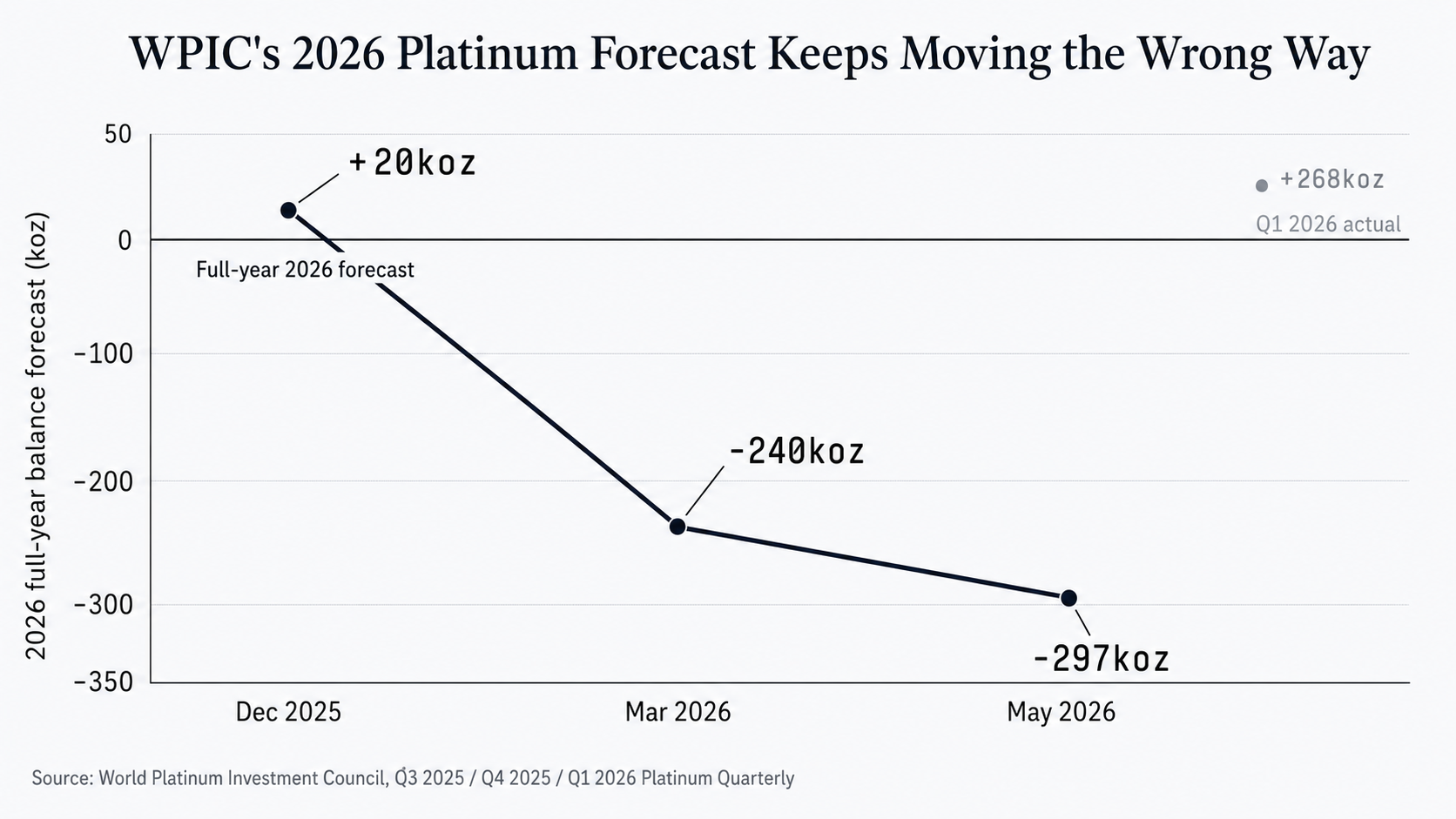
WPIC’s 2026 platinum balance forecast shifted from a 20,000-ounce surplus in December 2025 to a 297,000-ounce deficit in May 2026. Source: World Platinum Investment Council (WPIC).
GFEX Positioning Risk Grows as the ETF Cushion Shrinks
Two positioning reads argue physical tightness is not the only unresolved risk. Start with Guangzhou. GFEX’s June 2026 platinum contract, launched November 2025 with roughly 600kg (19,000 oz) warehoused, carried an open interest to inventory ratio near 24 to 1 as of late May 2026, more than double the 10 to 1 level MineralPrices calls its own delivery stress benchmark. A contract that thin runs a high ratio regardless of leverage. GFEX’s own December 2025 position limit move suggests the exchange read it as real risk anyway.
The sell side, meanwhile, reads the same liquidation and lands in three different places. UBS cut its target to $1,700 for September/December 2026 (only $1,800 by mid-2027) on June 29, 2026, flagging a “risk of a surplus” off its own tracker, a different snapshot than WPIC’s H1 estimate but the same direction: ETF holdings down roughly 500,000 oz to about 2.8 million oz this year. JPMorgan expects $1,800 by year end 2026 and $1,950 by year end 2027 on the same restrictions; Bank of America’s more aggressive call targets $3,000 by Q4 2026. None of the three engages WPIC’s own revision trend. That is the real gap, and it is the one my call leans on.
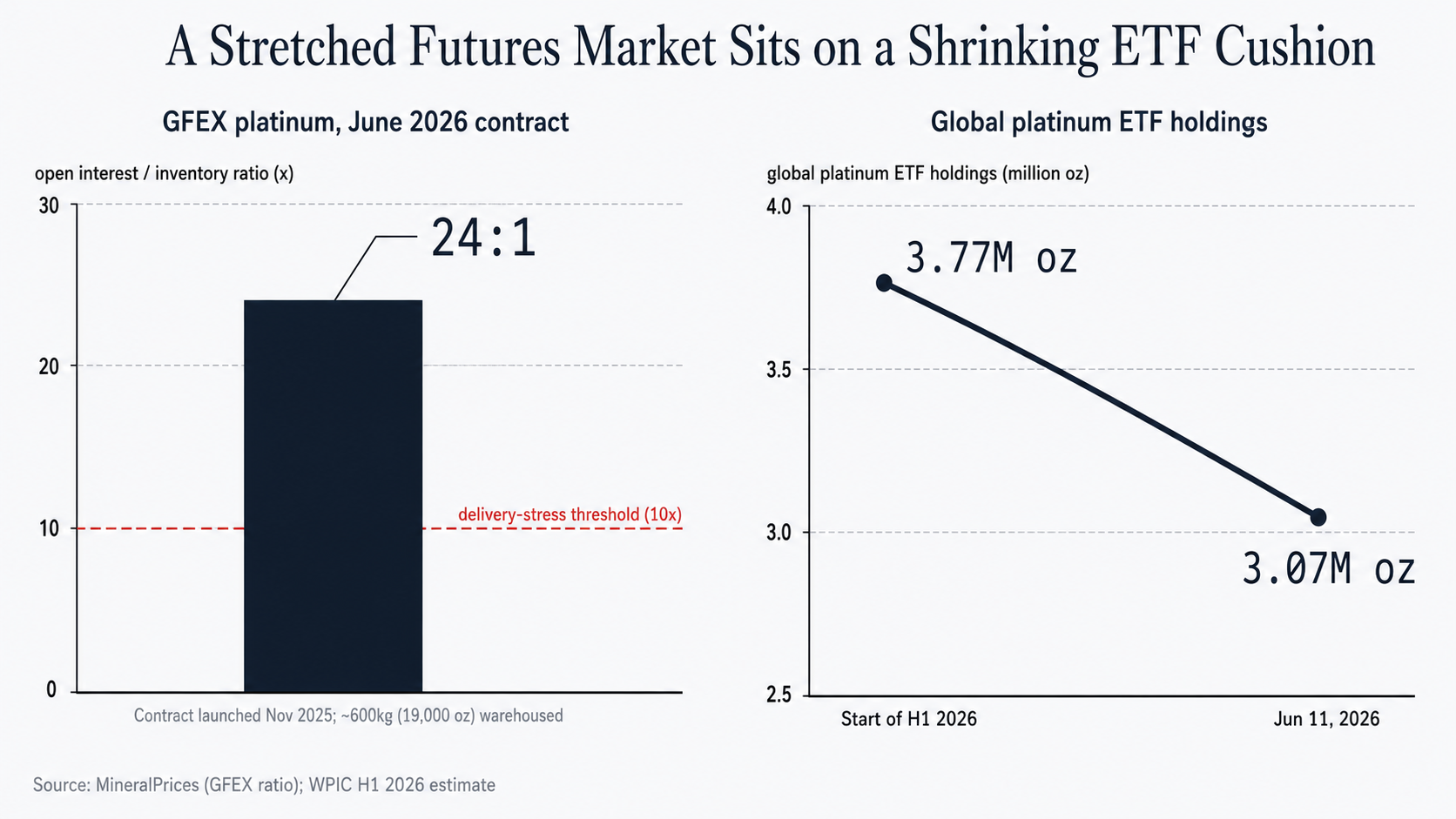
GFEX platinum open interest stood at about 24 times warehouse inventory while global platinum ETF holdings fell from 3.77 million to 3.07 million ounces in H1 2026. Source: MineralPrices; WPIC.
Platinum Price Forecast: $1,540 Support and $1,950 Upside Target
My base case for platinum is consolidation between $1,540 and $1,675 into and past the July 29 decision, with hold odds near 66% on one CME FedWatch derived tracker as of July 27. In my view, a newer positioning risk on a still shrinking supply base argues for a floor near current levels once the FOMC uncertainty clears. The fair entry zone sits inside that band, bounded below by $1,553 and $1,540 (just below the exact $1,539.60 July 1 print) and above by the $1,650-$1,675 resistance zone. A break above that resistance opens a path, I think, toward $1,800-$1,950 over two to four months. That is JPMorgan’s level; my timing is different, i.e. the deficit’s third straight upward revision has less supply left to hide behind as the ETF cushion runs out. WPIC’s next update, due September 9, 2026, is the first concrete test of the call. Invalidation: a close below $1,540 on ETF outflows running at or above the H1 pace rather than slowing. That opens the top of platinum’s decade long range near $1,348.20, the February 2021 high.
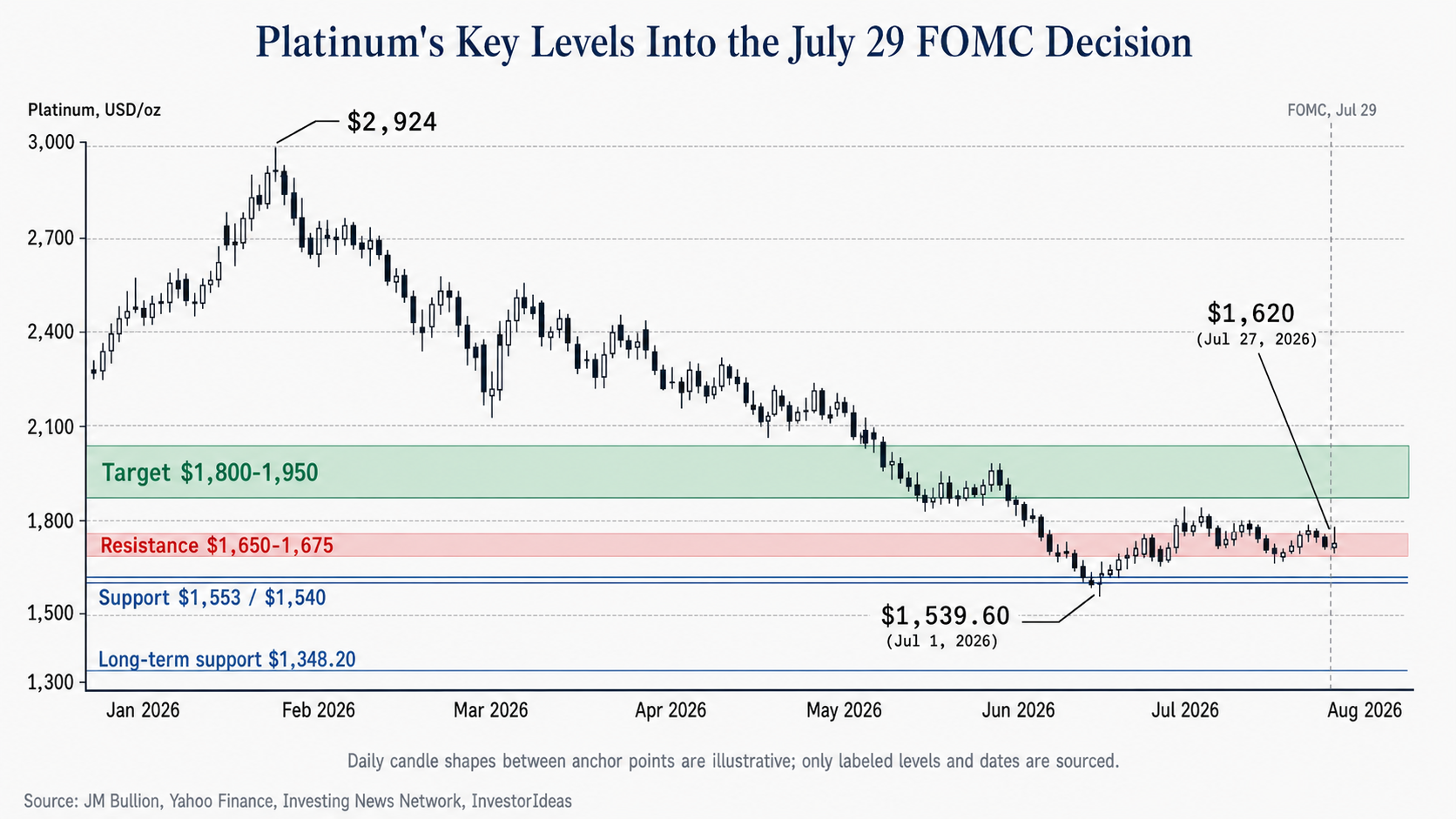
Platinum trades between support at $1,540-$1,553 and resistance at $1,650-$1,675 ahead of the July 29 FOMC decision, with $1,800-$1,950 as the upside target zone. Source: JM Bullion, Yahoo Finance, Investing News Network, InvestorIdeas.
Platinum Outlook Remains Constructive Despite Fed Risks
The base case is range bound platinum, $1,540-$1,675 into the July 29 decision, resolving toward $1,800-$1,950 as the positioning risk and the revision trend reassert, or toward $1,348.20 if ETF outflows resume at scale rather than exhaust. The bigger picture stays constructive over six to twelve months. South Africa’s mine decline has not paused for the crash. Inventories are the thinnest since 2014. WPIC’s own forecast has moved deficit ward for three straight quarters with record ETF liquidation running alongside it, and none of the sell side’s three way split engages that trend directly. This follows my recent gold forecast, which flagged the same hawkish Fed and Middle East risks now weighing on platinum. The FX Empire Economic Calendar has the decision time.