


Gold is the world’s oldest money. It’s the only money that no government can control, print, or unilaterally decide the value of. And it’s rallied 175% in U.S. dollar terms over the last three years, now holding around $5,000 per troy ounce.
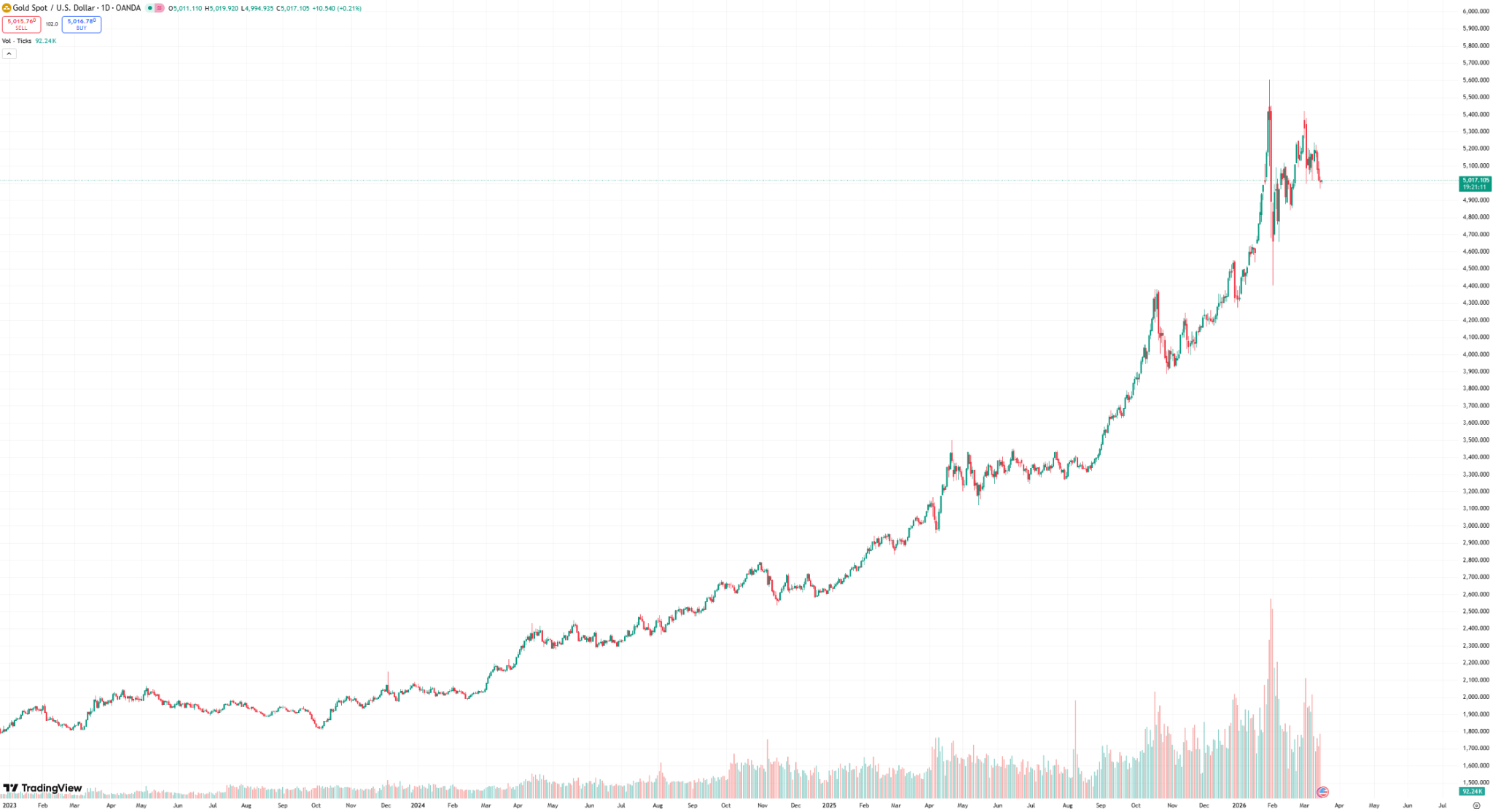
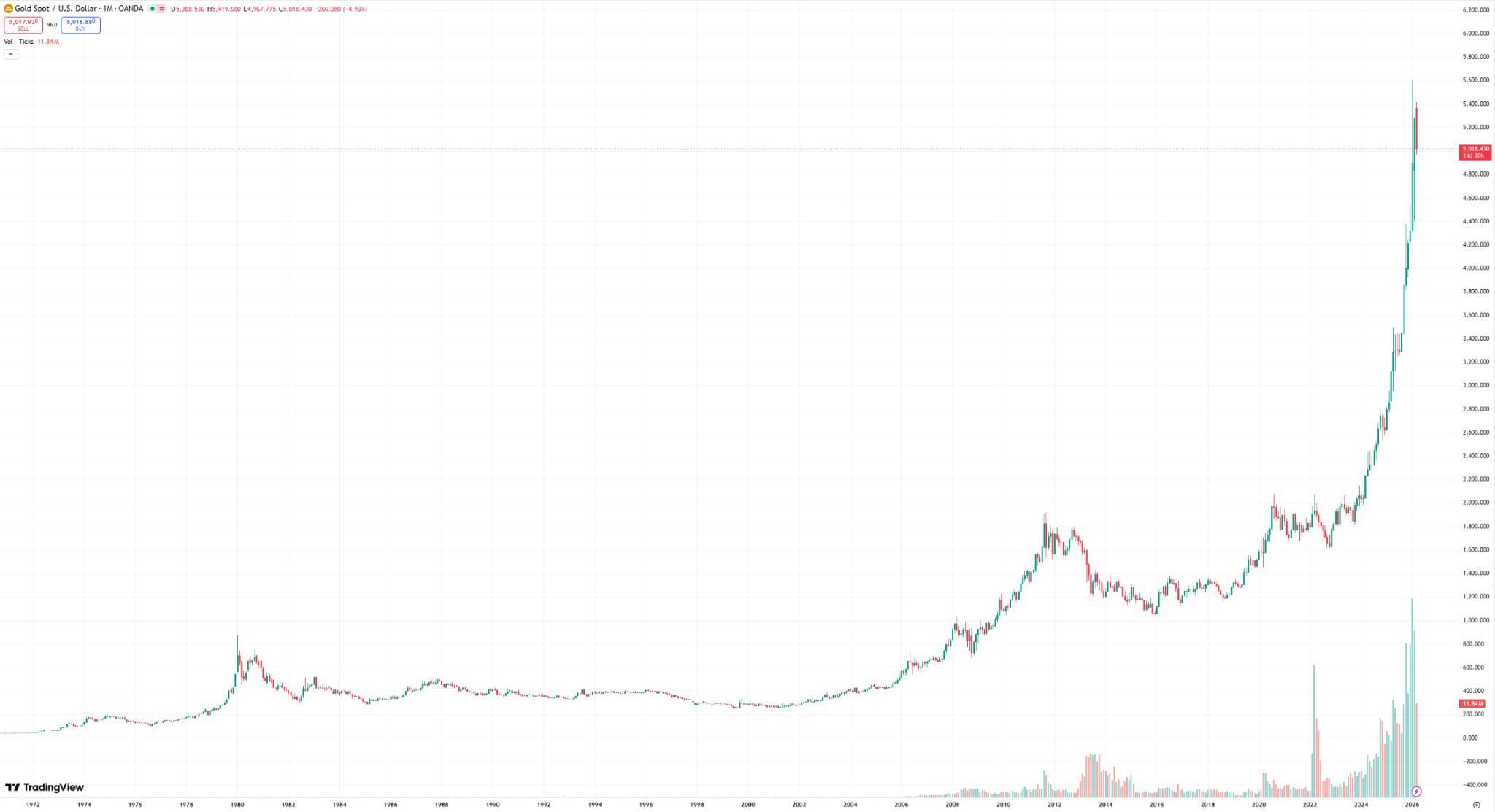
Long-term gold investors know that the precious metal has its own cycles, independent of other assets like equities or credit. But past cycles have looked little like this most recent leg. Looking back to the 1970s, when America came off the gold standard, this recent run-up looks incredible, so much so that analysts are now saying the most dreaded words in investing: “It’s different this time.”
Gold’s Supply Is A Constant
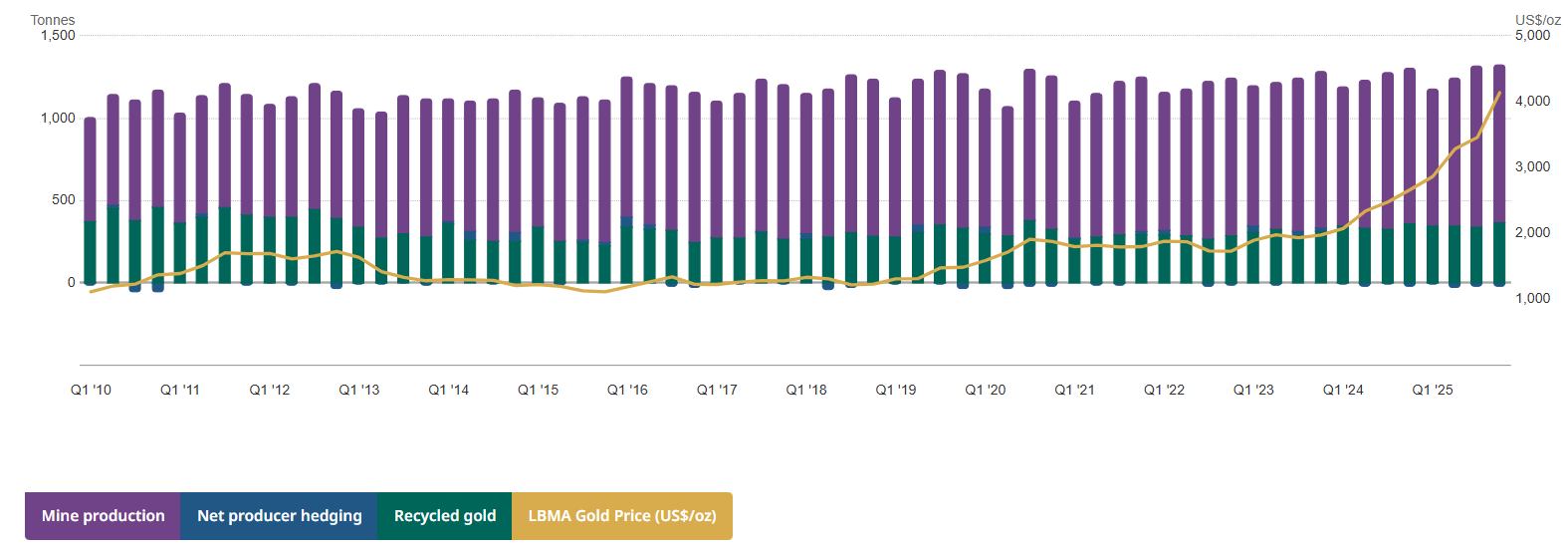
One of the traits about gold that precious metals investors must understand is that its supply is relatively fixed. It’s not only that there is a limited supply in the ground, but also that production follows a fairly predictable cadence. New mines take time to come online, with little said about the political barriers many operations in the West face from environmental restrictions. The easiest mines to build are already empty or running at full throttle, and our geological understanding is strong enough that projecting future output is fairly straightforward.
That has led to a market where supply generally inflects upward as new technology improves mining productivity but is otherwise stagnant and not especially responsive to the price of gold. Of course, gold mining operations would rather mine and sell more gold at $5,000 than at $2,000, but the transaction costs involved in ramping production up or down are rarely worthwhile.
Here is the supply of gold from 2010 to 2025. The price of gold changed from roughly $1,110 to roughly $4,000, but mine production changed from 632T to 950T. Changing output levels for gold producers is very different from what we see in other commodities, like oil producers that modulate output to influence price, such as OPEC+. Soft commodities like wheat and sugar face wild supply swings due to weather.
Gold’s Demand Is Dynamic
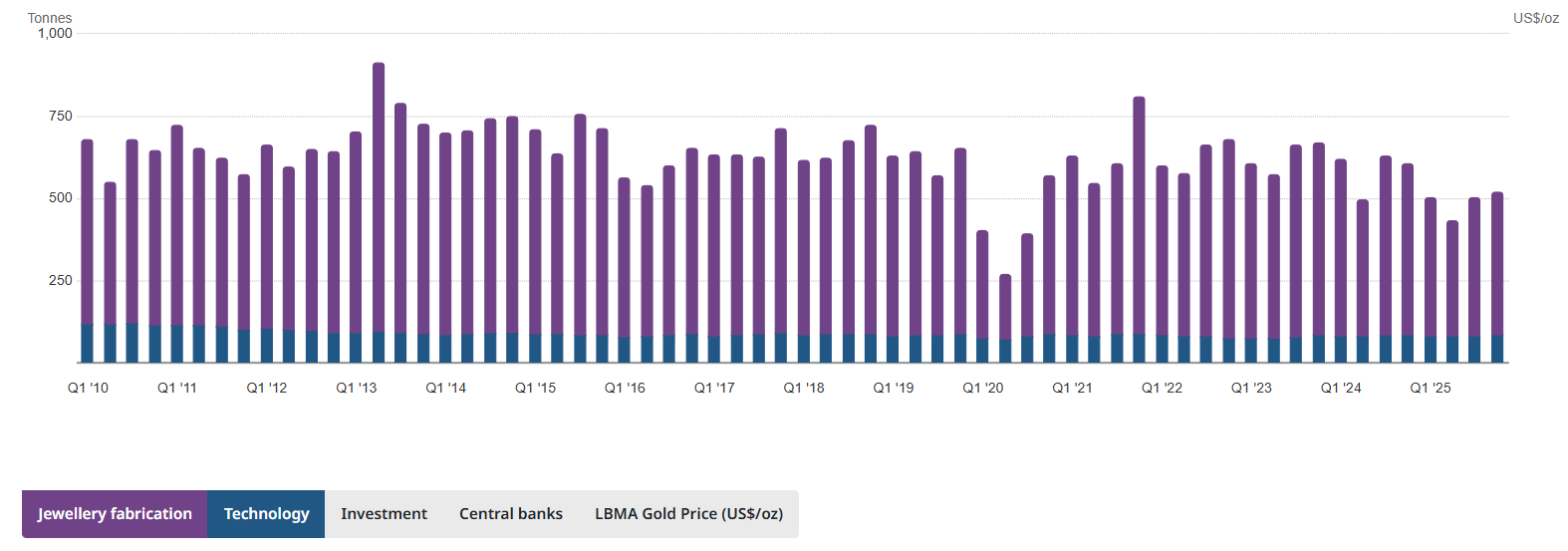
The second half of the equation is demand. Who is actually buying all the gold, and why? The breakdown is fairly straightforward. Most global demand is still coming from jewelry and technology, and both of those categories have fairly predictable demand schedules. They respond to price to some extent, but they also have an inelastic component that brings them back for similar amounts year over year.
Gold Price Forecast
Every new Gold analysis as it publishes, today's technical signal and key levels, live price — on one page.
See all Gold forecastsDemand has shrunk in these two categories since its 2022 peak, but the overall amount of gold purchased by them in 2024 was similar to prior years.
The categories investors are watching most closely are investment gold, purchased as bullion by individuals or through investment vehicles like increasingly popular gold IRAs or ETFs like the SPDR Gold Trust (GLD), which manages over $174 billion, and central banks. These are the key institutions of nation-states that work to stabilize their economies and currencies. Those two categories have been the underlying driver of gold’s price over the last few years as their demand has increased.
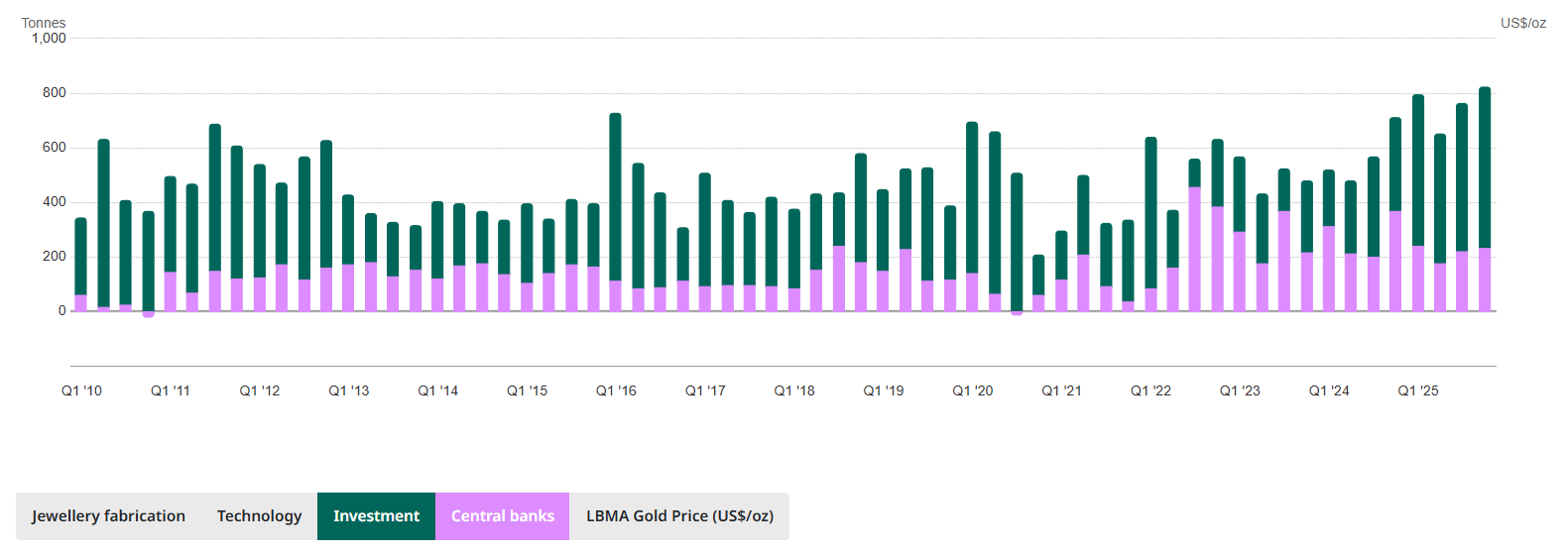
Central Bankers Stack Bullion
There was a clear flip in central bank behavior around the world following Russia’s invasion of Ukraine in 2022. It was not necessarily caused by the invasion itself, but by the U.S. response to it. The U.S. weaponized the dollar, freezing dollar-denominated assets that the Russian central bank estimates were worth ~$300B. This was a clear display of the United States using economic coercion against the Russian Federation.
It spurred a global race away from the dollar and toward an asset the U.S. can’t freeze. When you can’t trust dollars, what can you trust? Central banks largely chose the world’s oldest money. China led the way, and still does in many respects, as one of the fastest-accumulating central bank gold stockpiles in the world. Note the timing on the ramp-up.
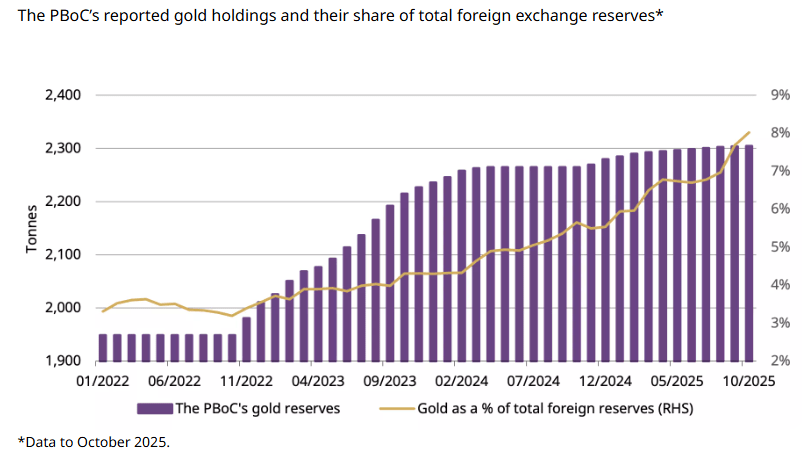
Central banks do not trade gold the way other gold-holding institutions do. They tend to hold it for a very long time, only selling if they need to buy their own currency, as in Singapore, or if their treasuries need cash quickly and cannot raise debt easily, as in Russia. Their demand for gold is sticky, and when they go on buying sprees they tend to remove floating supply from the market, putting structural upward pressure on prices.
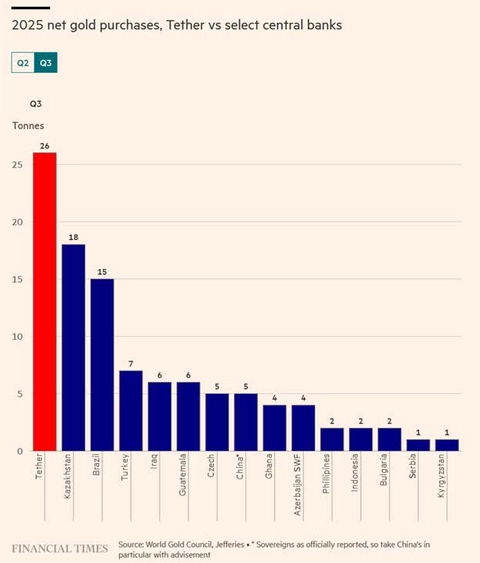
There is another form of quasi-central-bank demand adding to the dramatic increase in demand over the last few years: cryptocurrency issuers. Tether, which issues one of the world’s most famous stablecoins, USDT (USDT-USD), is also issuing tokenized gold. That is, it buys physical gold and then issues tokens representing ownership of that gold. This effort led Tether to outbuy most central banks in 2025, purchasing 26 tons from the market.
Investors Search for Safety
Over the last few years, institutional trust has eroded somewhat among investors. This is especially true with respect to the Federal Reserve’s handling of inflation and interest rates. Investors are seeking safe haven from inflation, and particularly from the perception of central bank mismanagement of monetary policy. Whether they are right or wrong matters less than the fact that, for gold demand, market consensus is what counts. Add in the ongoing rise in wars and conflict around the globe since 2022, and investors are increasingly turning away from older favorites like the dollar and toward alternatives like gold, Treasuries, and ex-U.S. currencies such as the Swiss franc (CHF-USD) and Japanese yen (JPY-USD).
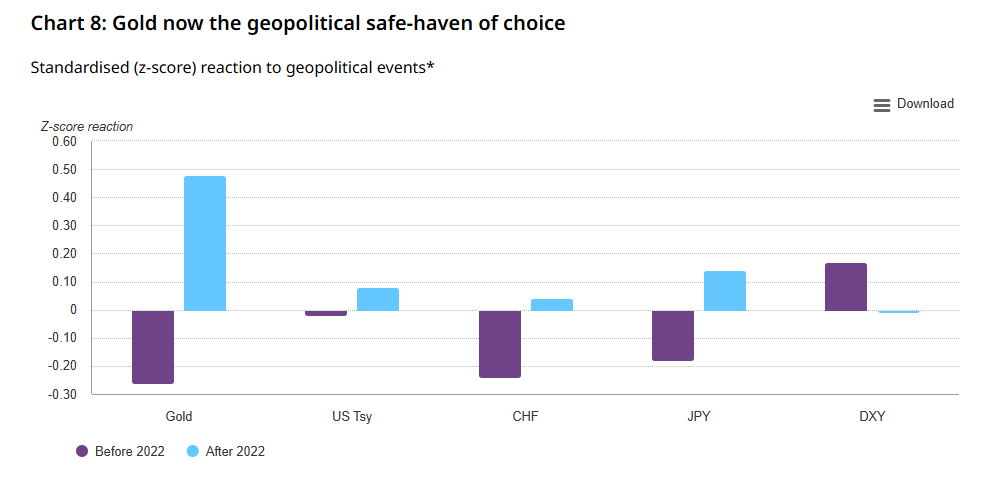
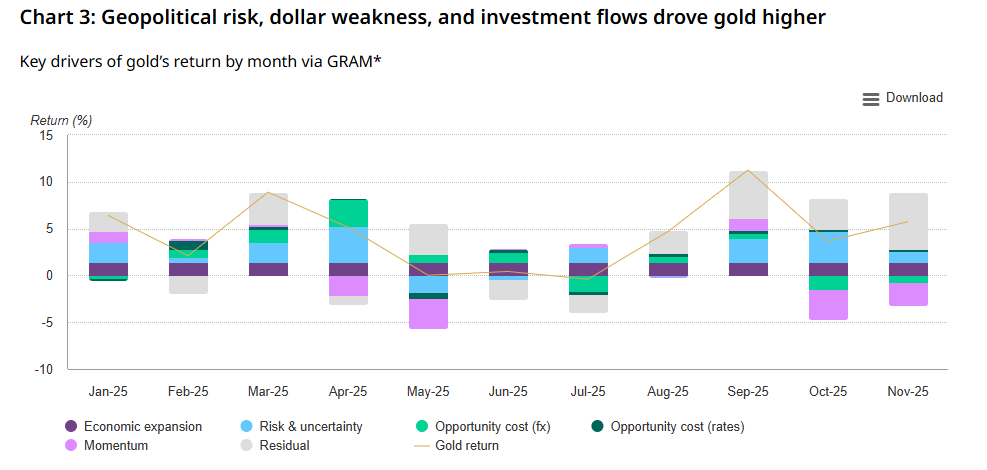
When looking at the rationale for investors buying and selling gold, “risk and uncertainty” consistently moved the buy needle, as investors increasingly look for safety anywhere they can get it. The biggest reason to sell? Momentum, meaning profit-taking. Consider that a central risk to the gold rally, as essentially all investors from before 2025 are sitting on gains. Some of them will need to sell and realize those gains at some point, even if they remain bullish on gold, whether through rebalancing, retirement spending, or something else.
The Gold Rally May Continue
The mismatch between supply and demand is fundamentally being driven by changes in global politics that have taken place over the last few years. Investors are losing trust in monetary policy and its efficacy, central banks are losing trust in their control over dollar-denominated assets, and new forms of demand from digital gold, not Bitcoin, but actual tokenized gold, continue to grow. These drivers of gold demand are reactions to changes in the status quo, and are therefore structural in nature.
The difficulty for investors is in sustaining the growth rates of the past few years into the future on demand and supply dynamics alone, because gold does not make earnings or pay dividends. Investment and monetary gold demand tends to weaken as prices climb, and central bank demand came in lower in 2025 than it did in 2024 and prior years, suggesting they may be pausing purchases as prices soar past $5,000.
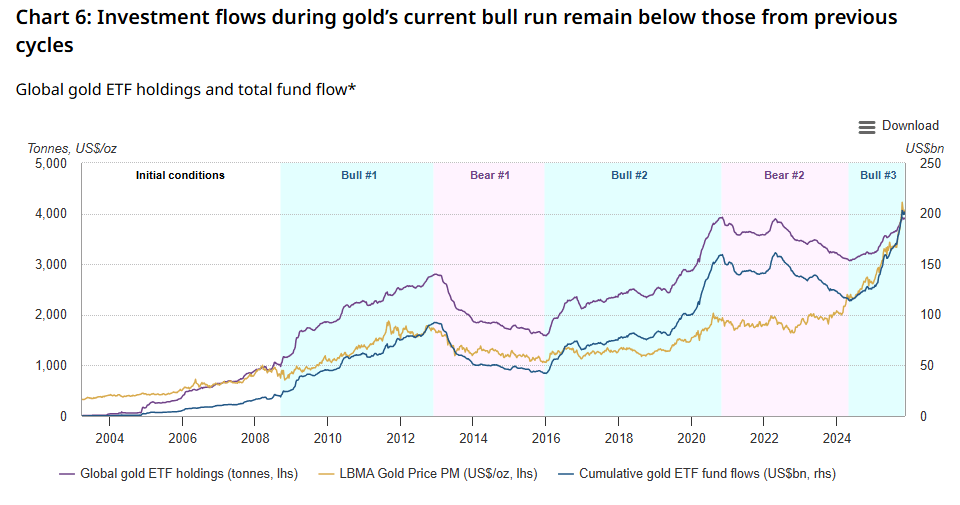
However, we are also seeing investment flows into ETFs come in lower than in previous rallies. In prior rallies, central bank demand and investment gold demand did not align as neatly as they have in this cycle, which may be a key difference to consider. Perhaps the retail crowd is still behind the curve. If so, that could meaningfully increase demand from here.
Conclusion
Gold is a hard commodity first and foremost, and money second. Its historic rally may be justified by ongoing developments in geopolitics and by the relationship between investor fear and where money flows when that fear rises.
As that answer increasingly becomes gold, we are getting a double whammy from central bank demand that is increasingly wary of holding dollars and dollar-denominated assets. Asset allocators at both the state and individual levels are seeking safe havens, and there are fewer and fewer assets in the world that still qualify. Gold is one of the few that does.
At the same time, gold has already run up significantly, and minor pullbacks can be healthy. The long-term trend could remain intact even if gold falls from these new peaks, likely buoyed at technical levels by latent retail investor demand. The continuing flight away from risk assets during geopolitical turbulence, including the wars in Europe and the Middle East, is also a boon for gold and precious metals more broadly, which tend to trade in sympathy.
Gold’s rally may not be the inflation of an asset bubble but a repricing away from trust in the dollar. If that is the case, then current levels may turn out to be a new structural floor.