



With both central banks confronting renewed inflation pressures, their decisions could reshape interest-rate expectations and trigger increased volatility in the US dollar and Canadian dollar.
The technical picture suggests that the USD/CAD pair is approaching a critical area after retreating from its October highs. On the daily chart, the pair seems to be moving inside the Ichimoku cloud, while the Relative Strength Index (RSI) signals bearish momentum without yet entering oversold territory. Meanwhile, the weekly chart shows an attempted rebound following two bearish weeks, although prices remain below the Tenkan-sen and the RSI is hovering around its neutral level.
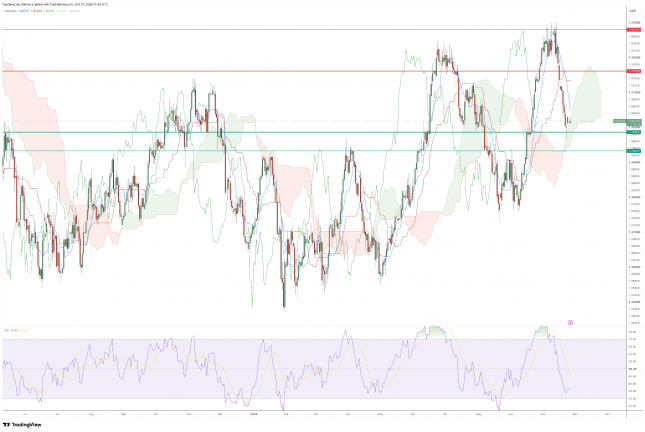
The daily chart shows that the Forex pair rallied towards 1.4270 in early October, reaching its highest level since April 2025, before undergoing a sharp reversal. Now trading around 1.4020, the pair has lost significant ground, suggesting that bullish momentum has weakened following the rejection at resistance near 1.4270.
The first area to monitor is the 1.3980–1.4000 support zone. This region combines horizontal support with the psychological 1.4000 threshold. Following the recent decline, the pair is approaching this area, making the next daily closes particularly important in determining whether selling pressure will intensify.
The Ichimoku indicator provides further insight into the short-term outlook. The recent pullback has brought prices towards the Kumo, or cloud, which can act as a dynamic support or resistance zone. A sustained move below the cloud and the 1.3980 support level would weaken the technical outlook and potentially push the USD/CAD towards the next support around 1.3930. If bearish momentum continues, traders could then look towards the 1.3850–1.3800 region, where previous price reactions suggest potential buying interest.
The RSI reinforces the picture of weakening momentum. The indicator stands near 38, below its moving average around 46. Although the RSI is approaching oversold territory, it remains above the conventional threshold of 30, leaving room for further downside. Traders should nevertheless watch for a bullish divergence or a recovery above 40, which could signal that selling pressure is beginning to ease.
On the upside, initial resistance lies around 1.4050–1.4070, followed by the 1.4160 area. A sustained recovery above the latter would suggest that buyers are regaining control after the recent sell-off. Beyond this level, 1.4270–1.4280 remains the principal resistance zone, corresponding to the October highs.
For now, the daily chart points to continued downside pressure, although the 1.3980–1.4000 area could provide an opportunity for a technical rebound. A decisive break below support would strengthen the bearish scenario, while a recovery above nearby resistance would suggest that the latest decline is losing momentum.
USD/CAD Price Forecast
Every new USD/CAD analysis as it publishes, today's technical signal and key levels, live price — on one page.
See all USD/CAD forecasts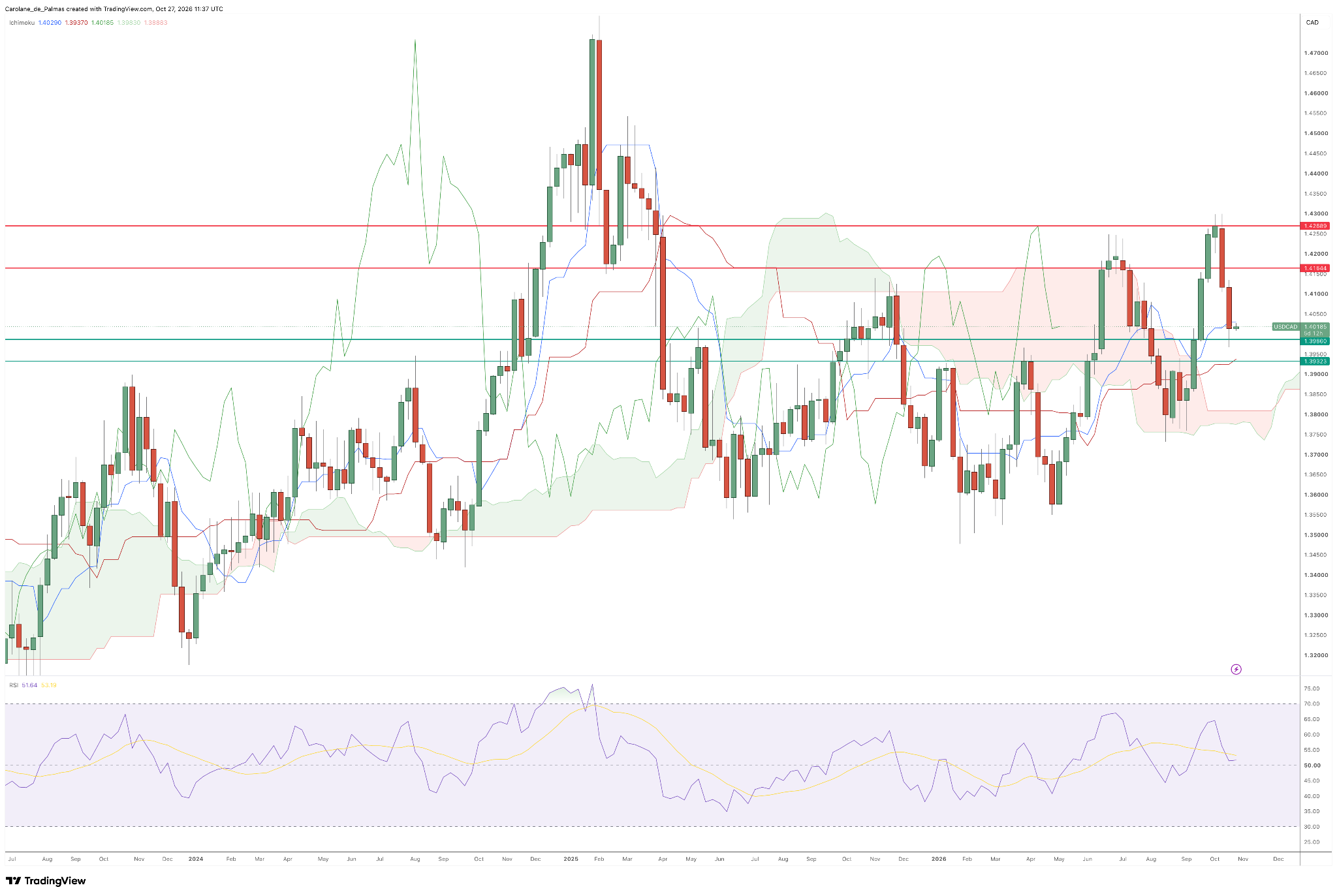
The weekly chart provides a broader perspective on the pair’s price action. The USD/CAD climbed towards 1.4750 in early 2025 before entering a prolonged correction, eventually approaching the 1.3594 support area. This region was tested again during several phases of weakness in early 2026, highlighting its importance within the broader market structure.
In April 2026, the pair began a recovery that gathered momentum over subsequent months, pushing prices towards 1.4270 in early October. However, the subsequent reversal shows that sellers remain active around this resistance area. After two strongly bearish weeks, the USD/CAD has attempted to rebound at the beginning of the current week, although this recovery has yet to confirm a renewed bullish move.
Prices remain below the Ichimoku Tenkan-sen, or conversion line, indicating that short-term momentum on the weekly timeframe remains under pressure. At the same time, the pair is trading above the 1.3980–1.3930 support zone. Holding above this area would help preserve the broader recovery structure, whereas a decisive breakdown could signal a deeper correction.
The weekly RSI, currently around 52, remains close to its moving average near 53 and within neutral territory. Unlike the daily indicator, it does not indicate pronounced bearish momentum. This divergence between timeframes suggests that the recent sell-off has weakened the short-term outlook without yet establishing a clear bearish trend on the weekly chart.
A “successful defence” of the 1.3930 level could allow the USD/CAD FX pair to consolidate before attempting another advance towards 1.4160. A sustained move above that resistance would bring 1.4270–1.4280 back into focus, with a confirmed breakout potentially opening the way towards 1.4400.
Conversely, a weekly close below 1.3930, particularly if accompanied by a breakdown below the Ichimoku cloud, would weaken the recovery structure. Such a move would increase the risk of a deeper correction towards 1.3850 and potentially the 1.3750–1.3700 region.
Bank of Canada: Will Inflation Concerns Support the Canadian Dollar?
The BoC is widely expected to raise its overnight rate by 25 basis points, from 2.25% to 2.50%, as policymakers seek to prevent higher energy prices from feeding into broader inflation. Canada’s annual inflation rate rose to 3.1% in September, slightly above the central bank’s 1%–3% target range. A Reuters survey found that 19 of 34 economists expected a rate increase.
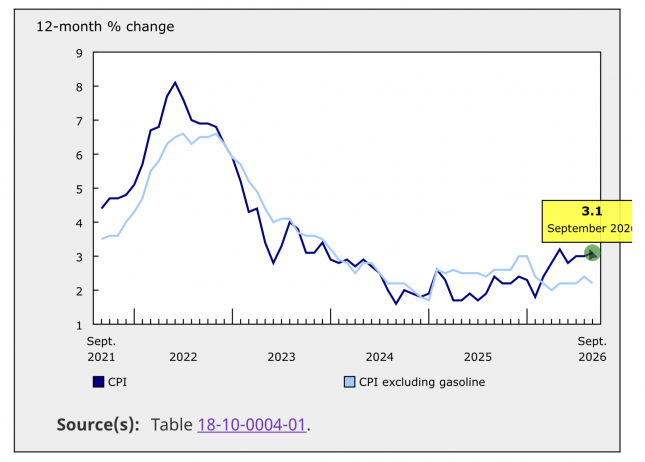
The accompanying Monetary Policy Report will be equally important, particularly any upward revision to the inflation outlook. A rate increase combined with a warning that price pressures could persist would support the Canadian dollar, potentially accelerating the USD/CAD’s decline towards 1.3980 and 1.3930.
However, a rate hike may already be reflected in market pricing. If the Bank presents the move as a precautionary response to energy costs while highlighting weak domestic growth, the Canadian dollar’s gains could prove limited. A less hawkish statement than anticipated could even trigger a rebound in the USD/CAD pair.
Federal Reserve: Can the US Dollar Regain Momentum?
The Federal Reserve is expected to leave its benchmark rate unchanged at 3.75%–4.00% following its September increase. Nevertheless, persistent inflation and higher energy costs have strengthened expectations of another hike in December.
For the USD/CAD, the Fed’s communication will be critical. If policymakers signal that further tightening remains likely, US Treasury yields could rise and support the dollar, particularly if the BoC’s decision is already priced in. This could limit the pair’s downside or trigger a recovery towards 1.4050–1.4070, and 1.4160 afterwards.
Conversely, a more cautious assessment of inflation or an emphasis on economic uncertainty could weigh on the dollar. If the Fed’s message is less hawkish than investors expect, the USD/CAD could break below its immediate support zone even if the BoC raises rates.
Ultimately, the pair’s next move will depend on the relative policy signals from both countries.
Sources: Reuters, Bank of Canada, Federal Reserve, CNBC, The Wall Street Journal, Statistics Canada, Investing, Investopedia, Yahoo Finance