


At the moment of writing these words, the GDXJ, the ETF for junior mining stocks, trades near $111.70, after touching $112.81 earlier today, and December gold futures trade near $4,125. The miners are rising sharply for the second session in a row, and on Friday, they rose 2.8 percent even though gold fell $38.60 after a strong jobs report.
In my gold price forecast for November 2026, I described about $3,500 as the next target for gold. Friday’s session didn’t change this outlook, but the miners did something I said would matter. On October 26, I wrote: “Until the miners start rising on gold’s down days, or at least falling less than gold, I think the decline in the sector has further to go.” The GDXJ closed at $99.94 that day and fell to $93.50 four days later.
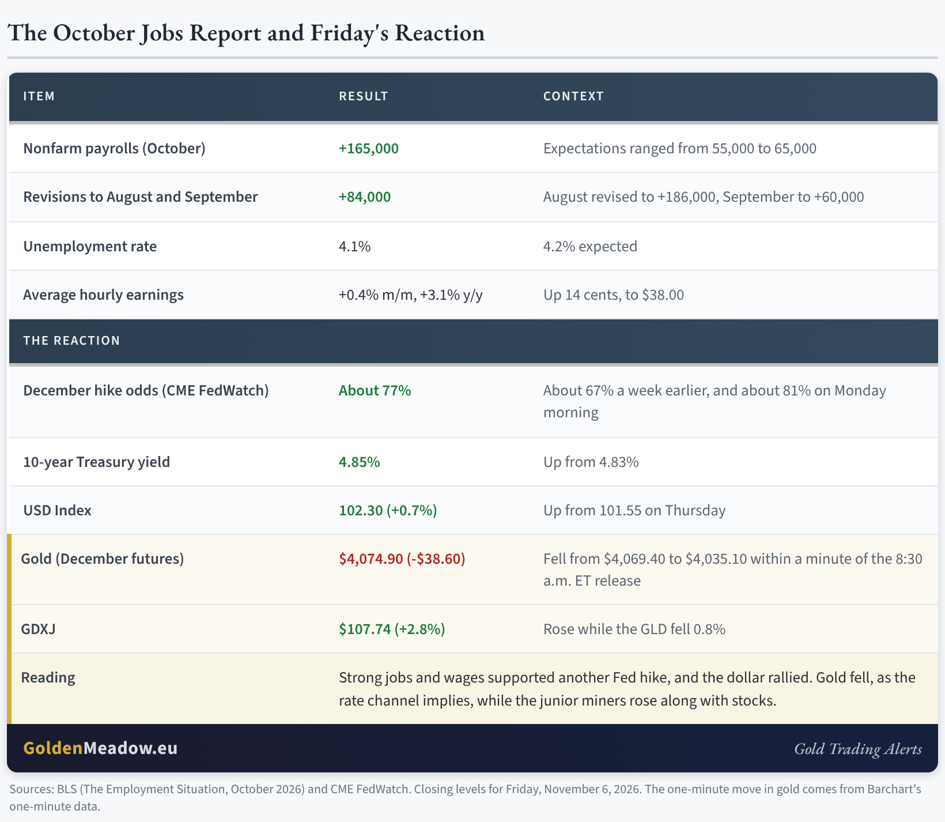
The October jobs report was much stronger than expected. Nonfarm payrolls rose by 165,000, compared with expectations in the 55,000-65,000 range, the unemployment rate dipped to 4.1 percent, and average hourly earnings rose 0.4 percent. Based on the CME FedWatch tool, the odds of a December rate hike rose to about 77 percent on Friday, from about 67 percent a week earlier.
Higher rates make gold, which pays no interest, less attractive, and gold reacted accordingly. December gold futures fell to $4,074.90, and the GLD fell 0.8 percent. The GDXJ rose 2.8 percent, to $107.74, after opening at its daily low and closing near its high. On the surface, this looks like the bullish sign I was waiting for, but there are two different reasons why miners rise while gold falls.
Gold Price Forecast
Every new Gold analysis as it publishes, today's technical signal and key levels, live price — on one page.
See all Gold forecastsTwo Reasons Why Miners Rise While Gold Falls
The first reason is the stock market. The GDXJ holds small and mid-sized mining companies, which trade along with the rest of the stock market. When stocks rebound, the juniors often rise with them, even on a day when gold declines. On Friday, the Nasdaq Composite rose 1.1 percent, and the Russell 2000 rose 0.9 percent.
The second reason is real strength in the sector. The miners’ profits rise faster than the gold price, so when investors start to price in a higher gold price, the miners turn first. At real bottoms, miners lead gold higher.
On a single day, both reasons look the same, so telling them apart takes a day on which gold and stocks both decline. If the miners hold up on such a day and keep their gains into the close, this is real strength. On Friday, stocks were rising too, so Friday doesn’t pass this test, and neither does today’s session, with gold and stocks both moving higher. This makes the stock market the key to what comes next for the miners.
Why the Stock Market Matters Now
Friday’s rebound in stocks came after a sharp decline. The S&P 500 gained 0.3 percent, to 7,376.86, but the index ended the week 2.7 percent lower. Last week, the S&P 500 futures broke below their mid-2026 highs and their rising, medium-term support line, which is a major breakdown. Today, stocks are extending the rebound, with the S&P 500 near 7,500, and the futures are moving back toward the levels they broke.
In my view, the rebound in stocks is corrective, and this suggests that the miners could be declining strongly soon as well. The same link works on the way down. On October 30, the S&P 500 fell 1.8 percent, and the GDXJ fell 5.9 percent. In 2008, when stocks crashed, the GDX fell 53.5 percent between September 19 and October 27, while the S&P 500 fell 32.4 percent.
Gold itself is rebounding today, and the way gold is rebounding points in the same direction.
Gold Rebounds, and Silver’s Lead Fades
Gold had a reason to rise this morning. Crude oil slid after President Trump said renewed attacks on Iran are “highly unlikely” if Tehran makes progress in the talks, and lower oil eases the inflation pressure, which helps gold through the interest rate channel.
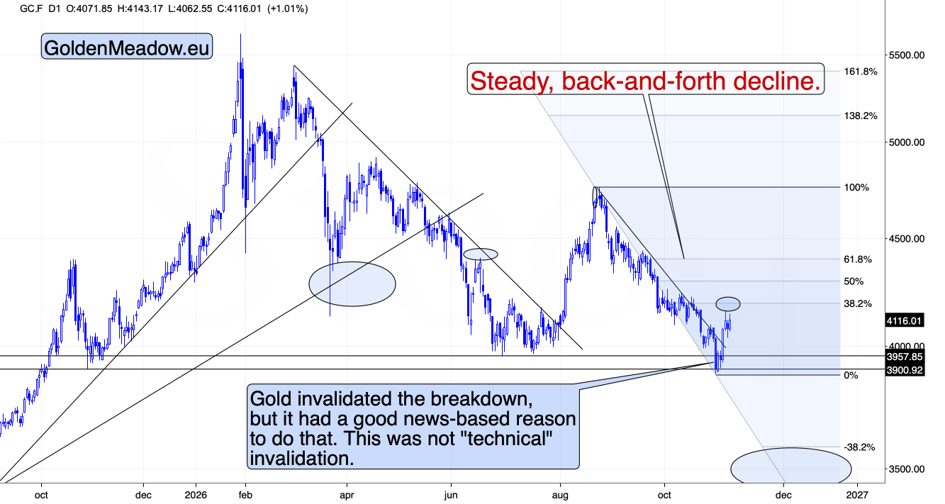
Gold is still below Thursday’s high of $4,155.80, and silver’s early lead is already gone. On Sunday evening, shortly after the markets opened, the gold-to-silver ratio fell to 77.41, but at the moment of writing, it’s back near 78.5, slightly above Friday’s 78.45.
In my silver price forecast for November 2026, I wrote: “When silver leads a rebound like this one, the rebound is usually corrective, not the start of a new rally, and Monday’s silver-led rebound ended the next day.” The rebound underway when I wrote these words faded within two days as well.
The next test comes tomorrow, when the October CPI report comes out at 8:30 a.m. ET. A hot reading would add to the case for a December hike, and to the pressure on gold.
This morning, before the opening bell, I wrote to my subscribers that the miners might soar today, and that I think such a rebound is likely to be temporary. The GDXJ has already moved above the upside target that I described in Friday’s Gold Trading Alert.
Where This Leaves Us
The junior miners rose on gold’s down day on Friday, and today, they’re soaring, but both times, they rose along with stocks, and the rebound in stocks looks corrective. Gold’s rebound has a news-based trigger, and silver’s early lead has already faded. In my view, the next big move in gold is still down, toward about $3,500, and once the rebound in stocks ends, the miners are likely to decline strongly as well.
Friday and today showed what the miners do when stocks rise. The real test comes when stocks fall.
Important note: the forecasts are up-to-date at the moment of their publication, we don’t guarantee updating them for free readers. We will, however, keep our premium subscribers updated at all times.
Thank you for reading today’s analysis – I appreciate that you took the time to dig deeper and that you read the entire piece. If you’d like to get more (and extra details not available to 99% investors), I invite you to stay updated with our free analyses – sign up for our free gold newsletter now.
Thank you.
Sincerely,
Przemysław K. Radomski, CFA