


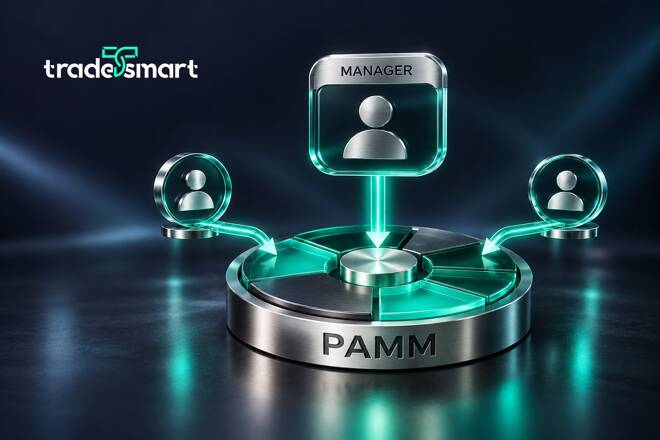
Not every trader wants to place their own trades. Some don’t have the time to follow the markets closely, others don’t yet have the experience to trade with confidence, and some would simply rather hand that responsibility to someone with a proven track record. TradeSmart’s PAMM offering is built for exactly that audience, giving clients a way to participate in the markets without managing the day-to-day decision-making themselves.
What PAMM Means
PAMM stands for Percentage Allocation Management Module. At its core, it’s a structure that allows a professional trader — often referred to as a money manager — to trade on behalf of multiple investors from a single pooled account, with each investor’s profits, losses and fees calculated according to the percentage of the pool they contributed.
That structure is what distinguishes PAMM from simply copying another trader’s individual positions. Rather than replicating trades into separate individual accounts, PAMM investors’ funds are combined into one managed account, and the manager trades that combined pool as a single strategy. Each investor’s share of the account’s performance is then calculated proportionally, based on how much of the total pool their investment represents.
How a PAMM Account Works in Practice
The mechanics are relatively straightforward from the investor’s side. An investor allocates a portion of their capital to a chosen PAMM manager’s account. That capital is pooled together with contributions from other investors under the same manager. The manager then makes all trading decisions — entries, exits, position sizing, risk management — across the full pooled account.
As the account generates profits or losses, those results are distributed back across investors according to their percentage share of the pool. An investor who contributed 10% of the total pooled capital, for example, receives 10% of the account’s profit or loss, before any performance fees are applied. Managers are typically compensated through a performance fee, calculated as a percentage of the profits they generate, which aligns their incentive with delivering strong results rather than simply generating trading volume.
Because everything is calculated proportionally and managed centrally, investors don’t need to manually execute a single trade themselves. Their role is largely limited to selecting a manager, deciding how much capital to allocate, and monitoring performance over time.
PAMM vs. Copy Trading
PAMM is often mentioned alongside Copy Trading, and the two solutions do serve a similar underlying need — giving traders a way to benefit from someone else’s market expertise without executing trades themselves. But the mechanics differ in a few important ways.
With Copy Trading, an investor’s account remains individually managed. Trades placed by the trader being followed are automatically replicated into the investor’s own account, and the investor typically retains the ability to adjust position sizing, pause the strategy, or stop copying at any time, trade by trade.
With PAMM, by contrast, capital is pooled into a single account managed directly by the money manager. Investors aren’t replicating trades into their own separate account — they’re holding a proportional stake in one shared account and receiving a share of its performance. This tends to appeal to investors who want a more hands-off, fund-like structure, and to managers who prefer to run one consolidated strategy rather than having their trades mirrored across many separate accounts with potentially different balances and settings.
In short, Copy Trading tends to suit traders who want visibility into individual trades and more granular control, while PAMM tends to suit investors who prefer a more delegated, portfolio-style approach.
Why Traders Choose PAMM
PAMM accounts tend to attract a specific type of investor. This includes people who want exposure to the markets but don’t have the time, experience or interest to trade actively themselves, as well as those with larger amounts of capital who are looking for a more structured, professionally managed approach rather than following individual trade signals.
It can also appeal to investors looking to diversify how their capital is managed. Rather than relying entirely on their own trading decisions, allocating a portion of capital to a PAMM manager offers a way to diversify strategy and decision-making itself, not just diversify across asset classes.
For experienced traders, PAMM offers a different kind of opportunity: the ability to manage outside capital and earn performance fees based on results, effectively turning a successful trading strategy into a scalable business rather than something limited to their own account balance.
What to Consider Before Choosing a PAMM Manager
As with any form of managed investing, choosing a PAMM manager isn’t something to approach casually. Track record, risk management approach, drawdown history and consistency over time all matter more than short-term returns alone. A strategy that produced strong gains over a short period isn’t necessarily one built to perform consistently over the long run, and past performance is never a guarantee of future results.
Investors considering a PAMM account should also be clear on the specific terms attached — including the performance fee structure, how frequently profits are calculated and distributed, and any conditions around withdrawing capital from the pool.
A More Complete Set of Options
By offering PAMM alongside Copy Trading, MT5 and its broader multi-asset access, TradeSmart gives traders and investors a genuine range of ways to participate in the markets — from fully independent manual trading, to trade-by-trade copying, to a more delegated, fund-style structure through PAMM. That range means clients aren’t forced to choose between hands-on control and professional management; they can select the approach that actually matches how much time, experience and involvement they want to bring to their own trading.