
Scope Ratings says in its Sovereign Outlook 2026 that geopolitical developments will remain fundamental for sovereign credit profiles, particularly in Europe. This includes uncertainties under volatile US trade and foreign policies but also China’s dominance across the raw materials crucial for global supply chains as well as the impact of China’s growing competitiveness in high-value-added goods exports.
For European sovereigns, significant uncertainty persists regarding the outcome of any potential ceasefire negotiations between Russia and Ukraine, or alternatively, military escalation. Either scenario would carry significant economic, fiscal and governance implications for Europe.

Domestic Conditions Also Pose Challenges for Advancing Structural Reforms
Domestic factors also play a crucial role, not least challenging budgetary outlooks and growing political polarisation that make it increasingly hard to implement structural reforms.
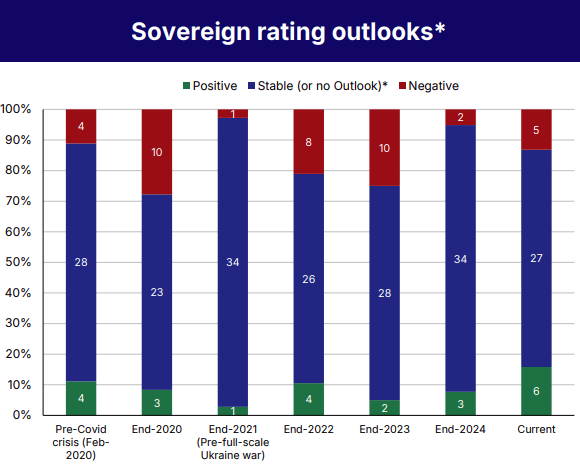
Figure 1. Sovereign rating portfolio: five sovereign issuers on Negative Outlook, six on Positive
Rating Risks Offset the Potential for Stronger Economic Growth, Fiscal Resilience
Significant geopolitical and fiscal risks outweigh the potential positive effects from stronger growth and emerging pockets of fiscal resilience within the EU. Among potential tailwinds in Europe, possible gains may be linked to artificial intelligence-driven productivity gains and the implementation of reforms in Europe related to the Next Generation EU funding programme.
In addition, many European sovereigns retain considerable funding flexibility, not only in southern euro area countries that are benefitting from fiscal consolidation but also countries like France, despite ongoing difficulties in reducing budget deficits.
EUR/USD Price Forecast
Every new EUR/USD analysis as it publishes, today's technical signal and key levels, live price — on one page.
See all EUR/USD forecastsScope’s overall outlook is reflected in recent actions on the long-term ratings of the US – downgraded to AA- in October – and France, affirmed at AA- but with the Outlook revised to Negative in September, primarily due to concerns about high budget deficits, rising government debt-to-GDP and a challenging political outlook.
Rating Convergence Trend Since 2019 Set to Continue
Another theme is the continued ratings convergence among investment-grade sovereign borrowers. While there is upside among previously lower-rated sovereigns such as Cyprus, Greece, Italy, Portugal and Spain, there is downside on the ratings of Austria, Belgium and Finland in addition to those of France and the US (Figure 1).
There are challenging fiscal dynamics among several highly rated sovereigns exacerbated by rising political polarisation across many countries. Governments face a very delicate balancing act between reducing budget deficits and stabilising public-debt levels, while meeting rising government interest payments and voters’ demands for high and increasing social spending. Social spending is typically linked to demographic pressures. Governments also need to address persistent security concerns. Implementing reforms to achieve fiscal sustainability while maintaining political stability represent a significant challenge.
How governments manage such pressures will prove central to informing the future ratings trajectory. Failure to meaningfully advance budgetary efforts could result in weaker credit profiles over the medium term while near-term market volatility could be addressed via the wide range of intervention tools at the disposal of central banks, including the European Central Bank.
Download Scope’s Sovereign Outlook 2026 presentation.
Watch the replay of the Sovereign Outlook 2026 webinar.
For a look at all of today’s economic events, check out our economic calendar.
Eiko Sievert is an Executive Director in sovereign ratings at Scope Ratings and a member of the rating agency’s Macro Economic Council. Carlo Capuano, Deputy Head of sovereign ratings at Scope, contributed to drafting this research.