
Making predictions in financial markets is an ungrateful endeavour because the forecaster is inevitably judged by the harsh clarity of hindsight. Furthermore, markets now exist in a world where even the most reasoned forecasts can become irrelevant overnight by unforeseen global shifts (or during Donald Trump’s press conference). Consider the recent price action in the gold market: at the end of 2025, the consensus of analysts favoured a $5,000 target for 2026. Yet, within the first three weeks of the new year, gold shattered those expectations, soaring toward $5,700 before January had even concluded, only to retreat back below the $5,000 threshold by 30 January.
It is amid these wild price fluctuations and uncertain macroeconomic environment that the global broker Elev8 embarks on a risky journey to offer its perspective on 2026, highlighting key trends and themes that will likely dominate financial markets. In this inaugural public outlook for the year ahead, my aim is not to provide concrete price targets and deliver rigid prophecies but to illuminate potential risks and opportunities, equipping traders with an elevated strategic perspective needed for informed decisions and preparing them for what could be yet another year of heightened turbulence.
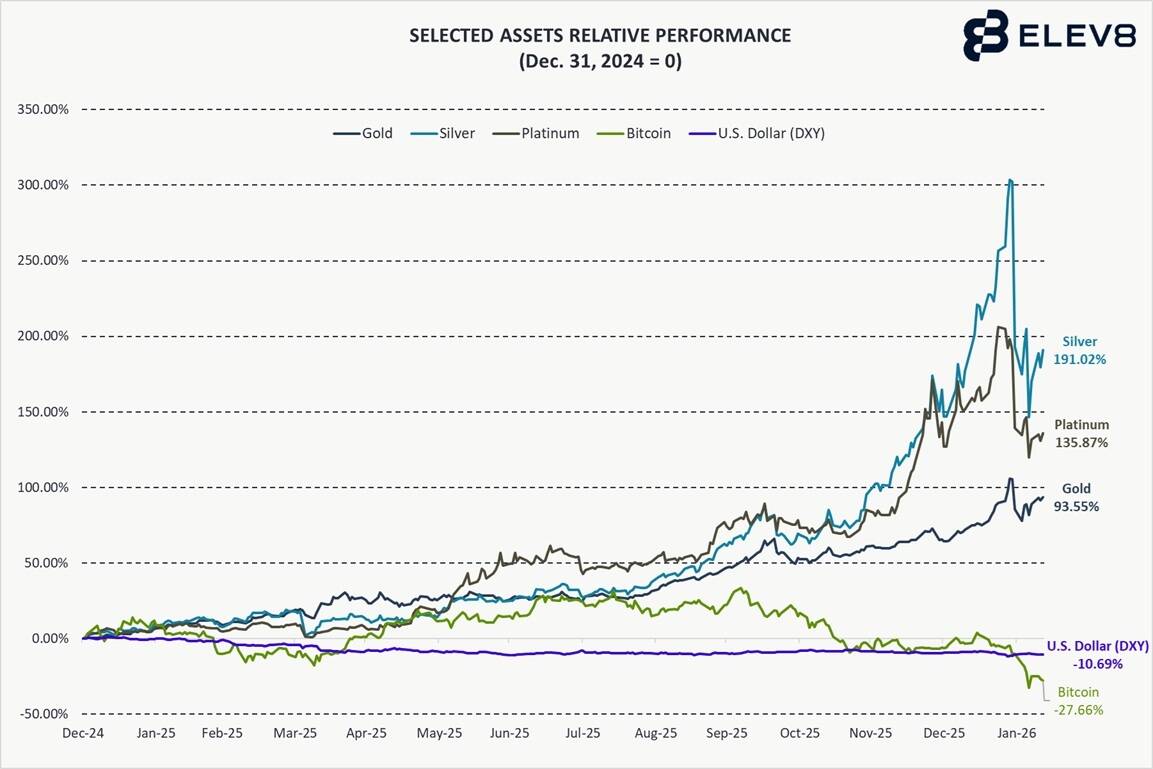
Selected assets relative performance (Dec. 31, 2024 = 0). Source: Elev8.

2026 Market Outlook: From Liquidity-Driven Trading to Fundamentals
Macro and Central Banks in 2026: Resilience, Inflation, and Slower Rate Cuts
The global economy displayed remarkable resilience throughout 2025, largely disconnecting the actual economic performance from persistent geopolitical and macroeconomic instability. Despite high-stakes and often unprecedented tensions, including ‘Liberation Day’ tariffs, mounting sovereign debts, continued conflict in Eastern Europe, periodic hostilities in the Middle East, and ‘intriguing’ developments around Venezuela, Canada, and Greenland—financial markets remained relatively unscathed. In fact, U.S. stock market indices continued scaling new heights, decoupling from the global discord.
Indeed, as 2026 begins, the global investment landscape is defined by a paradoxical calm. Investors have largely learned to live with geopolitical turbulence, treating persistent trade tensions and tariff threats as routine background noise rather than extraordinary shocks. However, the accommodative fiscal and monetary cushions that neutralised these headwinds in 2025 are now receding, suggesting that navigating the year ahead will demand far greater precision.
Central banks are currently searching for a delicate balance between cooling labour markets and the inflationary impact of energy costs and trade barriers. Following a year of significant easing, the pace of rate cuts is slowing drastically. For many major economies, 2026 represents the conclusion of the cutting cycle. Indeed, current market pricing implies a mere 50 basis points of further cuts from the Federal Reserve (Fed), with even thinner margins for the Bank of England (BoE) and the European Central Bank (ECB). While the bias remains toward easing, the threshold for further rate cuts is now a lot higher than previously due to the delayed inflationary effects of tariffs and the softening labour market. The Bank of Japan stands alone as the only major central bank continuing its tightening cycle, driven by consistent 2% inflation and a desire to normalise deeply negative real rates.
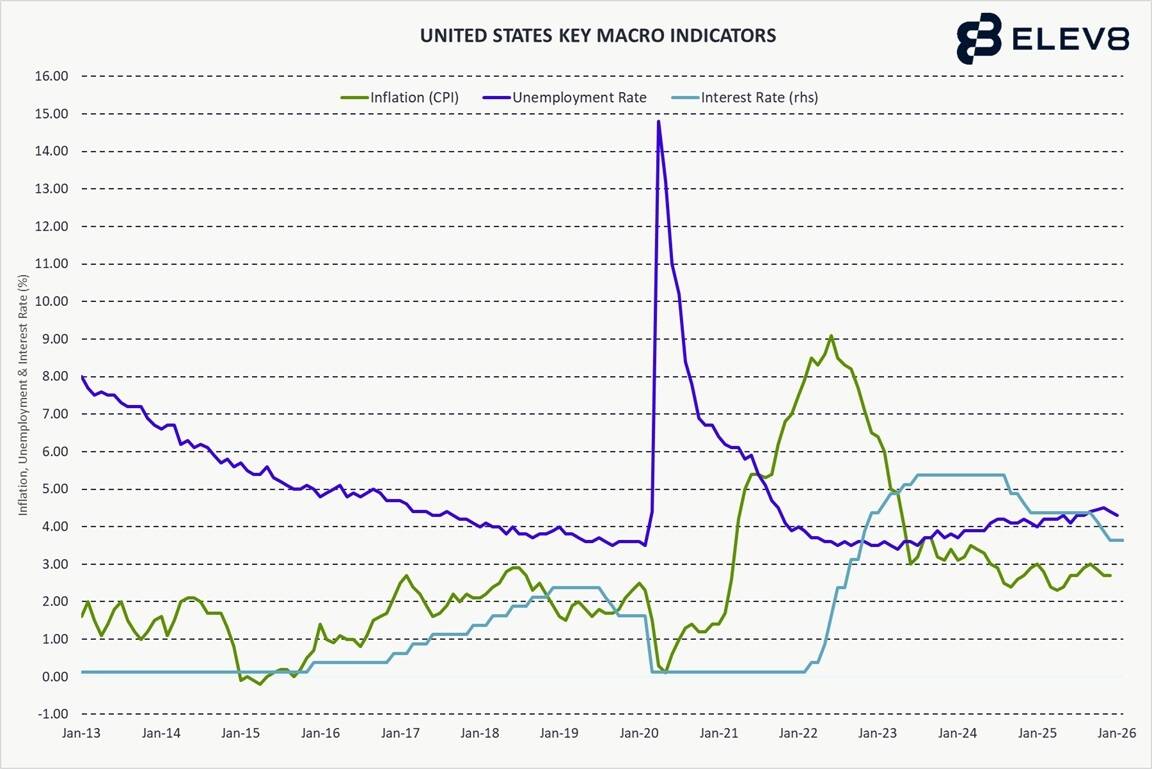
United States key macro indicators: CPI inflation, unemployment rate, and interest rate. Source: Elev8.
Meanwhile, soaring government debt remains a major threat to global stability. In case reckless, uncontrollable sovereign spending scares off private investors, central banks might be forced back into massive quantitative easing (QE). Should this materialise, it would undermine global currencies and trigger a historic rally in precious metals, and, possibly, Bitcoin. In any event, the era of fiscal expansion has reached its limit; as the safety nets of the previous decade fray, the focus is shifting away from transitory crisis management toward the long-term viability of global financial architecture.
Therefore, 2026 marks a decisive shift from reactive investing to fundamental analysis. While 2025 was dominated by trade rhetoric and institutional instability, the coming year centres on growth trajectories and debt sustainability. With the International Monetary Fund projecting steady global growth of 3.3%[1], it remains to be seen if the resilience of the private sector and accelerating technology investments are sufficient to offset the deepening fragmentation of the multilateral trading system.
Gold Price Forecast
Every new Gold analysis as it publishes, today's technical signal and key levels, live price — on one page.
See all Gold forecastsU.S. Dollar Outlook: Fed Neutrality, Leadership Shifts, and Key Technical Levels
I expect the U.S. Dollar Index (DXY) to remain under pressure as the Fed transitions toward a neutral interest rate regime. However, while a return to the 95.5 level on the DXY is within reach, a sustained move below 92.5 would require a significant fundamental catalyst. Technically, a drop below 92.5 would mark the break of a major bullish trendline from 2014, potentially opening the way towards 89.70, a five-year low.
A critical factor for the dollar’s 2026 trajectory is the upcoming shift in Fed leadership. The nomination of Kevin Warsh as the next Fed Chairman has catalysed a significant ‘regime change’ in market expectations, triggering a sharp de-leveraging event across non-yielding assets. However, Warsh has a rather nuanced stance on monetary policy, as he combines a desire for a leaner balance sheet with openness to productivity-driven rate cuts. Regardless of his intentions, Mr Warsh cannot ignore the practical risks and will likely proceed with extreme caution to avoid destabilising the $51 trillion U.S. bond market, so quantitative tightening (QT) seems less likely than QE in 2026.
Precious Metals Outlook: A Higher Structural Floor Despite Volatility
Gold and silver have already made history in 2026, surging to unprecedented all-time highs in mid-January only to be met by a violent reversal that saw both metals record their steepest single-day declines in decades. Despite the volatility, the fundamental trend for both metals remains decidedly bullish. Indeed, their long-term ascent is supported by a ‘perfect storm’ of fundamental drivers that remain firmly entrenched and are poised to exert further influence throughout the year.
For a start, the bullish case for gold (and indeed, for other precious metals) is currently underpinned by falling real interest rates and dollar weakness. This trend is further intensified by investor concerns regarding the Fed’s future independence and a broader erosion of trust in the dollar as a reserve currency. Furthermore, central banks continue to add to their reserves at record levels (according to the latest World Gold Council data, global gold demand hit a historic quarterly record of 1,313 tonnes in late 2025)[2]. Finally, gold continues to serve as the ultimate hedge against economic and political stress, having surpassed the $3,000, $4,000, and $5,000 milestones as various global crises—from tariffs to U.S. government shutdowns—unfolded. I remain bullish on gold and expect it to average $5,400 through 2026, potentially reaching $6,150 driven by central bank purchases and investor diversification.
Crypto Outlook: Catalyst Exhaustion, Consolidation Risk, and Miner Stress
Bitcoin entered 2026 under significant bearish pressure, shredding a third of its value in just five weeks and hitting a four-month low of just around $60,000. While the asset has since staged a partial recovery from those local lows, it is still down some 17% year-to-date.
Looking ahead, the market faces a visible lack of catalysts capable of driving a sustained rally toward new record peaks. It appears that the most significant bullish milestones have already been realised and priced in. Bitcoin has transitioned into a fully institutionalised asset class, supported by the widespread availability of spot exchange-traded funds (ETFs) for retail investors and the adoption of Digital Asset Treasuries as a standard corporate strategy. While the regulatory landscape has matured significantly, the momentum for further legislative breakthroughs has stalled. Consequently, with global monetary policies shifting away from aggressive easing and into a more restrictive phase, it is difficult to envision Bitcoin breaking out to new all-time highs this year. Instead, a prolonged period of sideways consolidation seems the most probable outcome for 2026.
Fundamentally, however, the recent devaluation of Bitcoin will likely lead to ‘miner capitulation’, which is a significant technical signal. With the mining cost-to-price ratio currently at 1.15, the average Bitcoin miner is operating at a loss. Historically, when the market price falls below the cost of production, inefficient miners are forced to liquidate, removing ‘weak hands’ and setting the stage for a powerful supply-side recovery. As global M2 money supply continues its upward trend past $113 trillion, Bitcoin remains a primary ‘liquidity sponge’ that should benefit from the long-term expansion of fiat currency.
Key Risks to the 2026 Outlook: AI, Energy, Trade, and Sovereign Debt
I have pinpointed four primary threats that could potentially escalate 2026 into a period of global crisis. To provide a clearer strategic outlook, I have categorised these risks according to my assessment of their likelihood.
- Artificial Intelligence (AI) bubble burst. U.S. big technological companies (Google, Microsoft, Meta, and Amazon) collectively plan to spend more than $600 billion on AI this year. These enormous capex projections are raising questions over the economic viability of many AI projects and are triggering concerns about the wider ramifications for U.S. and global growth. A failure to effectively monetise AI investments could totally crash U.S. stocks, plunging the U.S. into a recession and triggering aggressive Fed rate cuts.
- Oil price shock. Russia, the world’s second-largest oil exporter, continues to face severe international sanctions that constrain its output, while tensions between the U.S. and Iran have reached a critical state. With Iran holding the world’s third-largest proven reserves and exercising influence over the Strait of Hormuz—a chokepoint for 20% of the world’s oil—any escalation into open conflict could instantly paralyse global energy flows. Domestically, U.S. crude production has hit a plateau, ending its years of aggressive growth just as global demand proves more resilient than many forecasters anticipated. Given this volatile mix of peaking production, active maritime risks, and fractured diplomacy, I see an elevated risk for a sharp, if temporary, spike in oil prices.
- U.S.-China trade war heats up again. A 12-month trade truce currently in effect between the U.S. and China negotiated in October last year is viewed by both sides as a tactical pause rather than a permanent peace. Trade deal will have to be renegotiated at some point in 2026, and negotiations could get ugly. The risk is that non-tariff barriers will increase and rare earth export controls will reemerge. The impact will be a spike in inflation and disrupted supply chains.
- Sovereign debt crisis: So far, investors have tolerated rising government debt, but their patience is not endless. The yields on longer-dated government bonds in most industrialised countries are not far from multi-year highs, and a sudden loss of confidence could cause them to spike. If the U.S. government is forced to reintroduce QE or adopt yield curve control (YCC) to stabilise rising national debt, the dollar’s global credibility could face severe damage, potentially triggering a much sharper devaluation. Also at risk are France and the United Kingdom.
Conclusion: How to Think About Positioning for 2026
The financial landscape of 2026 is one of transition—a move away from reactive trading and toward a disciplined focus on economic fundamentals. As central bank easing cycles conclude and a ‘regime change’ at the Fed introduces fresh uncertainty, the era of easy gains has been replaced by an environment of heightened focus on long-term trends and capital preservation. Whether navigating the record-breaking volatility of precious metals or the sideways consolidation of an institutionalised Bitcoin, success in 2026 will not be found in chasing old prophecies, but in precision of strategic, conservative positioning. Multidimensional polarisation is the ‘new normal’ with monetary policy, AI productivity, trade barriers and protectionism pulling markets in completely opposing directions. Meanwhile, the risks associated with fiscal sustainability and geopolitical stability remain potent reminders of the need for an elevated strategic perspective.
Elev8 is a global broker that takes trading to a new level. Elev8 provides traders with an ecosystem designed to meet their needs, featuring a wide range of instruments, analytical and educational tools, integrated AI solutions, and responsive customer support. As a socially responsible broker, Elev8 funds various charitable projects and humanitarian efforts worldwide.