Will the AI Bubble Burst in 2026?
The question hanging over Wall Street as 2025 wraps up isn’t whether AI is real. Everyone knows it is. The real debate is whether investors have pushed this boom too far — and what finally breaks if they have.AI-related capital spending has become the biggest single driver of U.S. economic growth, adding over 1% to GDP in early 2025. Tech giants are on track to pour $350–$500 billion into AI infrastructure this year, with cumulative spending projected to hit $3 trillion by 2028. Goldman Sachs thinks annual data-center investment could reach $1.6 trillion by 2030. The scale is unlike anything in prior tech cycles.
This isn’t the dot-com era. Today’s leaders — Apple, Microsoft, Alphabet, Amazon, Meta, Nvidia, Tesla — are wildly profitable and collectively make up more than a third of the S&P 500. They have real revenue, real customers, and deep cash reserves. But the warning signs are piling up.

A Circular Money Machine That Looks Fragile
The most uncomfortable feature of this boom isn’t the spending — it’s the financing loops that now resemble the pre-crisis engineering of past bubbles.Nvidia is the core. It passed a $5 trillion valuation in October 2025 and is pouring $100 billion into OpenAI to help build data centers loaded with Nvidia chips. Microsoft owns 27% of OpenAI and represents nearly a fifth of Nvidia’s revenue. OpenAI partners with CoreWeave, a company Nvidia also owns a large stake in. And when CoreWeave issues billions in debt to build new capacity, Nvidia guarantees it will buy whatever CoreWeave can’t sell through 2032.
It’s not just vertical integration — it’s a closed system of mutually reinforcing balance sheets. Everyone is financing everyone else, and the loop only works as long as capital keeps flowing inward. The moment someone has to sell instead of buy, the whole structure looks vulnerable.
Private Credit: The Quiet Risk That Could Blow Up First
The single closest parallel to 2008 isn’t in public equities — it’s in private credit. The $3 trillion market has become the preferred lender for AI infrastructure, especially data centers. Meta secured $29 billion for a Louisiana facility, with $26 billion structured as debt from Blue Owl and PIMCO.Roughly $200 billion in data-center debt was raised in 2025 alone. By 2028, the market could exceed $1 trillion, with as much as $750 billion coming from private credit. Many of these deals involve off-balance-sheet financing, GPU-backed collateral, and complicated leasing structures with borrowers who have never been tested in a downturn.
Meta tripling its debt load in a single month raised alarms across the industry. And when AXA said in December that it would “avoid financing technological gambles” after watching lending volumes explode, it signaled that even major institutions are starting to worry.
As one analyst put it, this boom combines 1990s-scale infrastructure spending with 1920s-style unregulated lending — and layers 2000s-era financial engineering on top.
The Profitability Problem No One Likes to Talk About
The most awkward reality: the companies building the foundation for AI aren’t profitable.
OpenAI, valued at $500 billion, expects $13 billion in revenue and a $5 billion loss in 2025. It may burn more than $140 billion before it turns profitable — more than Amazon, Tesla, and Uber’s cumulative early losses combined.
Meanwhile, enterprise adoption is far slower than the hype suggests. An MIT study found 95% of companies see zero return on their generative-AI investments despite spending $30–40 billion. Bain estimates that AI will need $2 trillion in annual revenue by 2030 just to justify current infrastructure spending — more than the combined revenues of America’s largest tech firms in 2024.
That gap between vision and actual income is the classic hallmark of a bubble.
Big Tech’s Hedge: They’ll Benefit Either Way
Despite the headline spending numbers, the giants aren’t taking as much risk as it appears.Microsoft outsources heavy lifting to OpenAI. Amazon supports any model customers want. Meta is giving away its model for free. As Harvard’s Andy Wu argues, this tells you what Big Tech really believes: core AI models might not be great standalone businesses.
The majors can afford misfires. Nvidia’s valuation has surged, but its earnings expanded even faster. The S&P tech sector trades at 30× forward earnings — high, but nowhere near dot-com extremes. Apple, once criticized for being slow on AI, now looks smart for not overspending.
Market Concentration Has Hit Rare Levels
By late 2025, five companies made up 30% of the S&P 500 and 20% of the MSCI World — the highest concentration in 50 years. U.S. equities trade far richer than global peers, with the S&P at 23× forward earnings versus 14× for the FTSE.Only Alphabet and Nvidia beat the market this year. Oracle, despite rising 14%, plunged 42% from its September high after missing revenue and lifting its AI capex forecast to $50 billion. It wiped out $80 billion in market value overnight.
AI has driven 75% of S&P returns, 80% of earnings growth, and 90% of capex growth since late 2022. The numbers reveal a market increasingly dependent on a handful of companies betting heavily on AI infrastructure.
Goldman Sachs Warns: Five Danger Signals
Goldman Sachs notes that $19 trillion in market cap is running ahead of economic impact. The bank cites five danger signals reminiscent of the 1990s: peaking investment, falling profits, rising debt, Fed cuts, and widening credit spreads.The conclusion: AI may be transformative, but investors may have already overpaid for that transformation.
What Could Actually Pop the Bubble
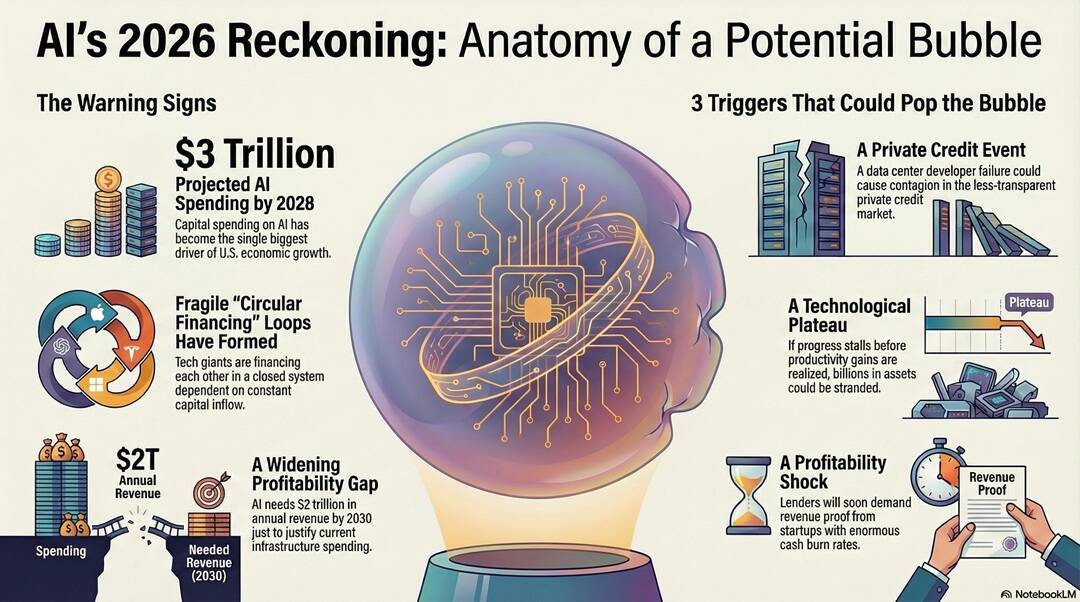
Three scenarios stand out.
- A credit event. Private-credit lenders have extended enormous sums to untested borrowers using unconventional collateral. If a major data-center developer fails, contagion could spread through a market with limited transparency and weak investor protections. When firms begin restricting redemptions to keep capital locked up, that’s rarely a good sign.
- A technological plateau. If AI progress stalls before hitting the productivity gains required to support these valuations — or if a cheaper model undercuts the leaders — the investment thesis breaks. Hardware build-outs can’t be unwound. Billions of dollars of stranded data-center assets would be left behind.
- A profitability shock. AI startups with enormous burn rates must refinance within the next few years. Lenders will demand revenue proof. If those numbers disappoint, the circular financing loops around Nvidia, OpenAI, and CoreWeave could unwind quickly. Even Sam Altman has said “someone is going to lose a phenomenal amount of money.”
The Bull Case: Not All Bubbles Burst the Same Way
There is a real optimistic argument.Jerome Powell points out that unlike past bubbles, AI firms are generating actual revenue and driving measurable economic output. Morgan Stanley notes that corporate cash flow is triple its 1999 level, giving firms more buffer.
Data-center demand is projected to grow more than 19% annually through 2030. Nvidia sees global capex rising from $600 billion to as much as $4 trillion. If demand keeps up, today’s spending rush won’t look reckless — it will look early.
The better comparison may be the telecom boom of the 1990s: the bust was brutal, but the infrastructure eventually justified the investment.
So, Is This a Bubble — and Does It Burst in 2026?
By classic metrics, yes — we’re in a bubble. Valuations have outrun cash flow, leverage is piling into speculative assets, and financing loops are supporting an ecosystem that depends on constant inflows.Whether it bursts in 2026 comes down to time. If companies can keep funding losses, and lenders keep extending credit, the sector can grow into its valuations. If not, the correction could begin next year.
The most likely scenario isn’t a sudden collapse. It’s a rolling reset similar to 2000–2002, where the weakest players fail first and drag parts of the system with them. Big Tech will survive. The casualties will be the unicorns, the developers relying on off-balance-sheet structures, and the investors who believed the hype without checking the math.
Ray Dalio said it clearly: the tech is real, but investors may be pricing the future far too early. Even Sam Altman says it’s a bubble while raising money at ever-higher valuations.
AI will transform the world. The real question for 2026 is whether the financial structure built around it can hold — or whether gravity steps in first.