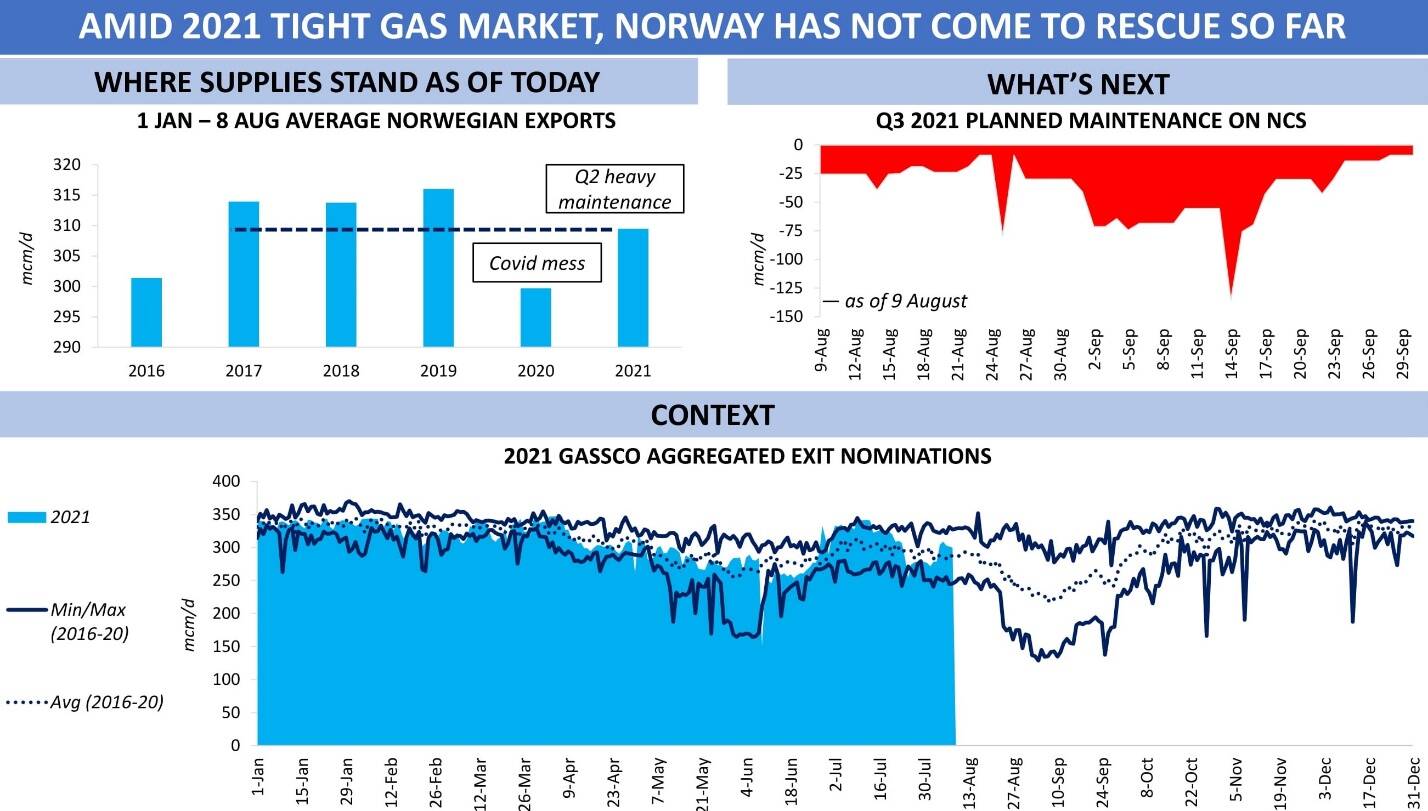
From cold waves extending well into May across NWE and CEE and much lower wind generation in Germany to stronger LNG demand among Asian buyers and reduced pipeline exports from Russia – all the key factors have come together. Norway, which might have provided a partial relief to gas supplies into the region, also has not made much progress in offering more volumes within the region this year.
On average, aggregated Norwegian gas flows recorded a slight decline between January and early August 2021 in comparison with the same period in previous years, excluding 2020. That said, gas prices were standing at exceptionally high levels throughout most of this year.
Norway has been unable to take advantage of favourable market conditions mainly because of the heavy maintenance carried out in Q2. As a result of forced adjustments to outage schedules for the country’s fields and terminals made last year due to the pandemic, 2021 planned works were particularly extensive.
However, even following the seasonal maintenance, flows had held steady at above 300 mcm/d only for a month before the unplanned outage at the Troll field started in late July, resulting in a 15pc drop in gas supplies from the NCS.
Troll outage was concluded on 5 August, and one would think that Norway is now given the ideal opportunity to maximise exports. Indeed, Norwegian flows have exceeded 300 mcm/d early this month, but there is some nuance to the situation (what a surprise in 2021). During the next two months, Norway’s potential for maintaining current production levels is likely to be limited as the second piece of yearly maintenance has just begun.
This time, much less Norwegian gas production will be affected by the planned outages than in the previous quarter. In the present circumstances, however, the loss of even 38 mcm/d between August and September can have a tangible impact on NWE market.
The opinions expressed in this blog are mine only and do not reflect the views of my employer