
Bitcoin (BTC) eyes the $100,000 psychological level as rebounding demand for spot ETFs sends BTC through $95,000.
The US BTC-spot ETF market has faced a challenging time since the Canary XRP ETF launched in November. However, demand rebounded in the reporting week ending January 16, tilting the supply-demand balance in BTC’s favor.
Crucially, markets shrugged off fading bets on a March or June Fed rate cut as US economic data continued to signal a robust economy. These dynamics support a bullish medium-term price outlook.
Below, I consider the key drivers behind recent price trends, the short-term outlook, the medium-term trajectory, and the key technical levels traders should watch.

US Spot-ETF Market Sees Inflow Surge, Lifting Sentiment
The US BTC-spot ETF market saw net inflows of $1.42 billion in the reporting week ending Friday, January 16, the largest since the week ending October 10. Crucially, this week’s inflows reversed $680.9 million in net outflows from the previous week and took flows in early 2026 into the black. Month-to-date net inflows in January stood at $1.21 billion.
According to Farside Investors, key flow trends for the reporting week ending January 16 included:
- iShares Bitcoin Trust (IBIT) had net inflows of $1.04 billion.
- Fidelity Wise Origin Bitcoin Fund (FBTC) reported net inflows of $194.4 million.
- In total, nine ETF issuers reported weekly net inflows.
- Meanwhile, Grayscale Bitcoin Trust (GBTC) saw net outflows of $1.6 million.
Demand for US BTC-spot ETFs remains crucial for the supply-demand balance trajectory. $1.6 billion of net inflows on January 13 and 14 sent BTC to a January 14 high of $97,900, its highest level since December 4. Meanwhile, net outflows of $394.7 million on January 16 left the bulls defending $95,000.
Despite the pullback to $95,000, BTC has risen 4.6% in the current week, underscoring the influence of spot ETF flows on price action.
US BTC-spot ETF market inflows support a cautiously bullish short-term and positive medium-term outlook.
Bitcoin Price Forecast
Every new Bitcoin analysis as it publishes, today's technical signal and key levels, live price — on one page.
See all Bitcoin forecasts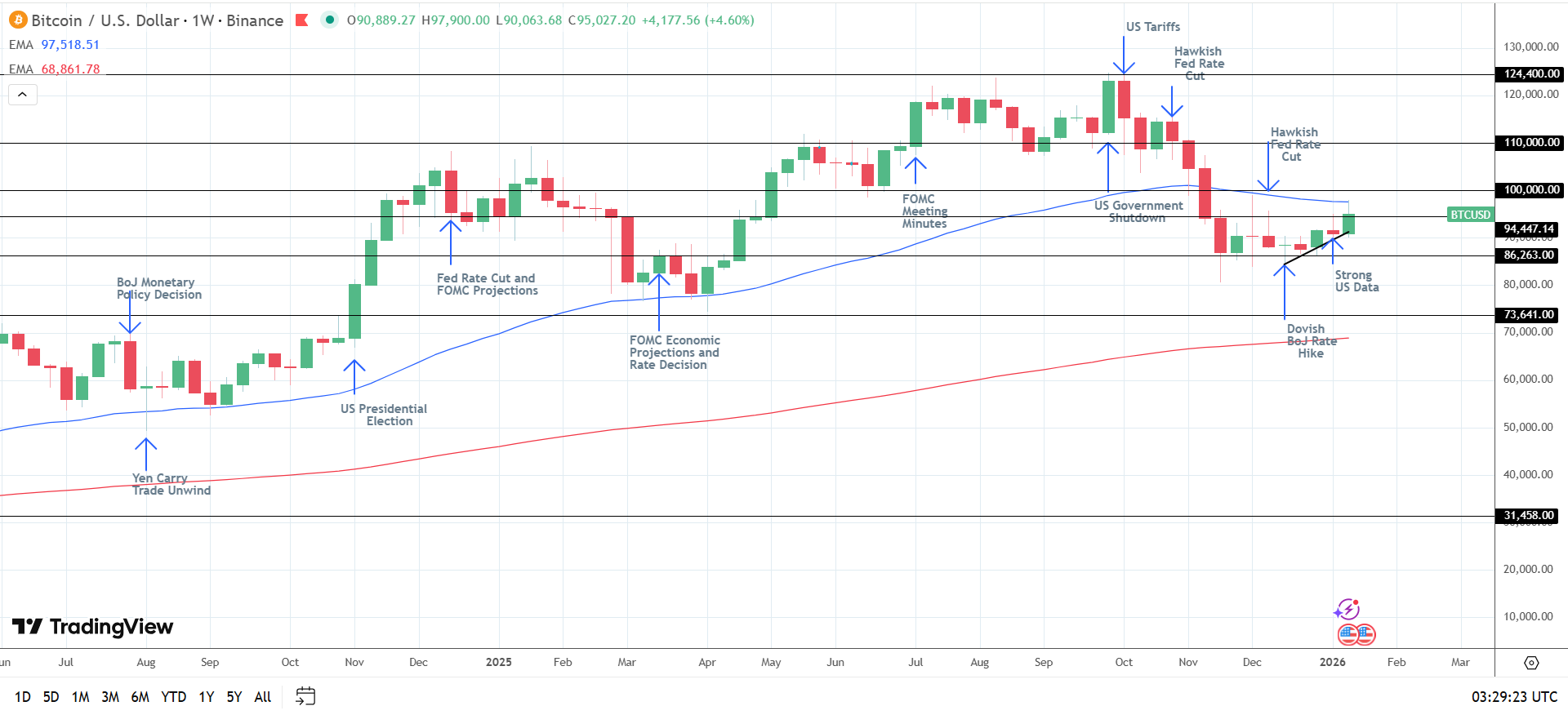
Open Interest Sets Up Bullish Outlook
Revived demand for BTC-spot ETFs coincided with surging open interest (OI), signaling a breakout. Market intelligence platform Santiment commented:
”Top cap open interest is rising as we head into the weekend on sideways price action. Currently, open interest data shows: Bitcoin: $36.5B (+20.8% YTD).”
Rising OI does not necessarily signal a price breakout. However, upward OI trends, combined with increasing prices suggest new money entering long positions, a bullish signal.
Commentary on social media has turned bearish, according to Santiment, aligning with the bullish OI-BTC price signals. Santiment stated:
“According to social data, the commentary toward Bitcoin across social media has interestingly turned more and more bearish as prices have bounced this week. With markets typically moving the opposite direction of retail sentiment, the most FUD seen in 10 days may propel BTC to its first revisit above $100K since November 13th.”
The Bitcoin Test: US Labor Market and Inflation in Focus
This week, US labor market and inflation data will influence the Fed’s rate path and demand for risk assets. Softer labor market conditions and cooling inflation would likely revive bets on a March Fed rate cut, boosting demand for BTC.
Crucially, inflation numbers are likely to be key, given December’s upbeat US jobs report. Economists expect the US Core PCE Price Index to rise 2.7% year-on-year in November, down from a 2.8% increase in September.
According to the CME FedWatch Tool, the chances of a March cut fell from 53.9% on December 17 to 21.1% on January 17. Meanwhile, the probability of a June cut dropped from 84.1% on December 17 to 60.7% on January 17.
Bitcoin Fear & Greed Index Indicates Improving Sentiment
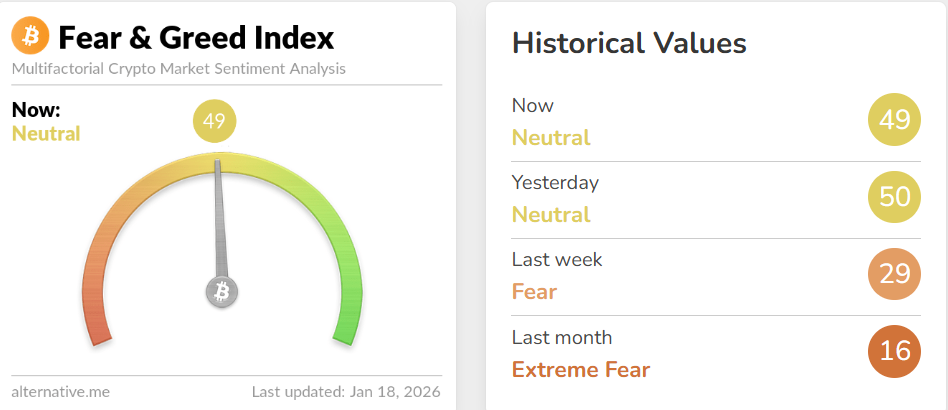
The rebound in demand for spot ETFs and Santiment’s price outlook aligned with the Bitcoin Fear & Greed Index’s recent trends. The Fear & Greed Index fell from 50 on January 17 to 49 on January 18, remaining in the Neutral zone. Despite the January 18 drop, the Index has climbed from 29 (Fear zone) over the week, indicating improved sentiment.
Downside Risks: Central Banks and ETF Flows
While fundamentals support a constructive bias, downside risks remain, including:
- The BoJ announces a hawkish neutral interest rate (potentially 1.5%-2%), signaling multiple rate hikes. Higher BoJ interest rates and Fed rate cuts would narrow rate differentials, triggering a yen carry trade unwind.
- US economic indicators and the Fed support a more hawkish rate path.
- BTC-spot ETFs face renewed outflows.
These events would likely send BTC toward $90,000, exposing the November 21 low of $80,523.
In summary, the short-term outlook remains cautiously bullish as fundamentals outweigh the technicals. The medium- to longer-term outlook is constructive.
Technical Analysis
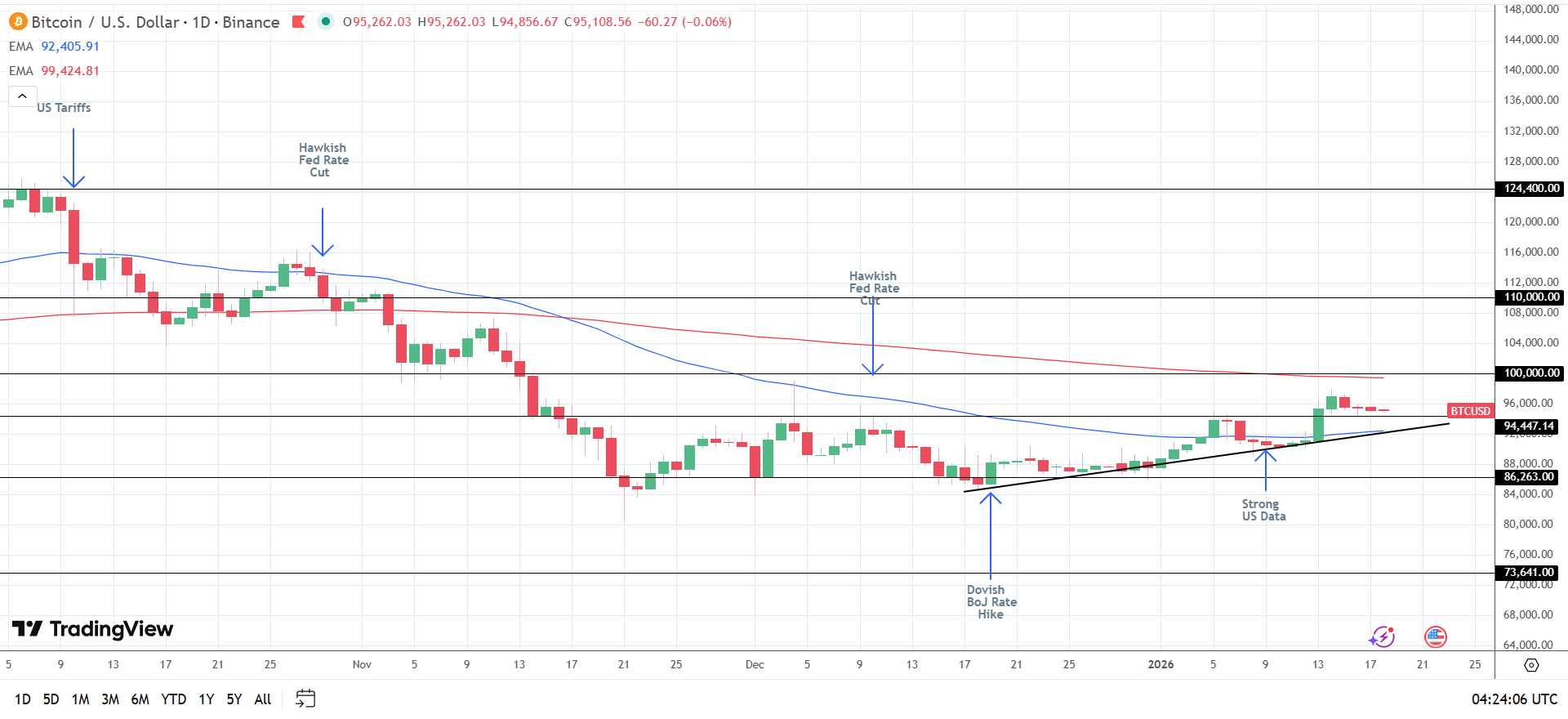
The weekly gains sent BTC above its 50-day Exponential Moving Average (EMA), while remaining below the 200-day EMA. The EMAs indicated a bullish near-term but bearish longer-term bias. Crucially, improving fundamentals aligned with near-term technicals, signaling a breakout.
A break above the 200-day EMA would bring the $100,000 resistance level into play. Importantly, a sustained move above the 200-day EMA would signal a near-term bullish trend reversal, opening the door to retesting the $110,000 level. Importantly, a sustained move through the 200-day EMA would reinforce the bullish short- to medium-term price outlook.
Bullish Structure Intact: What Happens if BTC Holds $92,500?
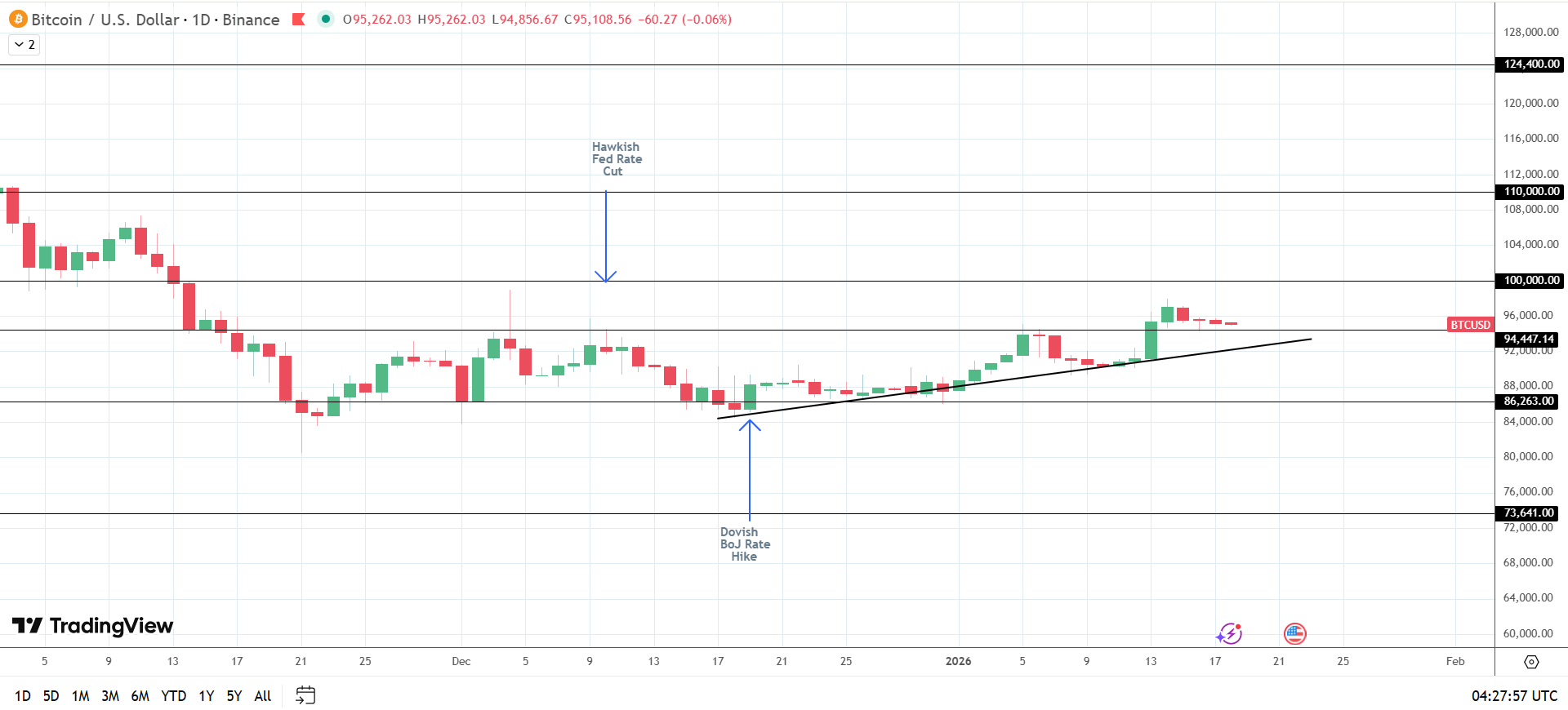
Avoiding a sustained fall below the trendline, currently around the $92,500 level, would support a move to $100,000. A breakout above $100,000 would validate the bullish structure, reaffirming the bullish short-term (1-4 weeks) target of $110,000 and the medium-term (4-8 weeks) target of $115,000.
However, a drop below the trendline would expose the November low of $80,523 and invalidate the bullish structure.
Track BTC market trends with our real-time data and insights here.
Outlook: $92,500 Support Key to Bullish Outlook
US economic indicators, the BoJ, and demand for US BTC-spot ETFs will dictate demand for BTC in the near term.
The US Personal Income and Outlays report (January 22) will be the key event of the coming week. Softer US inflation and rising bets on a March Fed rate cut would likely lift sentiment.
Considering the current market forces, the outlook remains constructive, with a 6-12 month price target of $150,000. The US Senate’s passing the Market Structure Bill would add to the bullish outlook.
Stay informed on BTC trends by monitoring macroeconomic developments, ETF flows, and technical indicators here.