
Japanese inflation figures eased fears of a yen carry trade unwind on Friday, December 26, sending Bitcoin (BTC) to a session high of $89,383. The inflation data cooled bets on aggressive Bank of Japan rate hikes. Japanese Government Bond (JGB) yields pulled back from 2.1%, its highest level since 1999.
Crucially, USD/JPY held above the 155 level, while the Nikkei 225 ended the week up 0.60%, keeping the yen carry trade alive despite 10-year JGB yields hovering above 2%.
Easing bets on aggressive BoJ rate hikes coincided with hopes for a March Fed rate cut, lifting sentiment.
However, the US BTC-spot ETF market outflows extended for a second consecutive week, leaving BTC in negative territory.
Despite extended US-BTC-spot ETF outflows, shifting sentiment toward BoJ and Fed rate paths supports a bullish outlook.
Below, I consider the key drivers behind recent price trends, the short-term outlook, the medium-term trajectory, and the key technical levels traders should watch.

Tokyo Inflation Cools BoJ Rate Hike Bets
Tokyo’s annual inflation rate fell from 2.7% in November to the BoJ’s 2.0% target in December. The so-called core-core inflation rate softened from 2.8% in November to 2.6% in December.
December’s inflation data cooled fears of a higher BoJ neutral interest rate, neither accommodative nor restrictive. A lower neutral rate would signal a wider-than-expected US-Japan rate differential upon reaching monetary policy normalization. Wider US-Japan rate differentials would continue to fuel yen carry trades into risk assets.
Bitcoin’s inverse correlation with 10-year JGBs has underscored crypto market sensitivity to the BoJ’s policy stance, as shown in the chart below.
Bitcoin Price Forecast
Every new Bitcoin analysis as it publishes, today's technical signal and key levels, live price — on one page.
See all Bitcoin forecasts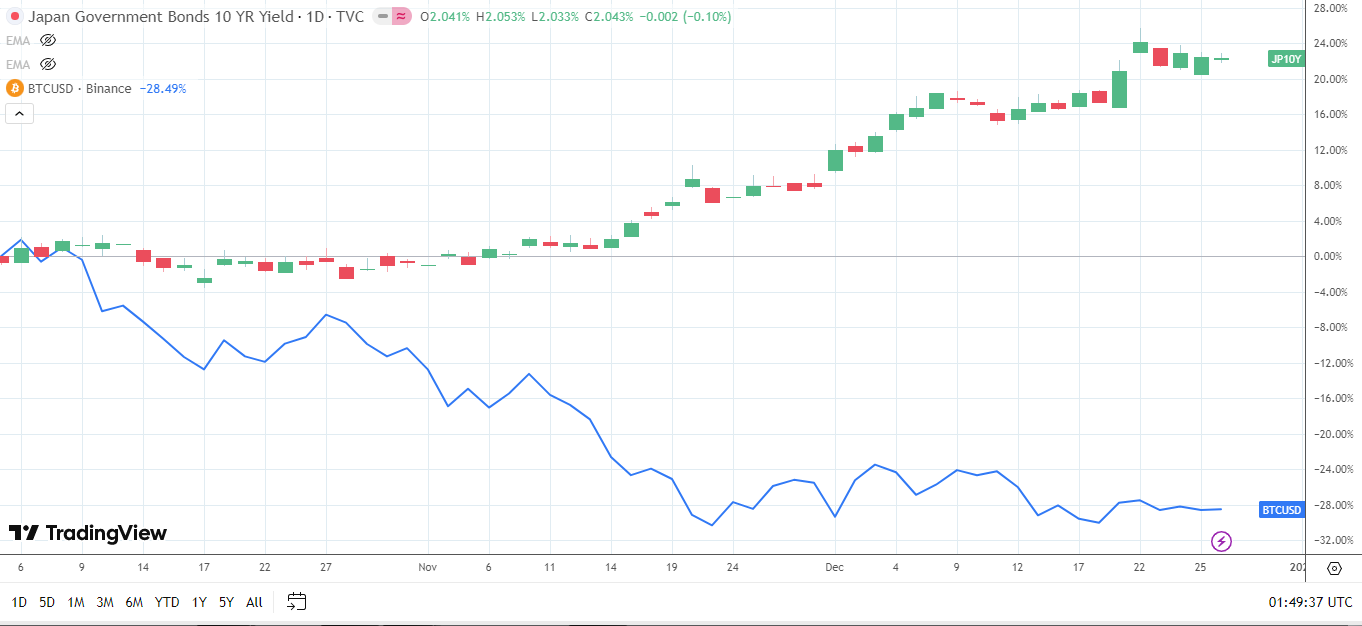
Economists Signal a High Inflation-Low Interest Rate Environment
The US economy soared 4.3% quarter-on-quarter in Q3, up from 3.8% in Q2, with PCE prices rising 2.8% QoQ, compared with a 2.1% increase in Q2.
A robust economy and indications of sticky inflation signaled a more hawkish Fed policy stance. However, a cooling labor market and expectations of an incoming Fed Chair, favoring lower interest rates, kept rate cut hopes alive. According to the CME FedWatch Tool, the probability of a March cut has increased from 46.5% on November 26 to 53.3% on December 26.
Economists have speculated that the Fed may lower rates and tolerate a higher inflation backdrop. Grayscale’s Head of Research, Zach Pandl, recently commented on unsustainable government deficits and debt and potential Fed action, stating:
“One path is fiscal belt tightening. We could raise everybody’s taxes and cut the entitlement spending to get this thing under control. I see no evidence that we’re going down that path. The other option is we could monkey around with somewhat low interest rates and tolerate a bit of inflation over time to try to manage the symptoms.”
Pandl sees the second path as the most likely, believing that artificially low interest rates and above target inflation would drive demand for alternative stores of value, such as BTC.
Fed rate cuts would narrow the US-Japan rate differential. However, a lower BoJ neutral rate would likely keep yen carry trades profitable enough to drive demand for risk assets.
President Trump’s push for a Fed Chair supportive of lower interest rates aligns with Pandl’s outlook.
US BTC-Spot ETFs Extend Outflow Streak
Easing fears of a yen carry trade unwind and hopes for Fed rate cuts bolstered demand for BTC. However, the US BTC-spot ETF market extended its outflow streak to two consecutive weeks in the reporting week ending December 26, leaving BTC below $90,000.
According to Farside Investors, the US BTC-spot ETF market saw $589.4 million in weekly net outflows, after outflows of $497.1 million the previous week.
Key flow trends for the week included:
- iShares Bitcoin Trust (IBIT) had net outflows of $242.7 million.
- Fidelity Wise Origin Bitcoin Fund (FBTC) reported net inflows of $110.7 million.
- In total, eight of the 11 ETF issuers reported weekly outflows, with the remainder seeing zero net flows for the week.
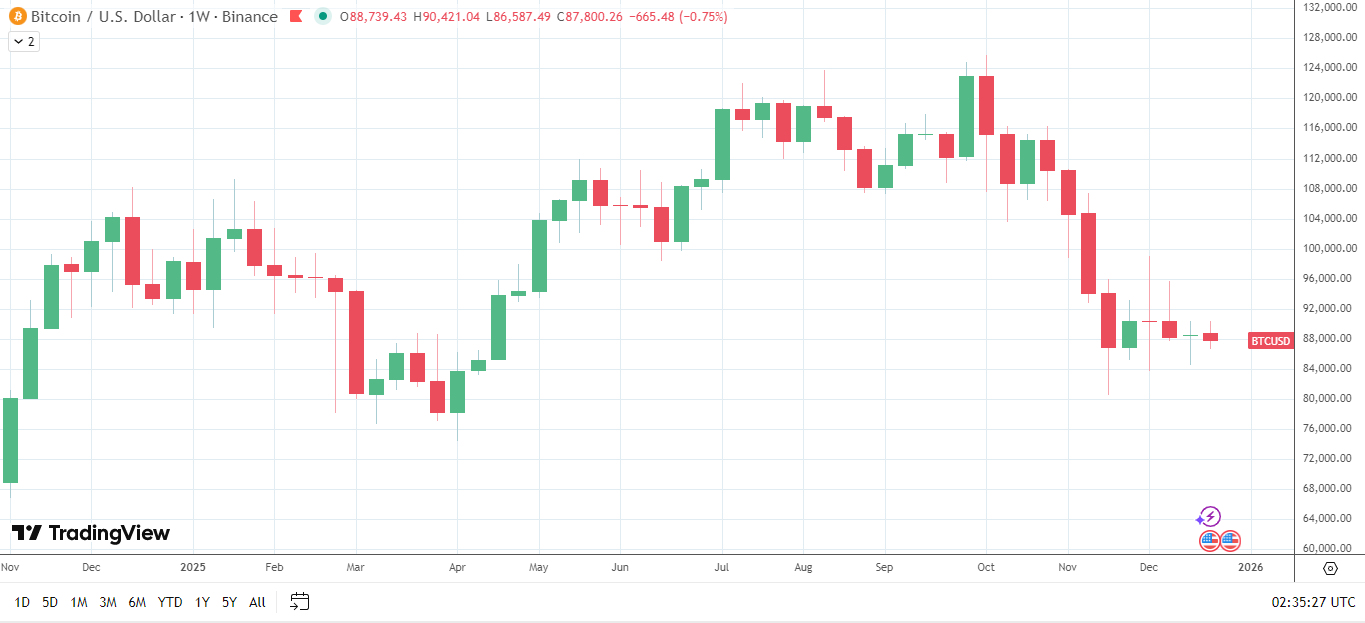
Demand for US BTC-spot ETFs remains crucial for the supply-demand balance. Outflows for the week left BTC down 0.75% for the current week despite three days of gains.
Bitcoin Fear & Greed Index Sends Oversold Signals
However, easing concerns over a yen carry trade unwind, a dovish Fed rate path, and progress toward crypto-friendly legislation would likely shift sentiment.
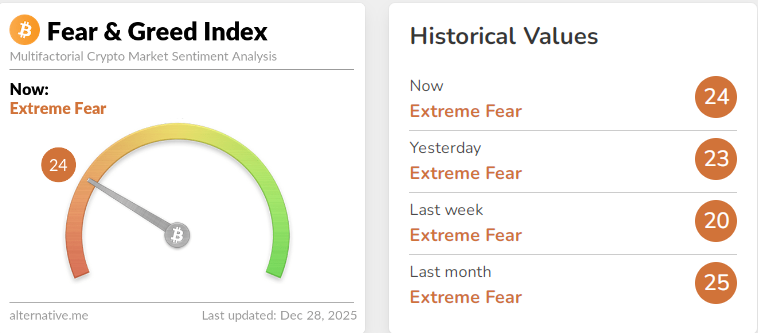
The Bitcoin Fear & Greed Index increased from 23 on December 27 to 24 on December 28. Despite edging higher, the Index remained within the Extreme Fear zone, indicating oversold conditions. The overbearish sentiment suggests a price recovery, aligning with the bullish short- to medium-term price outlook for BTC.
Downside Risks: Fed, BoJ, US Data, Regulatory News, and ETF Outflows
While analysts point to a price recovery, downside risks linger, including:
- The BoJ declares a high neutral interest rate of between 1.5% and 2%, triggering a yen carry trade unwind.
- The Fed downplays the chances of a March rate cut.
- BTC-spot ETFs face extended outflows.
These scenarios would likely push BTC toward the November 21 low of $80,523, exposing the April low of $74,394.
In summary, the short-term outlook remains cautiously bullish as fundamentals outweigh the technicals. The medium- to longer-term outlook is constructive.
Technical Analysis
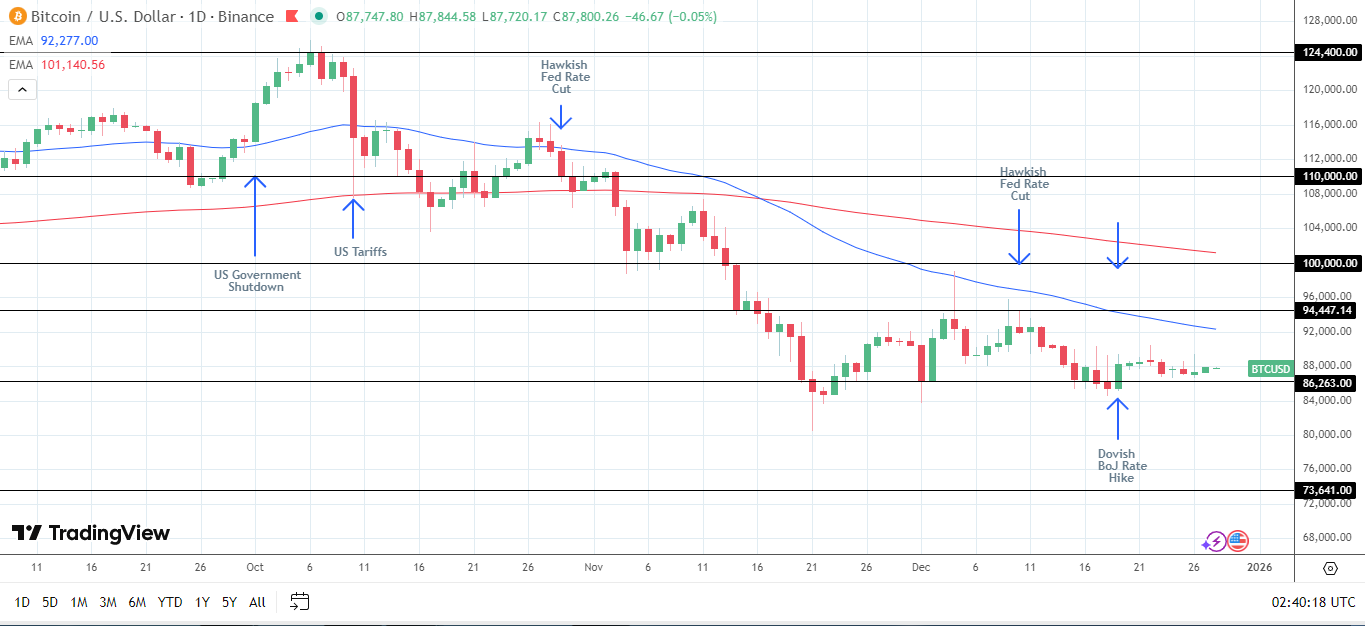
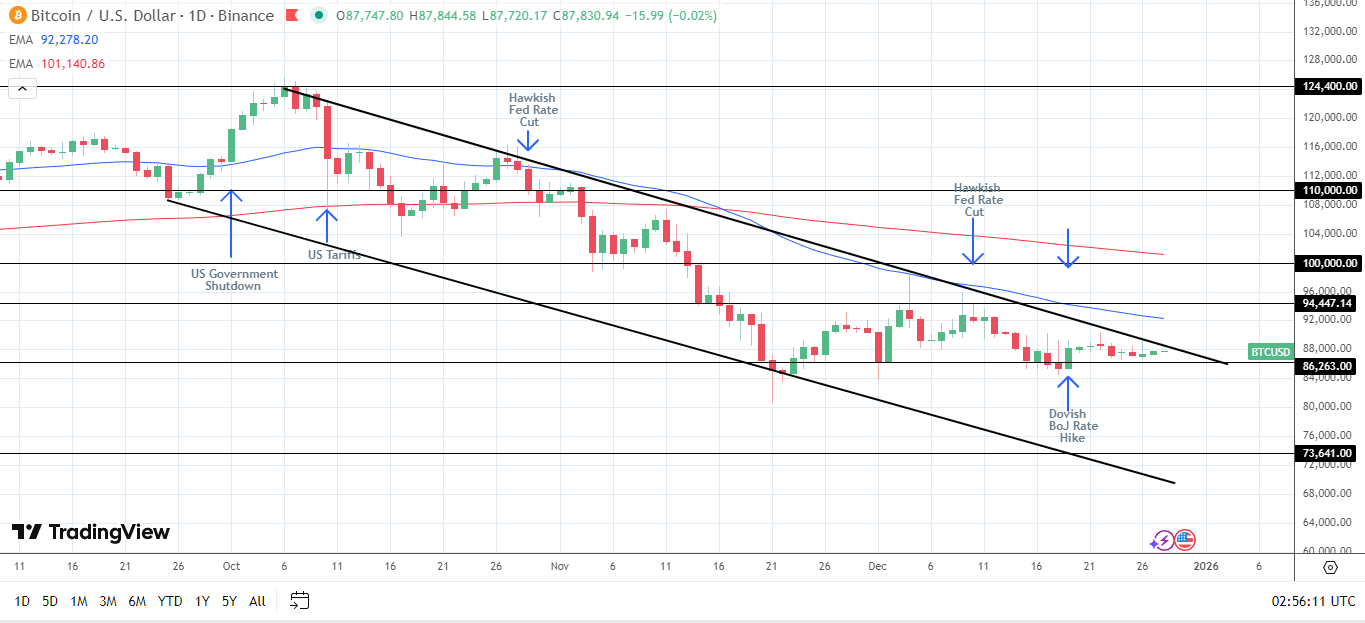
The weekly pullback left BTC trading below its 50-day and 200-day Exponential Moving Averages (EMAs), indicating a bearish bias. However, fundamentals are beginning to counter the technical indicators, pointing to an upswing.
A break above the 50-day EMA would pave the way to the $94,447 resistance level. Crucially, a sustained move above the 50-day EMA would signal a near-term bullish trend reversal, bringing the $100,000 psychological resistance level and the 200-day EMA into play. Significantly, a break above the EMAs would affirm the bullish short- to medium-term price outlook.
Bearish Structure Invalidation: What Happens if BTC Holds $80,000?
Avoiding a drop below the $80,000 level would bring support for a move to the upper trendline. A sustained break above the upper trend line would invalidate the bearish structure, reinforcing the bullish short-term (1-4 weeks) target of $95,000 and the medium-term (4-8 weeks) target of $100,000.
However, a break below the November low of $80,523 on November 21 would affirm the bearish structure, derailing the bullish price outlook.
Track BTC market trends with our real-time data and insights here.
Outlook: $80,000 Support Key to Bullish Outlook
Macroeconomic data, the Fed, the BoJ, and demand for US BTC-spot ETF will influence sentiment in the shortened week ahead.
The BoJ’s Summary of Opinions (December 29) and the FOMC Meeting Minutes (December 31) will be the events of the week. Dovish policy stances would likely lift sentiment.
Considering the current market dynamics, the outlook remains constructive, with a 6-12 month price target of $150,000. The US Senate’s passing the Market Structure Bill would add to the bullish outlook.
Stay informed on BTC trends by monitoring macroeconomic developments, ETF flows, and technical indicators here.