
Bitcoin (BTC) has retreated by 2.4% in the past 7 days after once again rejecting a move above $90,000 as investors continue to withdraw substantial sums for exchange-traded funds (ETFs).
According to data from Farside Investors, net outflows for BTC ETFs totaled $1.1 billion in the past 6 days, reflecting the market’s persistent bearish attitude toward cryptocurrencies.
These funds have experienced a strong wave of withdrawals in 8 of the past 9 working days. The largest single-day outflow during this period occurred on December 15, when investors took out $358 million.

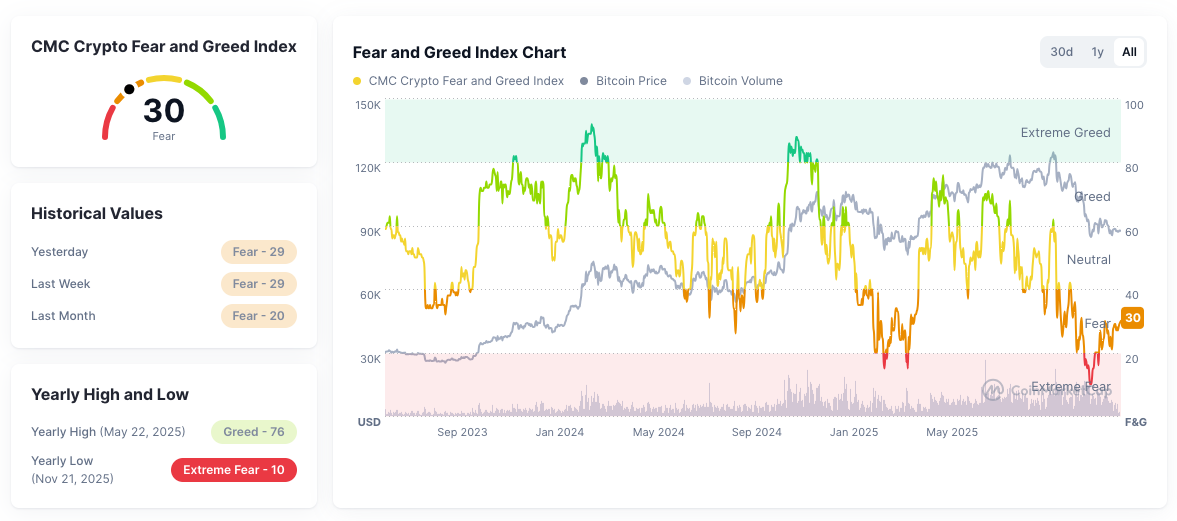
Crypto’s Fear and Greed Index – Source: CoinMarketCap
This means that, although investors are still in Fear mode, they are starting to lean toward a neutral attitude.
As a result of the latest downtrend, Bitcoin has once again swung to positive territory in terms of its year-to-date (YTD) performance and seems poised to finish the year with losses unless the price climbs above $90,000.
Open interest in BTC futures has been recovering lately, but it is still at a fair distance from the highs since early October, before the flash crash.
This indicates low trader participation, and could also mean that bears are positioning for the continuation of the current downtrend.
Data from CoinGlass shows that the top crypto’s long-short ratio across Binance accounts with exposure to BTCUSDT currently stands at 2.
This is a much lower ratio compared to the levels seen back when the token hit new all-time highs. Back then, this ratio sat at 4x and even 5x at some point back in September-October.
Bitcoin Price Forecast
Every new Bitcoin analysis as it publishes, today's technical signal and key levels, live price — on one page.
See all Bitcoin forecasts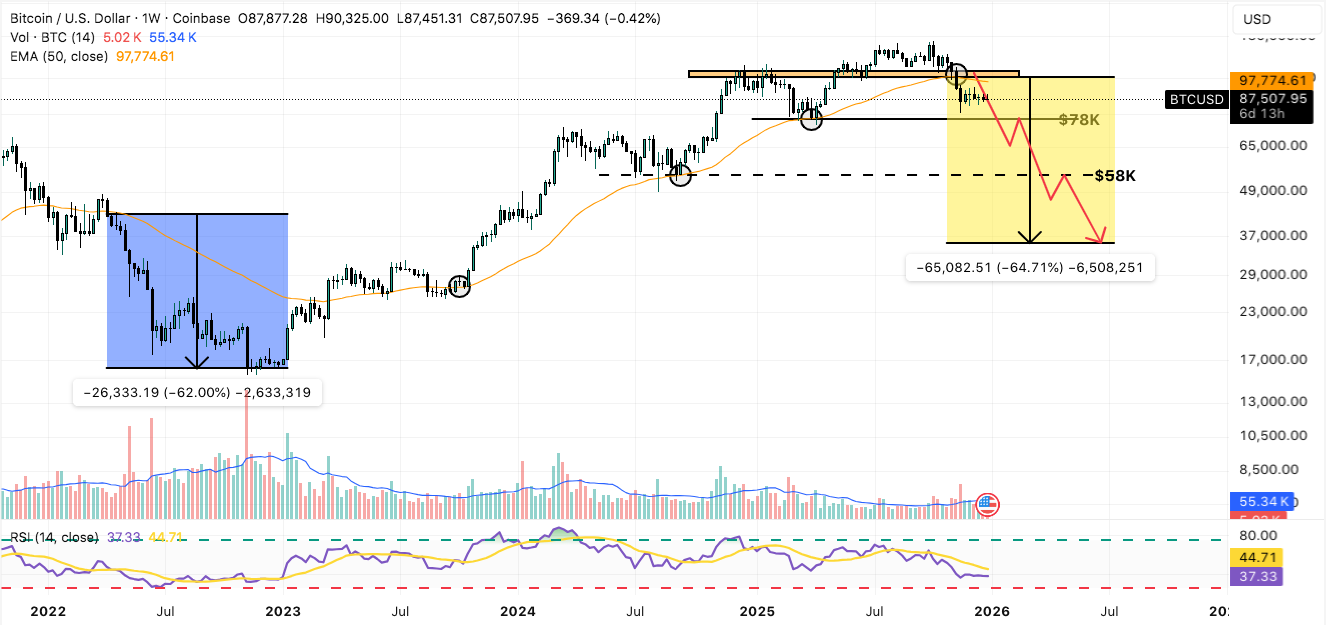
BTC/USD Weekly Chart (Coinbase) – Source: TradingView
BTC had respected this key line multiple times in the past few months until it finally succumbed on November 10 as the price dropped below $100,000.
The last time this breakout happened, it resulted in a 62% loss for the top crypto in a period of around 9 months.
If this historical pattern unfolds similarly and BTC drops by a similar magnitude, the worst-case scenario of this bearish cycle sees the token hitting $36,000 by August 2026.
A break below $78,000 would confirm this prediction as the price would form a bearish structure. The next stop in that case, after a necessary retest from below, would be $58,000.
For now, the price can still retest the $100,000 area. A rejection of a move above this mark would also provide confirmation that this bearish scenario is unfolding as expected.
Meanwhile, looking at the 4-hour chart, Bitcoin seems to have been in consolidation since late November, trading within a relatively predictable range of $84,000 and $94,000. This could be an indication that investors are accumulating the token ahead of its next big move.
This makes the $84,000 area the key support to watch in the next few days. A break below could set in motion a move toward $78,000 based on the path we set forth in a higher time frame, meaning a total downside risk of 8%.