
The Fed cut interest rates by 25 basis points on Wednesday, December 10, but signaled a less dovish 2026 rate path, briefly sending USD/CNY higher. However, Yuan strength prevailed. USD/CNY fell to its lowest level since October 2024 in early trading on Thursday, December 11.
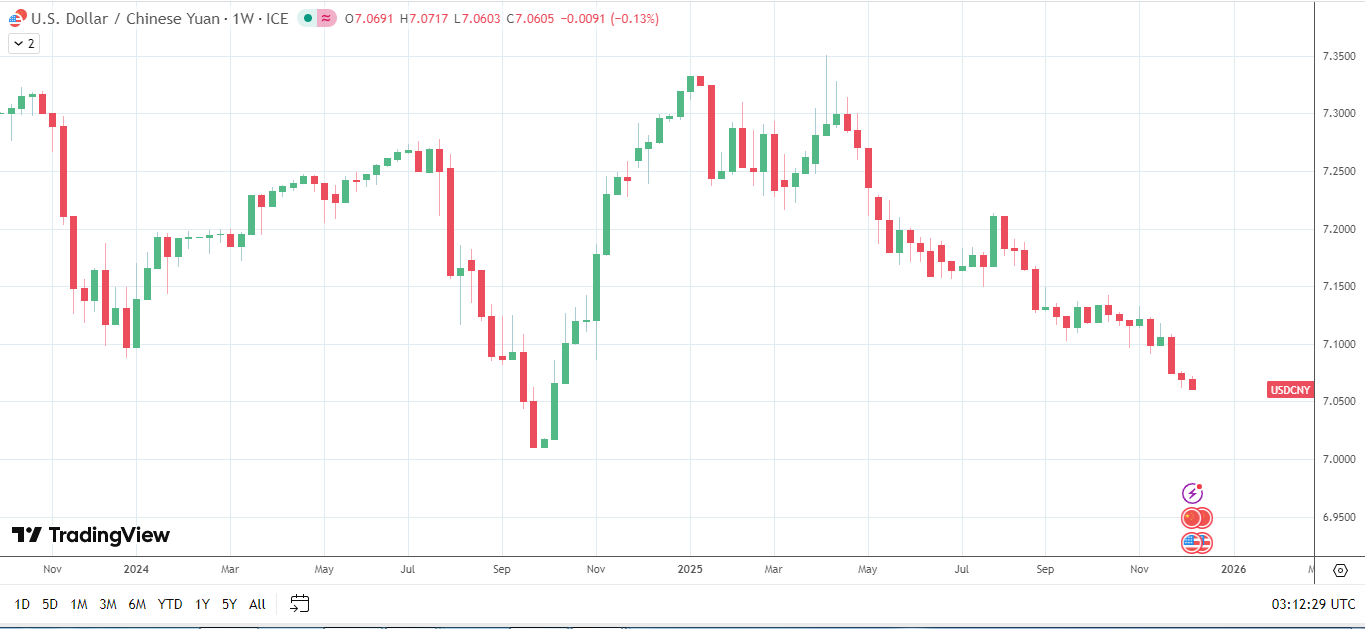
Easing US-China trade tensions, China’s economic resilience, and Beijing’s pledges for further stimulus support have boosted demand for the Yuan. A stronger Yuan would help maintain stable US-China trade relations and support broader economic conditions. Notably, the CSI 300 is eyeing a three-day winning streak on Thursday, December 11. The 2025 high of 4,762 is in reach, setting the stage for a bullish end to the year.
Below, I will explore the key drivers behind recent gains, the medium-term (3-6 months) outlook, and the key technical levels traders should watch.

Chinese Trade Surplus Breaks $1 Billion
US trade tariffs on Chinese shipments and efforts to cut reliance on China have yet to gain traction. China’s trade surplus rose above a whopping $1 trillion year-to-date in November. Furthermore, manufacturing sector output increased 7% in the first ten months of 2025 compared to the same period in 2024.
Exports rebounded in November, up 5.9% year-on-year (YoY) after falling 1.1% in October, while imports increased 1.9% YoY (October: +1% YoY).
The International Monetary Fund (IMF) reacted to China’s economic resilience and Beijing’s pledges to bolster domestic consumption and stabilize the labor market. On Wednesday, December 10, the IMF raised its 2025 GDP growth forecast for China from 4.8% to 5.0%, matching Beijing’s GDP growth target. Furthermore, the IMF forecast economic growth of 4.5% in 2026, up from 4.2%.
The IMF attributed the revisions to lower-than-expected tariffs on Chinese goods and macroeconomic stimulus.
However, the IMF also called on Beijing to transition away from an overreliance on exports and investments with greater urgency, and to prioritize a shift to a consumption-led economy. The IMF warned of imbalances in China’s economy and called for the swift rollout of measures to reduce household savings.
Hong Kong Hang Seng Price Forecast
Every new Hong Kong Hang Seng analysis as it publishes, today's technical signal and key levels, live price — on one page.
See all Hong Kong Hang Seng forecastsDomestic Weakness Clouds Consumption Outlook
Beijing’s efforts to boost domestic demand and accelerate a transition to a consumption-driven economy encountered setbacks in 2025. US tariffs and waning external demand forced firms to cut prices, squeezing margins. Margin concerns led firms to lower wages and cut jobs, weighing on consumer sentiment and spending.
The ongoing housing crisis has added to the weakening consumer sentiment, another key focal point for Chinese lawmakers as the year draws to a close.
Retail sales increased 2.9% YoY in October, down modestly from a 3.1% rise in September, but falling sharply from a 6.4% surge in May.
An increased focus on boosting domestic demand could become more crucial given recent trade developments, which may challenge the IMF’s 2026 GDP growth forecast. However, new risks emerged after the IMF projections.
Mexico and EU Tariff Threats Add New Trade Risks
On Wednesday, December 10, Mexico’s Senate approved a bill to introduce 5% to 50% tariffs on Asian countries without a trade agreement. The CN Wire reported on the Senate vote, stating:
“The levies, taking effect next year, target goods ranging from clothing to metals and auto parts, with Chinese output a key focus. Lawmakers also empowered the Economy Ministry to adjust import tariffs as needed, a tool that could support Mexico ahead of next year’s USMCA review with the US and Canada.”
Mexico has been a key trade hub for Chinese auto parts and car manufacturers looking to circumvent US tariffs. This week’s vote highlighted the Mexican government’s concerns about a retaliatory response from the US administration against economies enabling Beijing’s efforts to dodge tariffs.
Meanwhile, the EU could become another headache for Chinese exporters. Chinese automakers reportedly sold more vehicles in Western Europe than South Korean for the first time in September.
Chinese automakers have been significantly undercutting the competition. Measures have included rapid innovation, price wars, and control over battery supply chains, offering EU buyers a much cheaper alternative. EU companies have complained about China’s rising dominance, reportedly complaining about an undervalued Renminbi supporting Chinese exporters.
This week, French President Macron threatened tariffs on Chinese shipments. Macron accused Beijing of targeting the heart of Europe’s innovation and industrial model. Chinese rare earth mineral exports will likely be a talking point, given the EU’s heavy on supply from China.
Tariff threats are likely to test risk sentiment. However, Beijing’s successful navigation of US tariffs and stimulus plans support a bullish short- to medium-term outlook for Mainland China’s indices.
Medium-Term Outlook: Bullish as Year-End Rally Builds
The IMF’s revision to GDP growth forecasts, rebound in external demand, and Beijing’s pledges lifted sentiment.
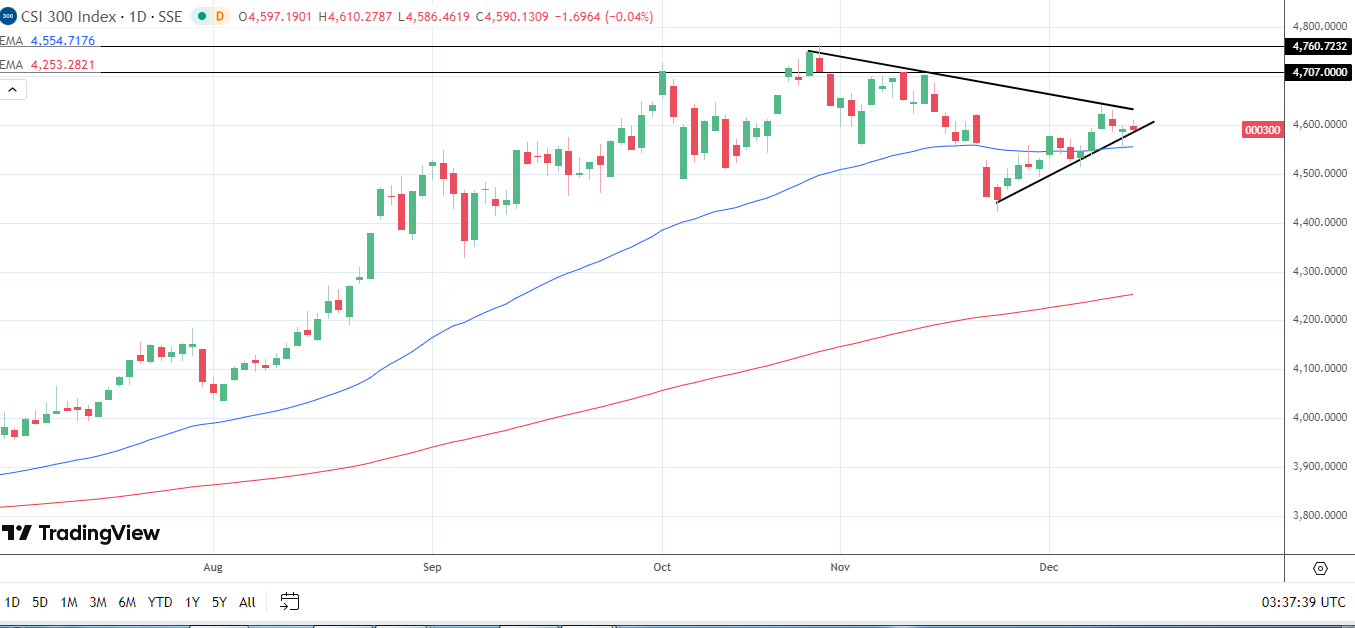
Given these dynamics and cooling US-China trade tensions, the short- to medium-term outlook remains bullish for the CSI 300. The CSI 300 has gained 1.4% in December and 16.65% year-to-date in 2025.
Technical Signals Favor Higher CSI 300 Levels
Bullish fundamentals align with technical indicators for the CSI 300. The CSI 300 continues to trade above its 50-day and 200-day EMAs, indicating a bullish bias. A breakout above the November 11 high of 4,707 would pave the way to the October 30 high of 4,762.
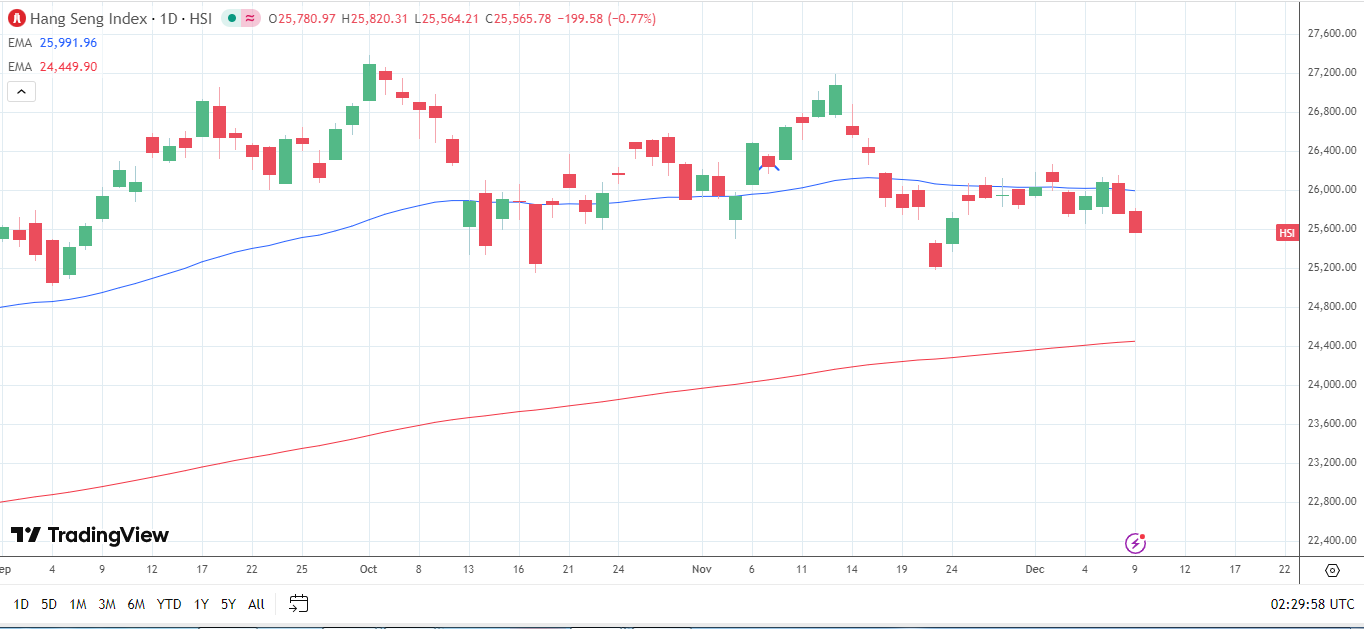
Meanwhile, the Hang Seng Index has come under selling pressure in recent sessions. The Hang Seng Index remained below its 50-day EMA, signaling a bearish near-term, but bullish medium- to longer-term bias. However, a break above the 50-day EMA and 26,000 would bring the October high of 27,382 into play.
Key Downside Risks to Monitor
Despite improving sentiment toward the Chinese economy, several events could derail the bullish outlook, including:
- Beijing delays the rollout of fresh stimulus and monetary policy support.
- Rising US-China trade tensions.
- Weakening demand, intensifying margin squeezes, and higher unemployment.
- China Vanke debt crisis spreads.
Considering these downside risks, the medium-term bullish structure would be invalidated if the CSI 300 and the Hang Seng Index fell below their June closing prices of 3,936 and 24,072.
Conclusion: Bullish Heading into 2026
In summary, the short-term outlook remains cautiously bullish, while the medium-term outlook remains constructive.
Policy support from Beijing, improving US-China trade relations, and easing EU-China trade tensions will continue to lift sentiment.
Nevertheless, Beijing will need to roll out fresh stimulus and monetary policy measures to target weak domestic demand, the housing market crisis, and a teetering labor market. Effective measures would likely send the CSI 300 and the Hang Seng Index toward their all-time highs of 5,931 (2021) and 33,484 (2018), respectively.
Discover strategies to navigate this week’s market trends here.