
Geopolitical tensions intensify as the US sends China-bound Venezuelan crude to America.
US President Trump declared that Venezuela will hand over sanctioned oil to the US on Wednesday, January 7, raising concerns about U.S.-China relations. Deteriorating relations may reignite the US-China trade war, weighing on sentiment.
Mainland China’s CSI 300 and the Hang Seng Index declined on January 7 and extended their losses in early trading on Thursday, January 8.
Despite this week’s pullback, hopes for further stimulus from Beijing continue to support a positive medium-term outlook for Mainland China indices.
Below, I will explore the key drivers behind recent gains, the medium-term (3-6 months) market outlook, and the key technical levels traders should watch.

US Control of Venezuelan Crude Oil Spotlights Trump-Xi Relations
This week, President Trump announced the seizure of sanctioned Venezuelan crude, sparking concerns over a potential spat with China.
The US President posted on X (formerly Twitter):
“I am pleased to announce that the Interim Authorities in Venezuela will be turning over between 30 and 50 MILLION Barrels of High Quality, Sanctioned Oil, to the United States of America. This Oil will be sold at its Market Price, and the money will be controlled by me, as President of the United States of America, to ensure it is used to benefit the people of Venezuela and the United States. […] It will be taken by storage ships, and brought directly to unloading docks in the United States.”
Political commentator Mario Nawfal, with 2.7 million followers on X, commented on the US announcement and on China’s dismay, stating:
“After Trump announced the U.S. will refine and sell up to 50 million barrels of Venezuelan oil previously frozen under sanctions, Beijing fired back, calling the move a blatant power grab and a direct hit on their interests. Why? Because that oil wasn’t just sitting there, China had already paid for a big chunk of it, through loan-for-oil deals and state-backed agreements with Maduro’s regime.”
Nawfal underscored the escalation in US-China tensions, adding:
“This is also about who gets to call the shots in Venezuela post-Maduro, and right now, Beijing just got boxed out while Washington takes over the chessboard. It’s a high-stakes geopolitical standoff over energy, influence, and who controls Latin America’s future. China just lost billions in oil access, but the U.S. just cashed in.”
Notably, President Trump previously stated that he has a good relationship with Chinese President Xi Jinping and that China wouldn’t have a problem with the US operation.
Hong Kong Hang Seng Price Forecast
Every new Hong Kong Hang Seng analysis as it publishes, today's technical signal and key levels, live price — on one page.
See all Hong Kong Hang Seng forecastsUS Pharma Exposed to Rising Geopolitical Risks
Trump’s declaration and China’s dissatisfaction about seizing sanctioned Venezuelan oil may expose cracks in the US-China trade war truce.
On Wednesday, January 7, the US-China Commission warned about China’s position in the pharma sector and potential ramifications to the US, stating:
“China is dominant in the global drug industry. If its influence goes unchecked, the US could face drastic consequences for the American healthcare system.”
Notably, the US-China Commission was silent on the developments in Venezuela, Trump’s announcement, and China’s reaction. The Commission did, however, warn that China is bypassing US export controls and sanctions and making strong strides in the tech space, stating:
“China is systematically circumventing US export controls and sanctions—exploiting a fragmented U.S approach while racing ahead in critical technologies.”
The US-China Commission is a bipartisan Commission created by Congress to monitor and report on trade, economic, defense, and foreign affairs issues in the US-China relationship.
China Exports Robust Despite US Tariffs and Increasing Global Tariff Threats
The US-China Commission’s comments coincided with trade data from China, which signaled robust economic momentum at the year’s end.
US imports from Southeast Asia soared 25% year-on-year in the third quarter of 2025, with Vietnam leading the surge. Meanwhile, direct US imports from China tumbled by around 40% year-on-year. The Kobeissi Letter commented on the third-quarter numbers and Southeast Asia’s competitive advantage, stating:
“This comes as the region has a massive cost advantage over US and European manufacturing, which ranges from 20% to 100%, even after tariffs. Companies use Southeast Asian economies as alternative export bases to avoid China’s 37% reciprocal tariff. As a result, the amount of trade rerouting from China hit a record $23.7 billion in September.”
Notably, trade data for November 2025 signaled a sharp increase in external demand for Chinese goods. Exports increased 5.9% year-on-year, after falling 1.1% in October.
Resilient external demand for Chinese goods and Beijing’s monetary and fiscal policy support reaffirm a bullish medium-term outlook for Mainland China indices. Over the short term, however, trade developments will be key for market trends. The CSI 300’s pullback from its highest level since 2021 has been modest, suggesting investors are confident President Trump and Chinese President Xi Jinping will be able to navigate the choppy waters.
However, monetary and fiscal policy support will be key in the near term, given increased geopolitical risks. Considering the current market dynamics, fundamentals and technicals remain aligned, reinforcing the positive outlook.
Key Downside Risks to the Bullish Outlook
However, downside risks linger, potentially derailing the positive outlook. These include:
- Deteriorating US-China relations and a breach in the trade war truce.
- Increased global tariffs on Chinese goods.
- Beijing postpones rate cuts and fresh fiscal stimulus.
- Weakening demand for Chinese goods and services would squeeze margins, affecting wage growth and the labor market.
- Chinese housing market crisis escalates.
Despite these downside risks, China’s advancements in the AI space and growing self-reliance on chip manufacturing support the constructive short- to medium-term bias for Mainland China Indices.
Furthermore, markets remain hopeful that Beijing can boost domestic demand through subsidies and lower borrowing costs, while tackling deflation.
Medium-Term Outlook: Bullish, Dependent on Beijing
Recent economic data has improved sentiment toward China’s GDP growth outlook for 2026. Fresh stimulus and increased external demand overshadow waning domestic consumption. Further policy measures, targeting the labor market, the housing sector, and domestic consumption, would boost economic growth in 2026.
Given the current market dynamics and Beijing’s continued policy signals, the outlook for Mainland China’s indices remains bullish.
CSI 300 Technical Outlook: Resistance Levels in Focus
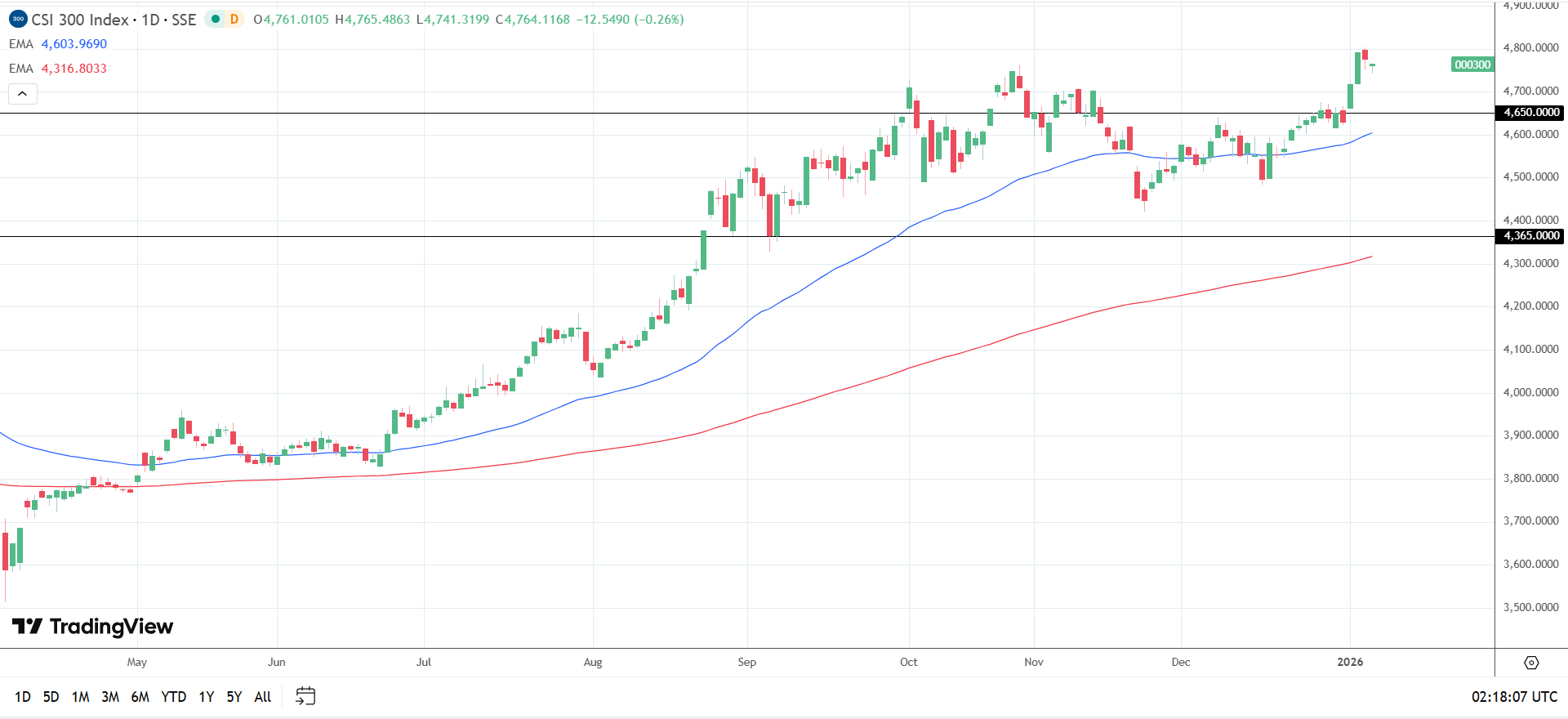
Fundamentals remain aligned with technicals in early trading on Thursday, January 8. Viewing the daily chart, the CSI 300 remains above its 50-day and 200-day EMAs, indicating a bullish bias.
A breakout above the January 7 high of 4,803 would pave the way to 5,000. A sustained move through 5,000 would bring 2021’s all-time high of 5,931 into play. Holding above the 50-day EMA would be key.
Hang Seng Index Forecast: Longer-Term Bullish Bias Intact
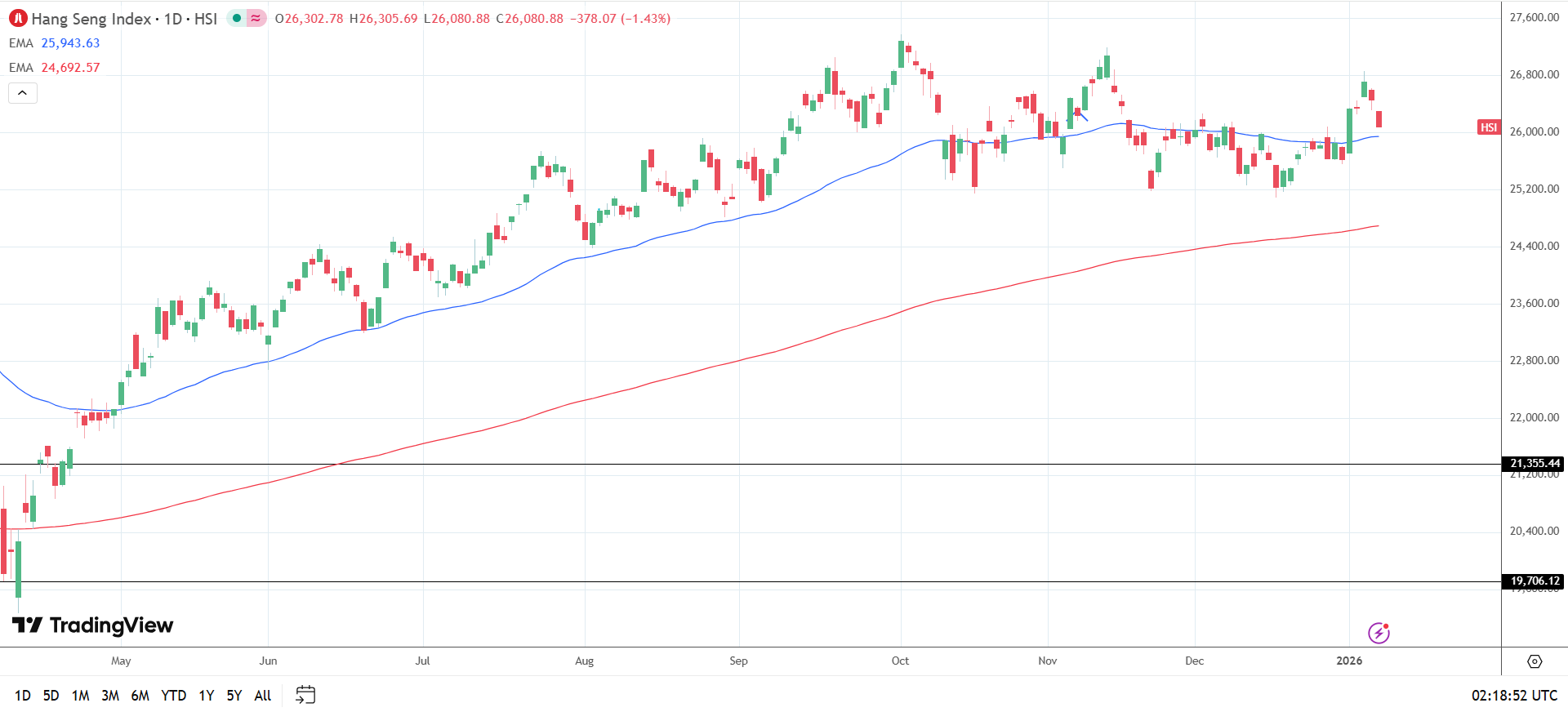
The Hang Seng Index’s trajectory aligns with the CSI 300’s, with the index holding above the 50-day and 200-day EMAs. The EMAs indicate bullish momentum, complementing positive fundamentals.
A breakout above October’s 2025 high of 27,382 would bring 28,000 into play. A sustained move through 28,000 would enable the bulls to target 30,000 for the first time since 2021.
Conclusion: Can Stimulus Offset Geopolitical Risks
To summarize, the short- and medium-term outlook remains bullish. China’s growing presence in the AI space, the US-China trade war truce, and Beijing’s monetary and fiscal policy support will likely lift buyer demand for Mainland China and Hong Kong-listed stocks.
However, bolstering the housing sector, developments in global trade relations, and deflation remain key for consumers and domestic consumption. Effective policy measures would likely send the CSI 300 to its 2021 all-time high of 5,931.
Discover strategies to navigate this week’s market trends here.
Hang Seng Index, China’s Trade-in-Policy, Trump, US Tariffs, CSI 300 Index, SSE Composite Index, China tariffs, Chinese President Xi Jinping, US President Trump, Indices, US-China Trade War, US-China Tariffs, China exports, President Trump, President Xi, Trade agreement, Trade deal, Trump-Xi Call, Venezuela, crude oil