


WTI Crude Oil
WTI faces an important information test during the trading session on Wednesday, as the EIA’s weekly petroleum release, scheduled for 10:30 a.m. Eastern, will give us a look at the state of crude oil in the United States.
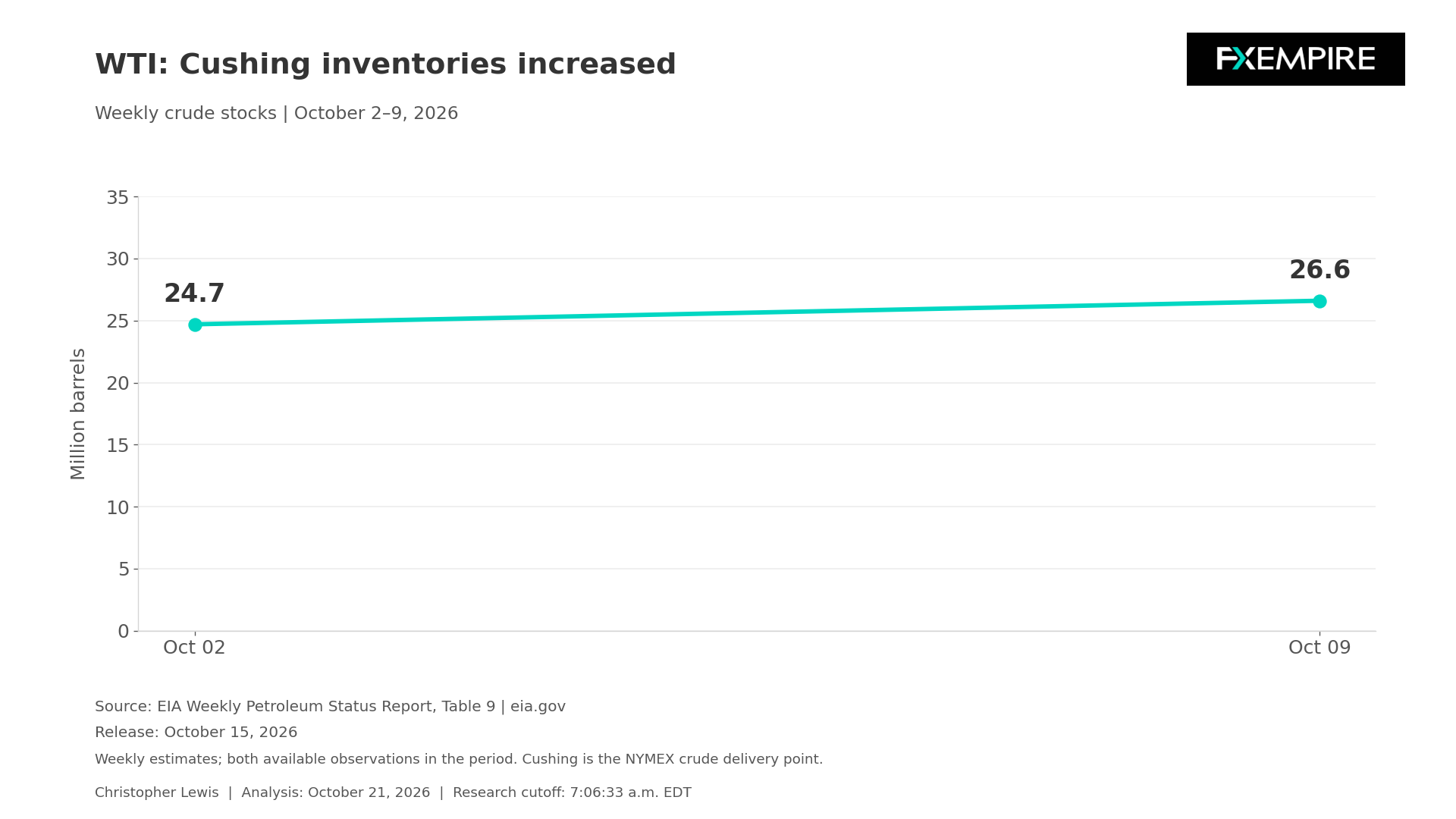
The latest official tables still cover October 9 and were released October 15 under the holiday-adjusted schedule. The most useful warning is that a national crude draw can coexist with a build at Cushing, a delivery point directly relevant to WTI. Commercial crude inventories, excluding the Strategic Petroleum Reserve, fell 8.6 million barrels to 415.6 million. Cushing, Oklahoma, moved the other way. Stocks increased to 26.6 million barrels from 24.7 million. The EIA identifies Cushing as the designated delivery point for all NYMEX crude futures. That divergence means that the large national draw cannot automatically be described as tighter availability.
Underlying Flows
The underlying flows also matter. Estimated domestic production declined to 13.679 million barrels per day, with crude oil imports falling to 6.049 million. Refinery inputs increased to 16.615 million barrels per day. Gasoline stocks built by a total of 3.5 million barrels, whereas distillates declined by 2.5 million. Together, these are mixed supply and product-balance signals.
DOE Release
Reserve policy adds a separate timing issue. On October 10, the DOE authorized an emergency exchange of up to 4 million barrels for hurricane-related supply disruption, with borrowed crude and premium barrels to be returned next year. This authorization came after the reporting week in the latest inventory table.
My interpretation is that today’s report needs to answer where tightening is occurring and whether reduced incoming supply persists. Another national draw accompanied by further Cushing accumulation would tell a different story from a broad decline across storage locations.
Buyers Get Pushed Back
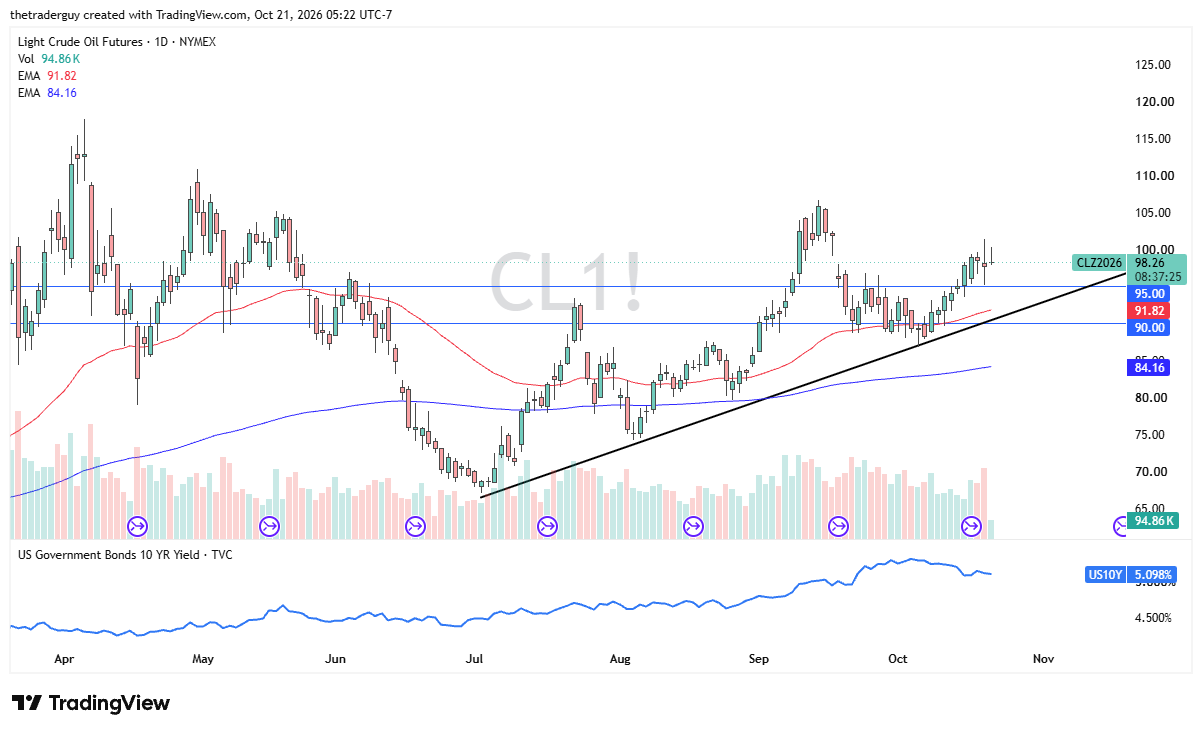
Early during the trading session here on Wednesday, we have seen sellers turn things around at the $100 level. The $95 level is an area that could end up being a certain amount of support based on market memory. That being said, the storage report and inventory report, of course, will move the needle as usual. It’s worth noting that we recently filled a gap. As things stand right now, a short-term buy-the-dip attitude is still how I look to trade this market.
Brent Oil Price Forecast
Every new Brent Oil analysis as it publishes, today's technical signal and key levels, live price — on one page.
See all Brent Oil forecastsBrent
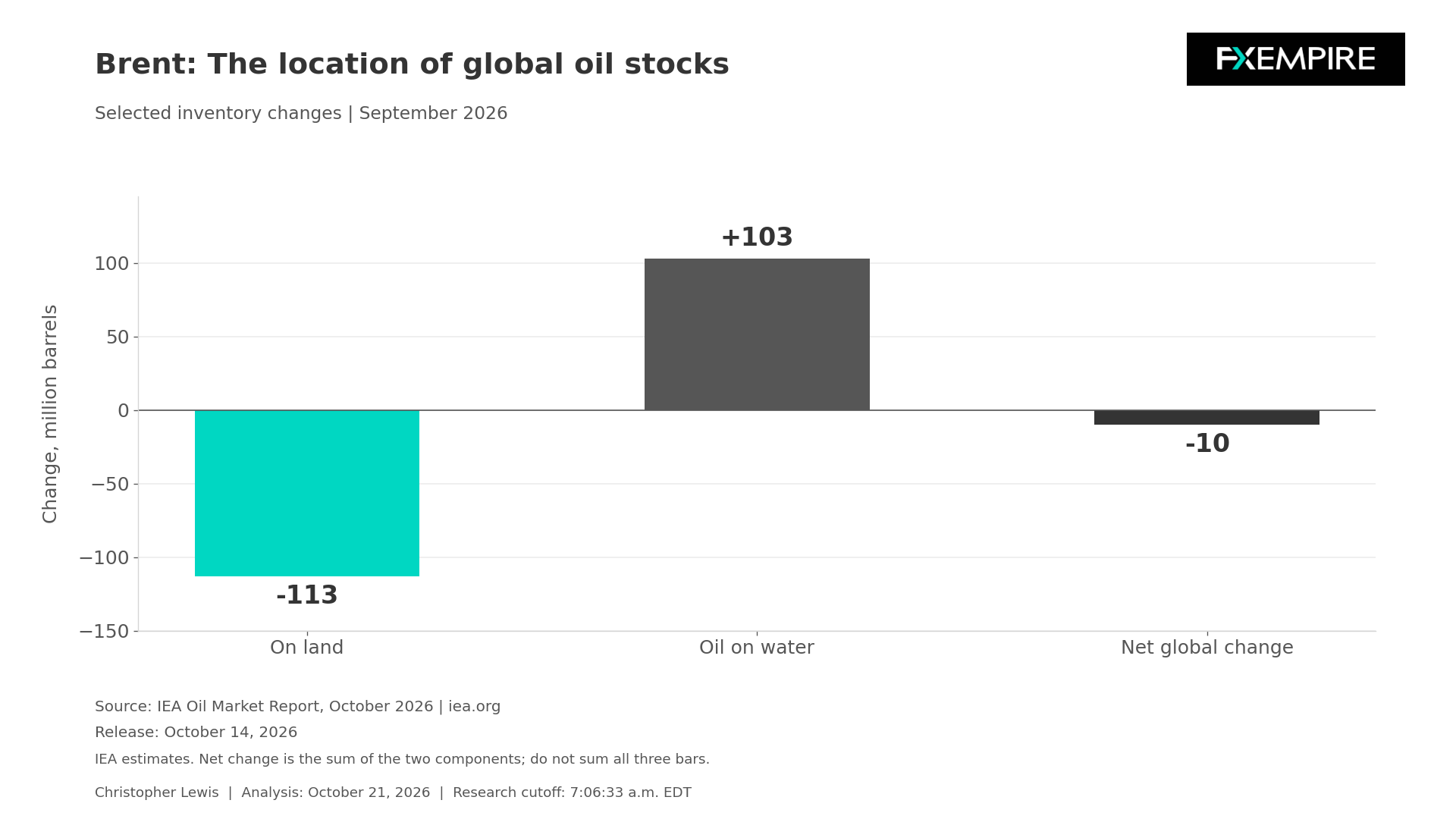
Brent has an international balance shaped by oil produced, oil transported, and oil already available to refiners. The IEA’s October 14 report estimates that September global observed inventories declined by 10 million barrels. Beneath that relatively small net change, on-land inventories fell by 113 million barrels, while oil on water increased by 103 million. More oil in transit can indicate improving exports, but it also means a larger share of the inventory buffer has not yet completed delivery. A cargo afloat is not interchangeable with immediately accessible refinery or terminal stock.
On-land Inventories Matter
I believe that replenishment of on-land inventories would be more convincing evidence of easing physical constraints rather than rising seaborne volumes alone. The IEA estimates global supply rose by 2.5 million barrels per day to 102.3 million in September. It nevertheless forecasts a 2.6 million barrel-per-day decline in average world demand for 2026. These are different categories of evidence: a monthly supply estimate and an annual consumption forecast. Recovering supply does not eliminate the logistical constraints, though.
EIA October Outlook
The EIA’s October outlook was published October 6, but its model inputs were finalized October 1. The EIA explicitly says the forecast excludes additional crude oil products resulting from the G7’s October 2 announcement. The limitation illustrates why an official forecast should not be described as incorporating every subsequent policy action or delivery.
For Brent, the constructive supply scenario is recovering exports translating into actual arrivals, rebuilding land-based buffers, and improving refinery access. The tighter scenario is that delivery constraints persist while stocks on land remain depleted. WTI connects through competing refinery feedstocks and U.S. exports, but its domestic stock movements do not help the international issues.
Technical Outlook
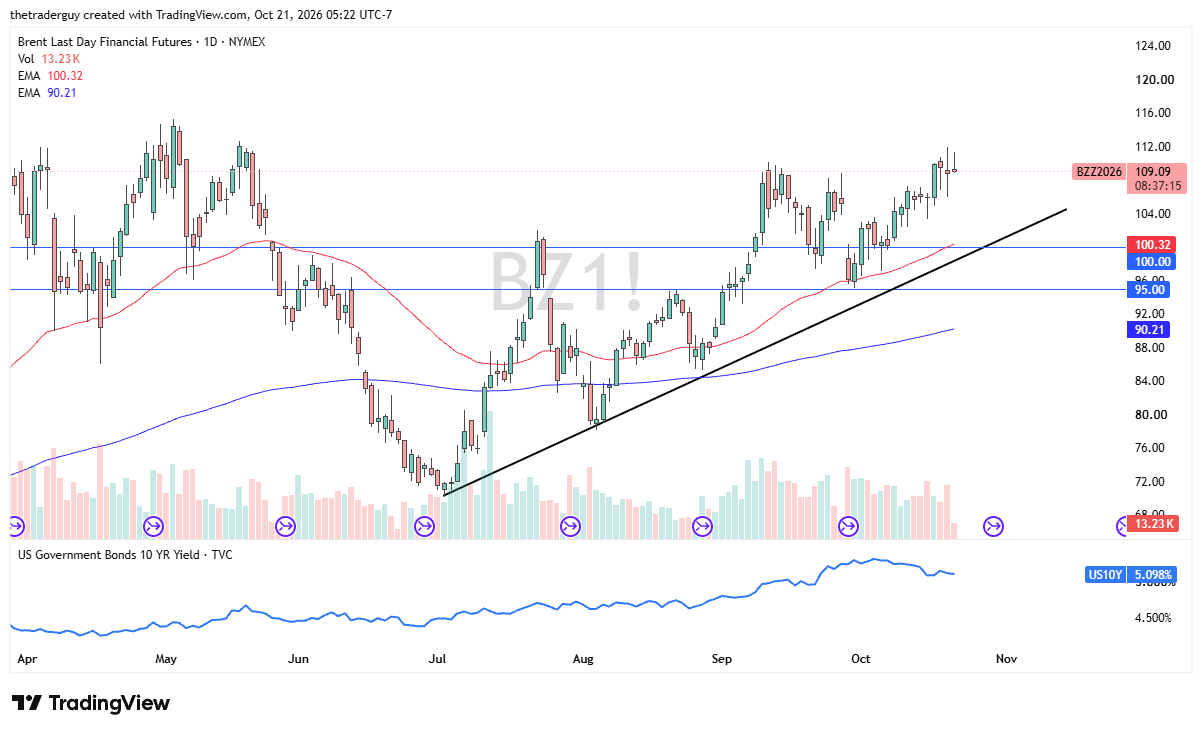
From a technical analysis standpoint, the Brent market looks very much like the WTI market, but it, of course, has a bit of a premium. Somewhere around the $110 level, it looks like there is a lot of pushback. So, short-term pullbacks, I think, continue to be buying opportunities, but I would feel much more comfortable buying Brent closer to the $104 level.