



Crude oil prices rebounded on Thursday, following Wednesday decline despite a larger than expected draw in crude oil inventories. Going into the Autumn in the Northern Hemisphere, distillate fuels which make up most of the heating fuels, have inventory levels are at the lower end of the 5-year range. With demand for distillates up more than 12% on a year over year basis, distillate demand might be the catalyst that drives oil prices higher.
Technicals
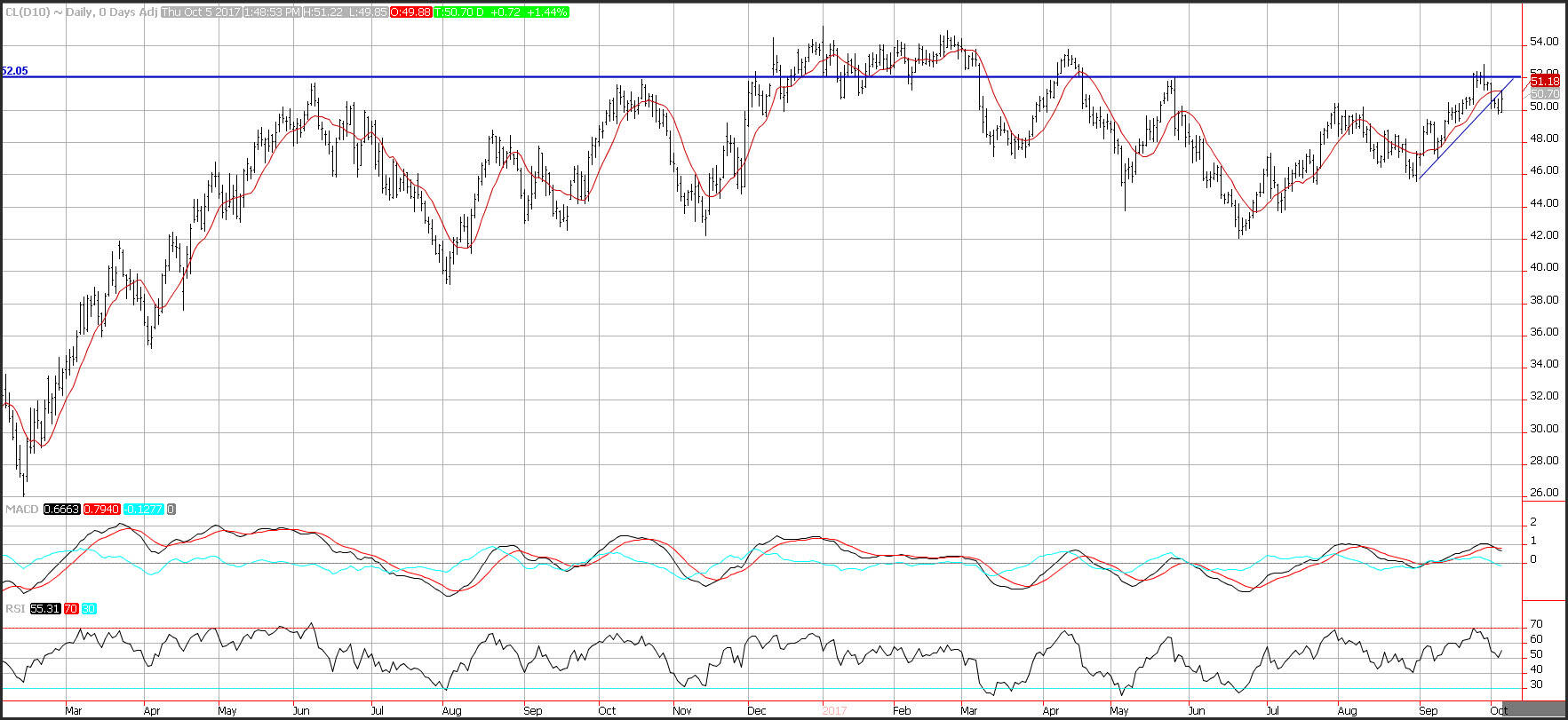
Crude oil prices rebounded on Thursday, after falling below 50 per barrel on Wednesday. Prices moved up 1.4%, testing resistance which was former support near an upward sloping trend line that comes in near 51.22, which coincides with the 10-day moving average. Support on crude oil prices is seen near the monthly lows at 49.76. Momentum has turned negative as the MACD (moving average convergence divergence) index recently generated a crossover sell signal. This occurs as the spread (the 12-day moving average minus the 26-day moving average) crosses below the 9-day moving average of the spread. The index moved from positive to negative territory confirming the sell signal. The MACD histogram is printing in the red with a downward sloping trajectory which points to lower prices.
Exports from the U.S. are Rising
EIA data about U.S. crude oil exports showed these had hit a record-high of 1.98 million barrel per day. This is the highest weekly average since exports were once again allowed, after a four-decade ban. Last week’s figure also beat the previous record set by exporters, which was hit in the previous week, at 1.5 million barrels per day.
Oversupply thanks to Harvey that drove the higher exports, and it was also to blame for the current decline in WTI prices and the growth of its discount to Brent. While the combination of the glut created by refinery shutdowns and the low price resulting from this glut, increased the appeal of U.S. crude for foreign buyers.
Car Sales Are Rising Which Could Influence Gasoline Demand
September volumes bounced sharply, rising to an annual rate of more than 18%. Readings from GM +11.9%, Ford +8.7%, Toyota +14.9% and Nissan +9.5% confirmed post-hurricane replacement demand for both new and used vehicles. One exception was Fiat Chrysler, which reported a 9.7% sales drop and a recall of some 709k in Dodge Durango and Jeep Grand Cherokee SUVs for brake malfunctions.
Canada’s Trade Surplus Widened
Canada’s trade deficit widened to -C$3.4 billion in August from -C$3.0 billion in July. The wider trade gap was contrary to expectations for a mild narrowing. Exports fell 1.0% month over month in August while imports were flat. The decline in exports follows sizable back to back tumbles in exports during June and July. Exports were 0.2% lower in August compared to the same month last year. The trade surplus with the U.S. narrowed to C$2.3 billion in August from C$3.2 billion in July. Exports to the U.S. fell 1.8% m/m in August while imports from the U.S. gained 0.9%. This is another disappointing trade report, which further underpins the widespread view that the Bank will not change rates this month and trims the chances for a rate hike in December as exports have tracked lower since June.
U.S. Jobless Claims Declined More than Expected
U.S. initial jobless claims fell 12k to 260 in the September 30 week after climbing 12k to 272k in the prior week, after dropping 21k to 260k in the September 16 week. That brought the 4-week moving average down to 268.25k from 277.75k. Continuing claims rose 2k to 1,938k in the September 21 week, after tumbling 43k to 1,936k in the prior week (revised from 1,934k), following a 44k jump to 1,979k in the September 9 week. Hurricane distortions continued to impact the data from Puerto Rico, Virgin Islands, Florida, and Georgia.
The U.S. Trade Deficit Narrowed
U.S. trade deficit narrowed 2.7% to -$42.4 billion in August from -$43.6 billion in July which was revised from -$43.7 billion. Imports dipped 0.1% versus -0.2% previously, while exports bounced 0.4% from -0.2% which was revised from -0.3%. Excluding petroleum, the deficit was -$37.6 billion from -$40.5 billion which was revised from -$40.6 billion. The “real” goods balance was -$61.8 billion versus -$61.8 billion which was revised from -$61.6 billion, with real imports slipping 0.6% from a 0.1% July increase, while real exports were off 0.8% from -0.7% which was revised from -0.6%.