


WTI
WTI crude oil enters the Friday session with a stronger U.S. growth backdrop but uneven evidence about oil demand. BEA’s October 29 advance estimate put third-quarter real GDP at 3.4% annualized, compared with 2.2% in the second quarter. This is the initial estimate for July through September, but it does suggest that there is plenty of economic resilience in the United States without necessarily saying that demand for oil is going to start to pick up as well.
EIA Report
The latest EIA petroleum report, released the day before for the week ending October 23, showed a bit of a distinction. Commercial crude stocks, excluding the Strategic Petroleum Reserve, fell 1.9 million barrels to 410.6 million barrels. Gasoline inventories increased 3.9 million barrels, while distillate stocks declined 1.5 million. WTI has a supportive crude-stock signal alongside a less uniform product balance for end consumers.
A gasoline build can reflect several situations when it comes to production, imports, and consumption. A distillate draw has different implications for refinery economics and seasonal supply flow. The situation calls for an examination of where the imbalance actually sits.
Supply Response
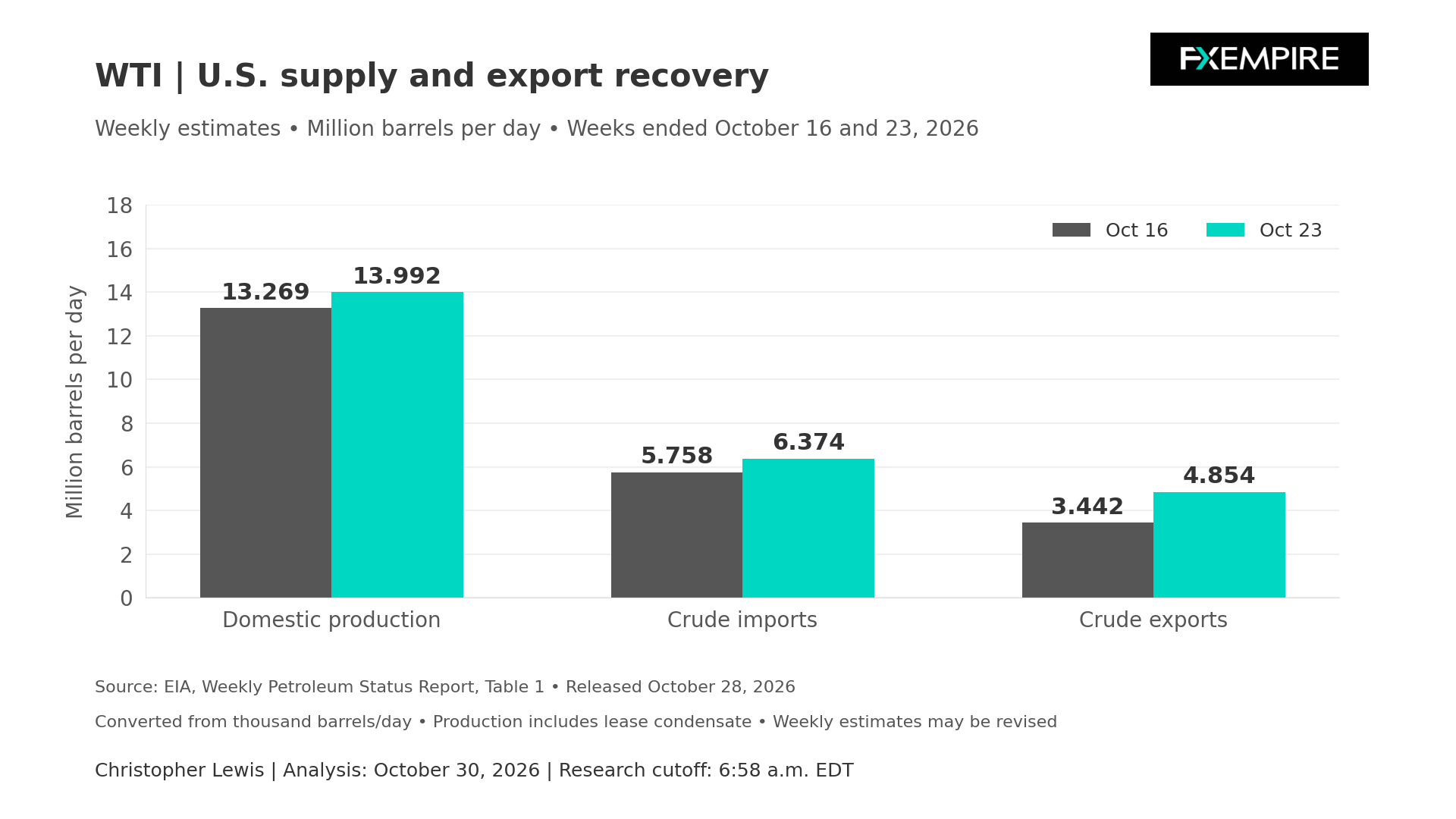
The supply response will also matter, as EIA estimated weekly production at 13.992 million barrels per day, up from 13.269 million. Crude exports have risen to 4.854 million barrels per day from 3.442 million, while refinery crude inputs eased a bit to 16.526 million barrels per day. This shows that stronger estimated production can, at the same time, exist with stock draws from overseas shipments.
Going forward, strong exports could help absorb some of the U.S. supply. On the other hand, a reversal in exports while production stays elevated could make inventory rebuilding much easier. Refinery intake and finished fuel stocks will help distinguish genuine consumption strength from changes in the timing of movement.
Brent Oil Price Forecast
Every new Brent Oil analysis as it publishes, today's technical signal and key levels, live price — on one page.
See all Brent Oil forecastsToday, we have the Employment Cost Index being released at 8:30 Eastern, and it could influence some small part of financing expectations, but it doesn’t necessarily replace physical demand evidence. WTI crude oil faces a test as to whether economic resilience translates into product consumption without eroding household purchasing power.
Technical Analysis

The technical setup for WTI at the moment does seem to be more buy-on-the-dip, as it has been for some time. The $105 level continues to offer a bit of resistance, extending perhaps to the $106.50 level.
Brent
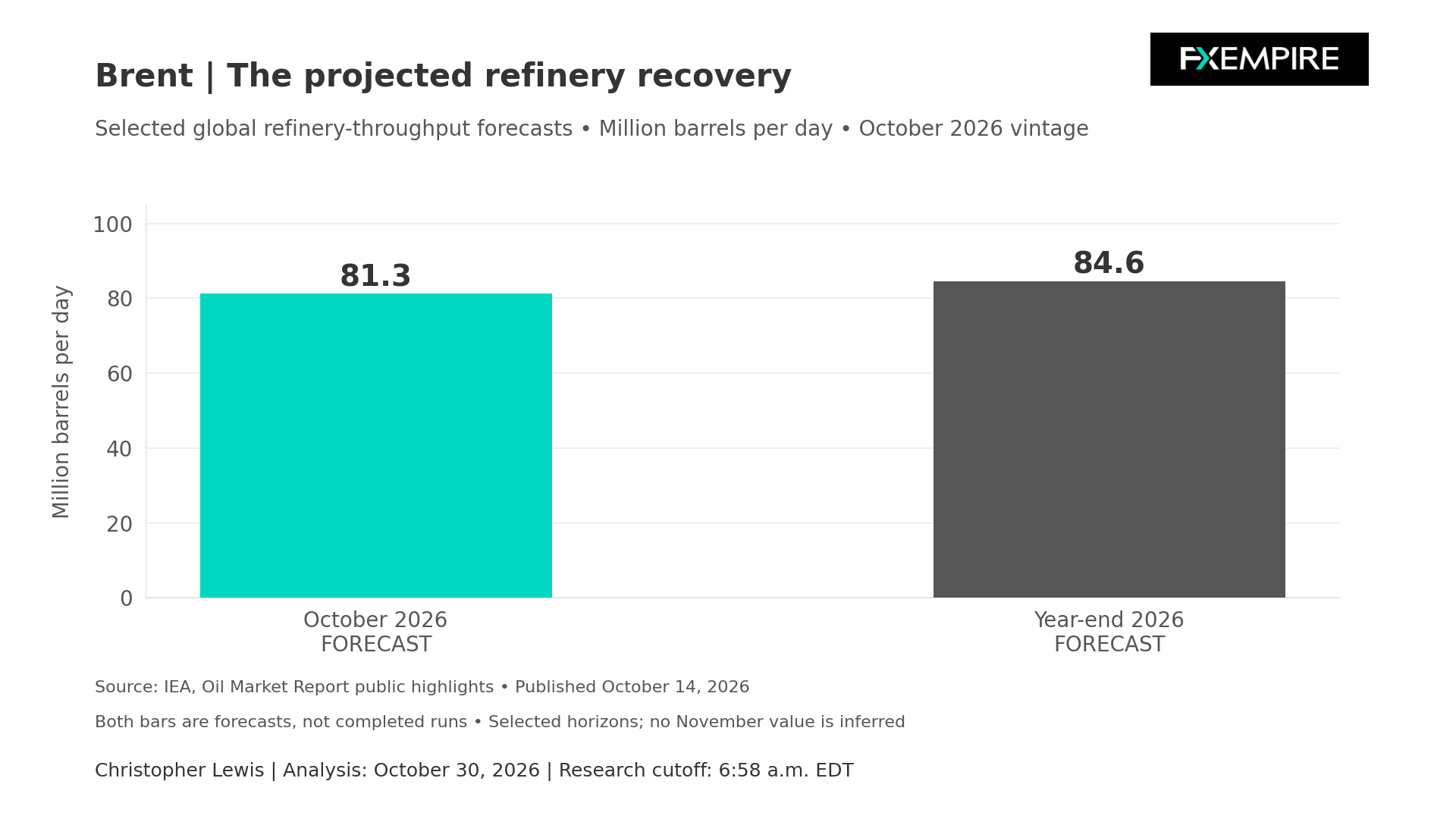
The Brent international balance depends on whether or not crude can move through the refining system and reach end users. This has been the problem for months. The IEA’s October 14 Oil Market Report projected global refinery throughput of 81.3 million barrels per day in October, recovering to 84.6 million by year-end. I assess that this is a projected recovery that states both an opportunity and a condition for Brent demand.
Higher runs could increase refiners’ crude purchases and therefore improve product availability for end consumers, but that outcome requires the ability to work with margins, appropriate feedstocks, and dependable deliveries, not necessarily something that we’ve seen over the last couple of months.
IEA Estimates
In September, IEA estimates show global supply recovering to 102.3 million barrels per day, up 2.5 million from August. At the same time, on-land inventories fell sharply while oil on water had increased. This cautions against equating production recovery with immediately accessible supply at every destination.
Reliable transport remains important because a barrel in transit cannot always substitute for a barrel available to a refinery in the short term. Longer delivery times, changes in crude quality, and local processing limitations can preserve regional tightness even when the overall output improves.
Demand
Demand will be another constraint at times. The October IEA report forecasts a 2.5 million barrel-per-day year-over-year contraction in fourth-quarter oil use. This does predate the U.S. GDP release that came out yesterday, but stronger American growth doesn’t by itself overturn the global forecast. U.S. economic activity, international fuel affordability, and refinery demand can evolve at different paces.
For now, the constructive scenario is reliable supply feeding sustained refinery recovery. The opposing scenario combines expensive delivery, weak margins, and softer consumption, all of which could come back to the forefront if the conflict in the Persian Gulf picks up again.
Technical Setup
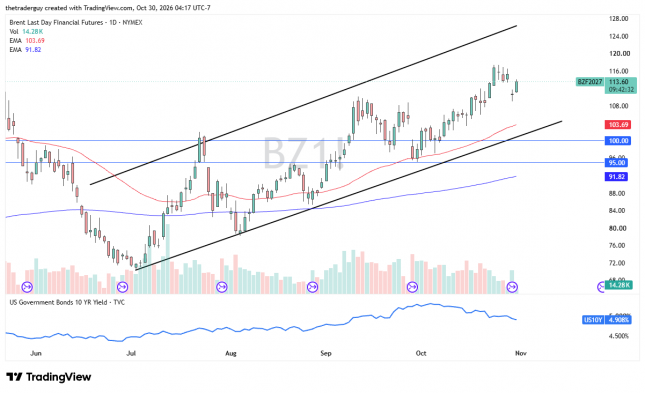
The technical analysis for Brent is interesting, as yesterday the futures contract rolled over, dropping quite a bit, but today we have seen a recovery. This is yet another example of buying the dip in this market. That seems to be the way going forward at the moment. $108 looks to be support, and $117 looks to be resistance. We are currently right between both of those in what would be short-term “fair balance.”