


WTI
WTI begins the Wednesday session with a little bit of positivity as we await the next EIA petroleum report, scheduled for 10:30 a.m. Eastern today. The latest available report remains the October 21 release covering the week ending October 16. The early report estimated crude inventories at 412.5 million barrels following a 3.1 million-barrel draw. Stocks are approximately 3% below their 5-year average in the report, with gasoline and distillate inventories around 5% and 9% below their respective averages. The chart below compares those shortfalls, but it does not include the upcoming numbers.
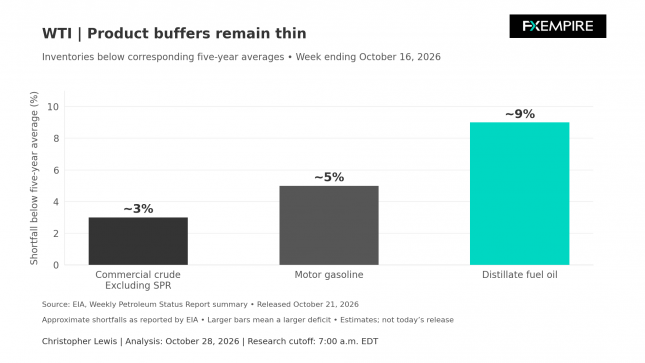
The assessment here is that the product balances deserve as much attention as crude itself. A crude draw can reflect strengthening refinery intake, reduced imports, or other temporary changes. The importance is greater when finished fuel stocks are struggling to rebuild as well. On the other side, an increase in crude alongside firmer refinery activity and improving product availability could indicate that the supply chain is becoming healthier.
In the October 16 reporting week, we saw refinery utilization of 93.4%, with distillate stocks rising 1.7 million barrels to 104.3 million, despite remaining below normal. This combination illustrates why weekly changes in inventory levels can answer different questions, and improvement in one week does not necessarily eliminate accumulated storage.
Plus, in the United States, we have to remember that there was recently a hurricane that shut down production in the Gulf of Mexico. The Department of Energy’s October 23 authorization of an exchange of up to 400,000 SPR barrels for the Phillips 66 Lake Charles refinery remains another implementation issue, as it supported a specific disrupted supply route. Authorization is not necessarily confirmation that those barrels have been delivered, but this is a loan and not a permanent change to the flow of oil in the United States.
Import and export details will help interpret any headline surprise. A change driven by cargo timing could also offer less evidence of a lasting demand shift than broader movement across the consumption curve.
At 2 p.m. Eastern, the Federal Reserve decision also adds the financing part of the demand channel. More restrictive guidance could weigh on growth expectations even if inventories remain lean. We will have to see whether or not that is going to have an influence on the WTI market.
Technical Analysis
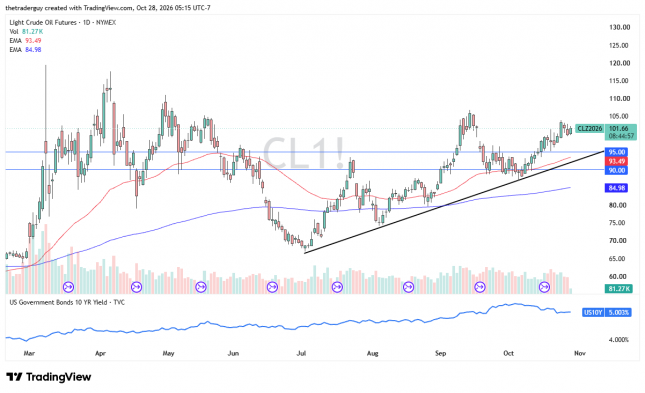
Early during the trading session on Wednesday, it does look like buyers are stepping back in to pick up WTI, but there remains a barrier right around the $105 level. It looks like the bounce occurred from the psychologically important $100 level, which could be a bit of a clue. But even if we were to break down below there, it seems as if there is support near the $97.50 level and, again, probably more importantly, closer to the $95 level, where the 50-day EMA currently sits.
Brent
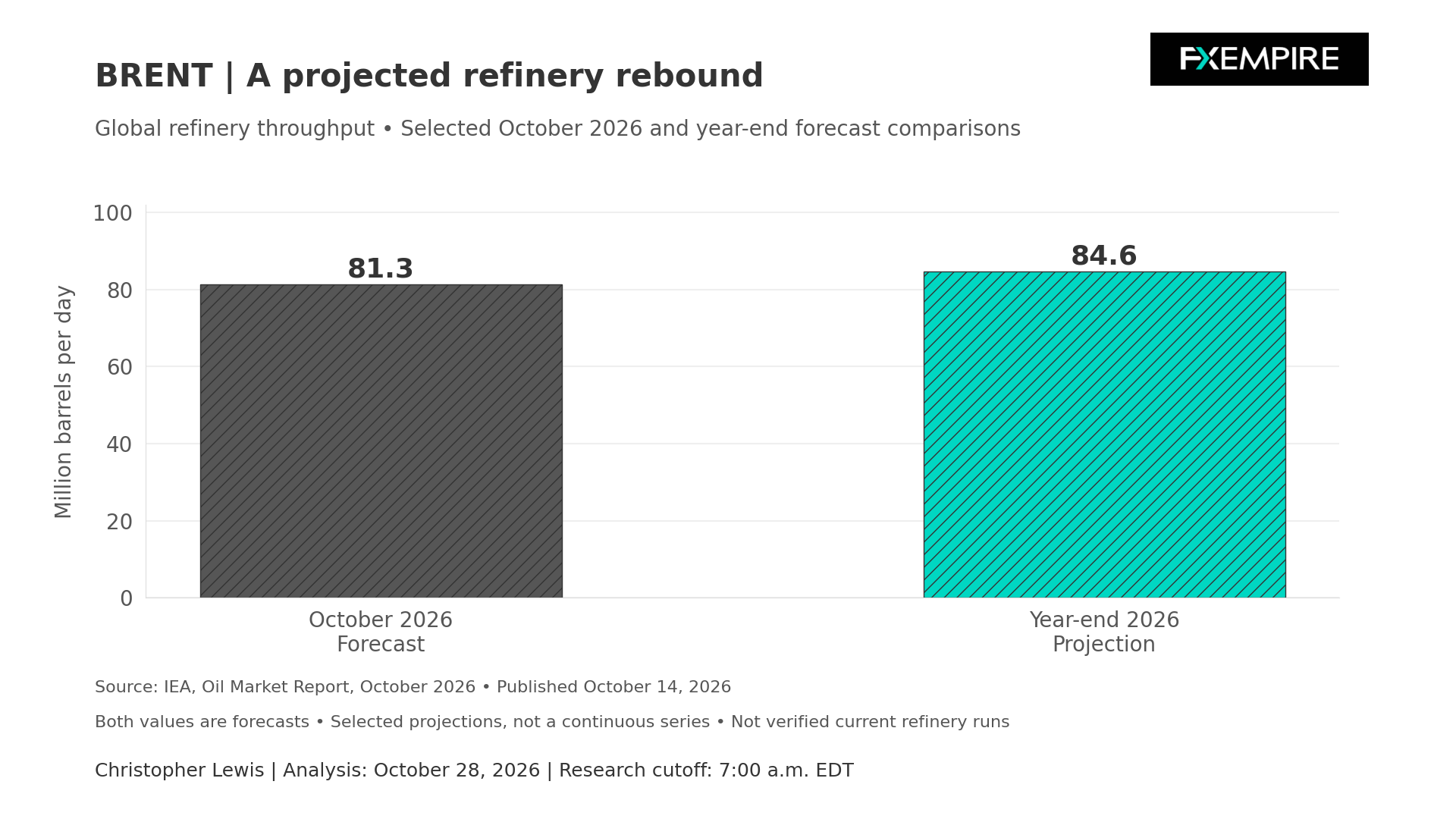
The Brent market is more international, and therefore it has a little bit of a different look to it. It has a prospective rebound in refinery demand, with continuing uncertainty over how much supply will reach consumers. The IEA report on October 14 projected global refinery runs of 81.3 million barrels per day in October, recovering to 84.6 million by year-end. The chart below labels these forecasts.
Brent Oil Price Forecast
Every new Brent Oil analysis as it publishes, today's technical signal and key levels, live price — on one page.
See all Brent Oil forecastsThe interpretation I take away from this is that an eventual increase in processing would raise crude requirements where refineries can secure feedstock and operate profitably. It also improves product availability. However, a refinery forecast is conditional on infrastructure, transport costs, sufficient demand, and insurance costs.
OPEC’s October 4 statement said seven participating countries would remain and maintain the levels of the September required production levels for November. Their next meeting is scheduled for November 1. This production policy was agreed on, but it does not necessarily have actual proof to attach to it. Physical flows can diverge from targets if shipping limits or infrastructure problems arise.
IEA Demand Forecast
Demand will remain the counterbalance to the situation. The IEA forecast fourth-quarter world oil consumption falling 2.5 million barrels per day year over year. A market, therefore, could face weak consumption growth and scarce accessible barrels simultaneously, meaning that a lack of demand will not necessarily drive down price.
The EIA’s October outlook requires a bit of timing qualification as well, as those inputs were finalized October 1, and it excludes any additional supply resulting from the G7 announcement on October 2. The connection with WTI runs through products. Stronger overseas fuel demand could support U.S. refining and exports, while improving international product supply could also reduce that pull.
On Wednesday, U.S. inventory details will provide an Atlantic Basin cross-check, followed by the Federal Reserve decision and Thursday’s GDP release. The weekend OPEC+ meeting adds a policy wrinkle as well, so traders will have to pay close attention to that.
Technical Analysis
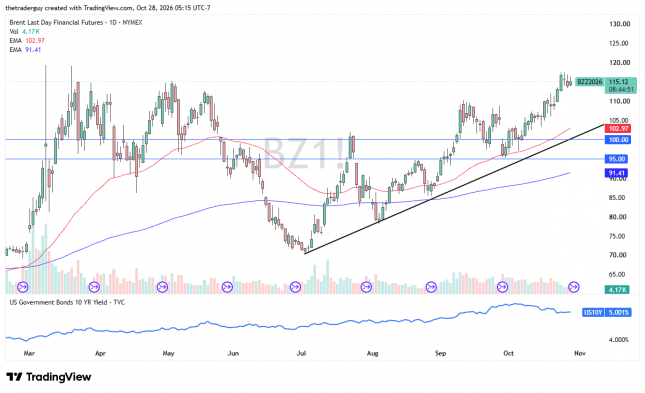
As things stand at the moment, I suspect there is still a buy-the-dip mentality out there, with the Brent market stronger than the WTI market. A certain amount of resistance is seen near $115, with the $112.50 and the $110 levels both offering potential supportive action.