



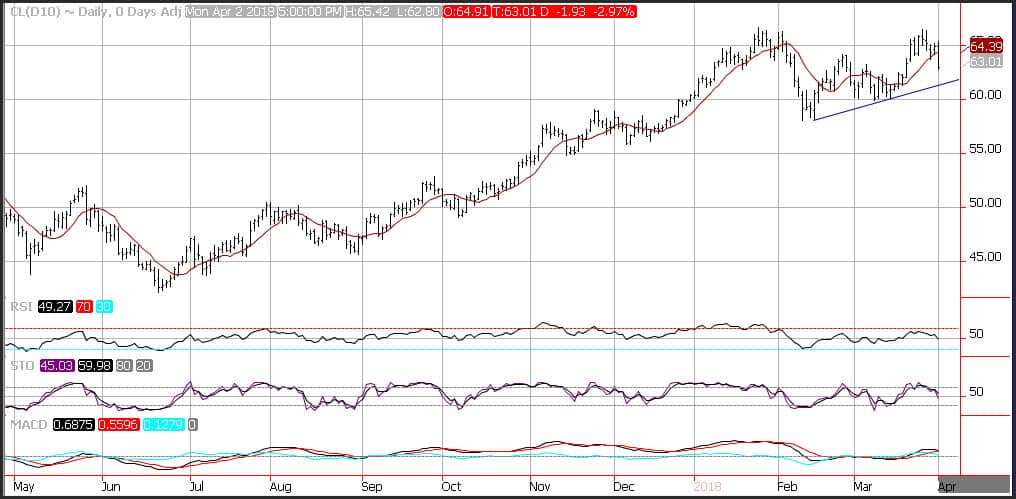
Crude shed as much as 2.33 per barrel, falling to 62.80 lows from opening highs of 65.31. The contract found buyers late in the session to recapture the 63-handle although the risk off trade continues to weigh on prices. Risk-off conditions have weighed on crude prices, as has a firmer dollar, and prospects for further production gains in the U.S. and Iraq.
Technicals
Crude oil prices dropped nearly 3%, and closed near session lows. Support on is seen near an upward sloping trend line that comes in near 61.46. Resistance is seen near the 10-day moving average at 64.39. Momentum is negative as the MACD (moving average convergence divergence) histogram prints in the red with a downward sloping trajectory which points to lower prices. The fast stochastic also generated a crossover sells signal which reflects accelerating negative momentum. Look for prices to test lower levels ahead of Wednesday’s EIA inventory report.
ISM Manufacturing Declined
U.S. ISM manufacturing index fell 1.5 points to 59.3 in March, mostly erasing the surprise 1.7 point increase to 60.8 in February, a 14-year high. Declines were broad-based but from high levels previously. The employment component dropped to 57.3 from 59.7. New orders slid to 61.9 from 64.2. New export orders fell to 58.7 from 62.8. Imports dipped to 59.7 from 60.5. However, prices paid climbed to 78.1 from 74.2. The latter number could be the focus for the markets.
U.S. Markit PMI rose
U.S. Markit PMI rose 0.3 points to 55.6 for the final March reading, versus the 55.3 in February, though it’s not quite as good as the preliminary 55.7 March print. This is the highest reading since March 2015. Output continued to expand “strongly,” according to the report, though the index slipped to 55.2 from 55.5 as activity slowed. Inflation pressures intensified with input and output prices accelerating to multi-year peaks. The report noted some upward impact on prices from the tariff announcements — “recent tariff announcements were already reported to have added to inflationary pressures, and also led to the stockpiling of goods expected to rise further in price in coming months. Input cost inflation consequently hit the highest since 2012. Increased costs were often passed on to customers, meaning prices charged for goods at the factory gate showed the steepest rise in over four years.”
February Construction Spending Rose
The 0.1% U.S. February construction spending rise followed big upward revisions that left a stronger than expected report, with strength in all the construction components except public construction. Boosts for the residential component were spread between new construction and home improvement, and nonresidential construction was raised as well. We still expect GDP growth of 2.4% in Q1 and 3.6% in Q2 after a 2.9% Q4 clip, but with growth rates for real residential construction of 9% in Q1 and 3% in Q2. Growth rates for real nonresidential construction should be near 10% in Q1 and 11% in Q2, and growth rates for real government purchases of 0.4% in Q1 and 1.2% in Q2. Construction spending has climbed sharply since July thanks to a big six-month public construction rebound before a February drop-back, and resumed strength in nonresidential construction and new multi-family construction into 2018 after a lull since Q1 of last year.
Canada’s Markit manufacturing PMI edged up to 55.7 in March from 55.6 in February. The index saw a record high 55.9 in April of 2017, only to repeat that figure in January of this year. Hence, the Markit manufacturing PMI is consistent with resilience in Canada’s manufacturing sector this year. Manufacturing improved in January’s GDP report, rising 0.7% after an 0.4% drop in December. GDP fell 0.1% in January, driven lower by a tumble in non-conventional oil extraction and a contraction in real estate.
NAFTA prospects took a hit after
NAFTA prospects took a hit after Trump tweeted that Mexico “must stop their big drug and people flows, or I will stop their cash cow, NAFTA. NEED WALL!” His Sunday tweet contrasts with encouraging developments last week, which saw the U.S. trade representative upbeat that something could be done relatively soon. The U.S. agreed to relent on a contentious position on auto import content, which was seen as one of the key sticking points to additional progress. Canada was more measured, but Freeland did say talks were making “good progress.” The eighth round of talks begins April 8.