


The EUR/USD moved lower as the dollar continued to benefit from the risk aversion theme. The decline in the EU manufacturing PMI released a day late due to the Easter Holiday confirmed weakness in the EU manufacturing section. German retail sales corrected lower, which also weighed on the currency pair.
Technicals
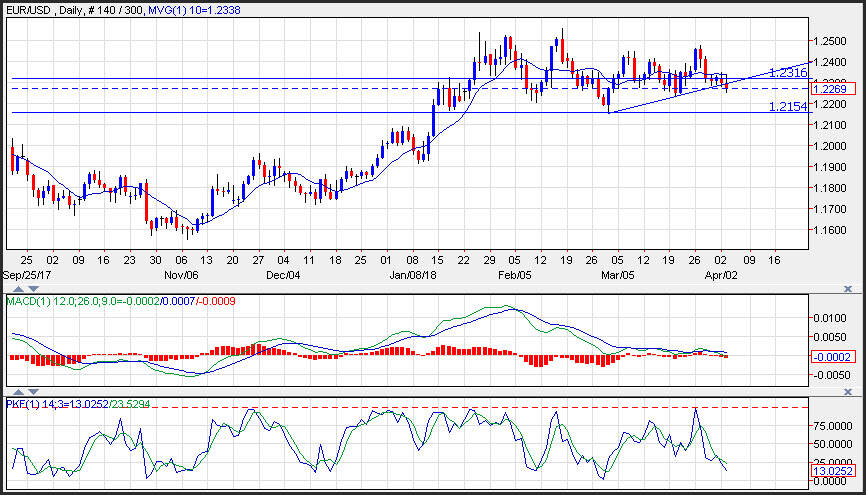
The EUR/USD, slipped through support near an upward sloping trend line that comes in near 1.23 which is now seen as resistance. Additional resistance is seen near the 10-day moving average at 1.2337. Support is seen near the February lows at 1.2154. Momentum is negative as the MACD (moving average convergence divergence) histogram prints in the red with a downward sloping trajectory which points to lower prices. The fast stochastic also recently generated a crossover sell signal which points to accelerating negative momentum.
EU Manufacturing PMI Moving Lower
Eurozone manufacturing PMI confirmed at 56.6, unchanged from the preliminary March reading and down from 58.6 in February. National data also held few surprises, with the French reading revised marginally higher, while the German reading was revised down to 58.2 from 58.4. The overall index remains at a high level consistent with ongoing robust growth in the manufacturing sector, but dynamics are slowing down, “across all nations and manufacturing sub-sectors”, according to Markit. At the same time, though Markit highlighted “increased signs of supply chain constraints” that are “reining in output growth and raising input prices”. So while the headline rate is down, that won’t remove the arguments for a phasing out of QE as ongoing monetary stimulus in this situation will only acerbate the problems. Indeed Markit argued that “we should not be too worried by the fall in the PMI as some moderation in the pace of growth from the surge seen at the turn of the year was inevitable, not least because short-term capacity constraints limit the economy’s ability to growth so quickly for long periods”.
German February retail sales unexpected corrected
German February retail sales unexpected corrected -0.7% month over month. The January number was revised slightly higher, to -0.3% month over month from -0.7% month over month, but while consensus expectations had been for a rebound from the dip last month, sales once again declined. The adverse weather conditions may have contributed, but the deceleration in the annual rate to just 1.3% year over year from 2.5% year over year will add to concerns that the German recovery is losing momentum as business confidence indicators decline.
The UK’s March manufacturing PMI beat expectations
The UK’s March manufacturing PMI beat expectations in lifting to a headline of 55.1, up from 55.0 in February, which was revised down from 55.2. The median forecast had been for a 54.7 reading. The breakdown showed mixed signals, with the rates of improvement in both new orders and employment slowing, with export orders deflating to a five-month low. Both input and output price inflation slowed. Overall, the headline is still the best so far this year, and marks the 20th consecutive month of expansion in the sector. Confidence remains upbeat, took, with 55% of companies forecasting output will be higher in 12 months time.
NY Fed is debuting new financing rates as Libor alternatives, see the NY Fed’s dashboard. The three rates are based on overnight repo transactions collateralized by Treasuries, with collateralized the key component. SOFR, the Secured Overnight Financing Rate, is the one chosen by the Alternative Reference Rate Committee to replace Libor. It was reported at 1.80% for Monday with a volume of $849 billion. The BGCR, the Broad General Collateral Rate, was 1.77% for April 2, with a volume of $361 billion. And the TGCR, the Tri-Party General Collateral Rate, was 1.77% for Monday with a volume of $329 billion. The OBFR, the Overnight Bank Funding Rate was 1.67% for March 30 with a $104 billion volume. The Fed and Treasury have been working on developing a Libor alternative for several years following the scandal.
U.S. chain store sales declined
U.S. chain store sales declined 1.9% to 116.7 in the March 31 week, after jumping a very strong 4.3% in the prior week. Despite the drop, sales fared “reasonable well,” said the report, supported by Easter. The 12-month pace slowed only slightly to 3.4% from 3.6%, with some calendar effect from Easter. Dollar stores continued to pace the industry, along with strong gains in drugs, discount, online-only, traditional grocery, as well as non-apparel specialty stores and home improvement stores.