



The EUR/USD gained traction following the softer than expected U.S. Payroll report. U.S. yields moved lower weighing on the greenback, giving the currency pair a boost. German industrial production dropped following Thursday manufacturing report, which provided a cap on the EUR/USD.
Technicals
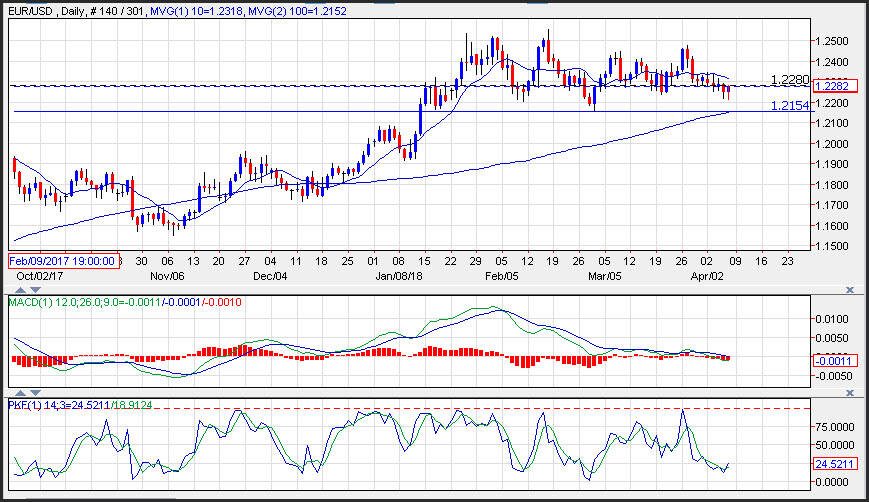
The EUR/USD moved higher but price action remains sideways chopping in a very tight range. Support is seen near the 100-day moving average at 1.2152, which coincides with the March lows. Momentum is negative but decelerating as the MACD (moving average convergence divergence) histogram prints in the red with an upward sloping trajectory which points to consolidation. For the week the currency pair was nearly unchanged opening where it closed which represents a doji day which reflects indecision.
U.S. Payrolls Came in Softer than Expected
The 103k U.S. March payroll gain missed expectations of 180K and comes in conjunction with a 50k in downward revisions was a big disappointment. Beyond payrolls the report was mixed, with a 0.1% hours-worked rise after the 0.6% February pop, and a firm 0.3% hourly earnings gain. There was largely expected declines of 37k for civilian jobs and 158k for the labor force that capped otherwise huge Q1 gains, leaving a participation rate downtick to a still-firm 62.9% from a 63.0% 4-year high. Goods sector restraint likely reflects some give-back of the February surge. Goods sector jobs rose by 15k with gains of 22k for factories and a firm 8k for mining, but with a 15k drop for construction. Hours-worked for the goods sector fell 0.2%, with declines of 0.1% for factories and 0.7% for construction, but with a 1.0% rise for mining.
The ECB’s Coeure Said that U.S. trade tariffs tightened market conditions
Coeure said that “while the effects of any tariffs on output and inflation may take time to materialize, falls in equity prices in response to the U.S. announcement to impose a tariff on steel and aluminum, and prevailing uncertainty on the scope of any retaliatory measures, have already contributed to tighter financial conditions”. He warned that fears of a trade war have led to the volatility in equity markets, which is not supportive for growth and employment. “A further adverse structural shock to productivity may lead us to be more often constrained in the longer term by the effective lower bound on nominal interest rates and to increase the need to resort to unconventional policy measures”.
German industrial production unexpectedly declined
German industrial production unexpectedly declined -1.6% month over month in February. January numbers were revised slightly higher to 0.1% month over month from -0.1% month over month reported initially, but the data are still much weaker than anticipated. The bad weather and heavy snowfall that month are likely to have had an impact and was already evident in recent survey data, so there could be a rebound in monthly data ahead. Meanwhile the annual rate of 2.6% year over year still looks actually more healthy and sustainable than the 6.3% year over year rate seen in January and capacity constraints are still evident in survey reports and limit the scope for further expansion.
PMI readings for March were weak across Europe
PMI readings for March were weak across Europe, partly due to adverse weather conditions with heavy snowfall disrupting transport and services. However, much of the dip in Eurozone confidence indicators is a reflection of a normalization of unsustainable growth rates earlier and the underlying picture remains very healthy, while in the U.K. the slowdown is becoming more evident and uncertainty continues to dent confidence. A BoE rate hike in May remains in play.
The eurozone services PMI corrected to 54.9 from 56.2 in February, the manufacturing reading fell to 56.6 from 58.6 in 55.0 which left the composite output index at 55.2. This is a sharp correction from the 57.1 in the previous month and in fact the lowest reading since the start of 2017. However, these were still high numbers and more importantly, a moderation from what looked like unsustainable growth rates in the past. Indeed, Markit said data suggests a quarterly growth rate of around 0.6% in the first quarter of the year, pretty impressive by Eurozone standards, and much more sustainable in the long run than the rates of 0.8-0.9% seen at the start of the last year.