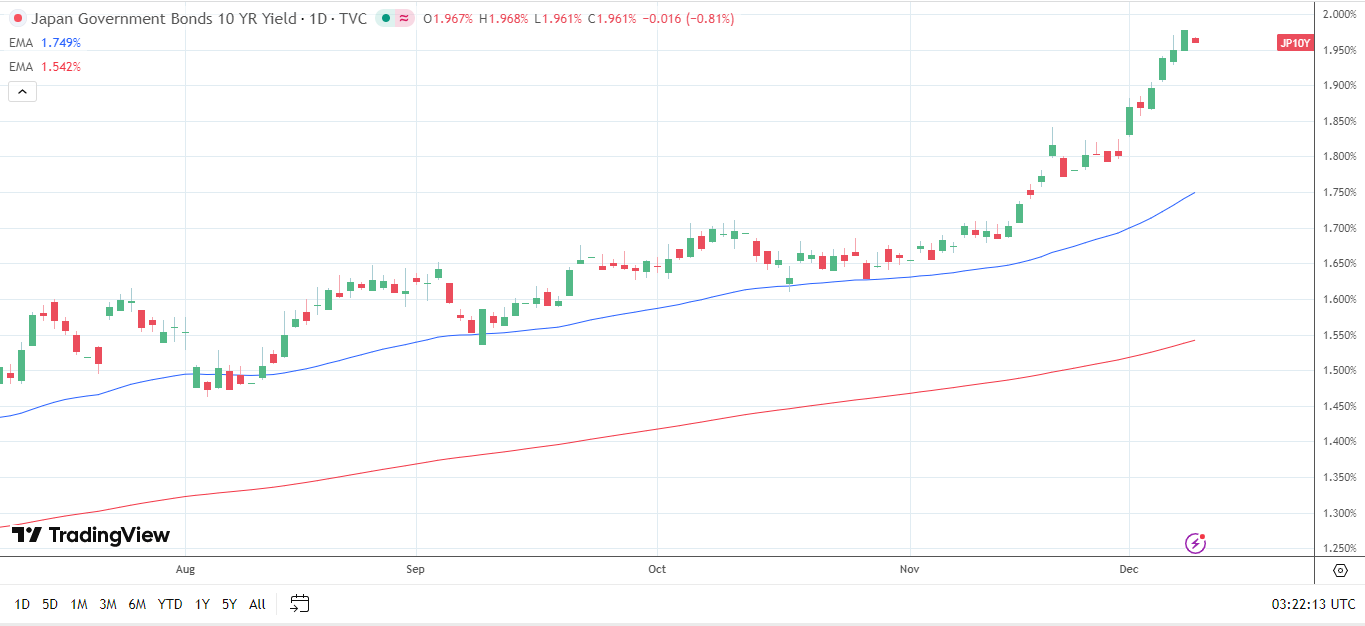
10-year Japanese Government Bond (JGB) yields dipped in early Asian market trading on Tuesday, December 9, while 10-year Treasury yields were flat, easing concerns about a yen carry trade unwind. Crucially, USD/JPY held onto the previous day’s gains, trading at 155.864. Falling JGB yields and the weaker yen sent the Nikkei 225 0.21% higher.
Traders monitor JGB yields, USD/JPY trends, and Nikkei 225 movements for early warnings of a yen carry trade unwind. Tuesday’s trends supported yen carry trades, lifting demand for US assets. US stock futures advanced in early trading on Tuesday, December 9, partially recovering overnight losses.
Easing fears of a yen carry trade unwind, despite a potential December Bank of Japan rate hike, and a likely Fed rate cut on Wednesday, December 10, support a bullish short- to medium-term outlook for US equity futures.
Below, I’ll outline the key market drivers, the medium-term outlook, and the key technical levels traders should watch.

BoJ Rate Hike Bets Intact as BoJ Governor Ueda Takes the Stage
Japanese wage growth accelerated in October, reinforcing Bank of Japan Governor Kazuo Ueda’s hawkish monetary policy stance. Notably, stronger wage growth will likely have a greater influence on policymakers than Q3 GDP data, which showed a 0.5% quarterly contraction. 10-year JGB yields climbed to their highest level since April 2007 before dropping back this morning.
While wage growth trends support a December BoJ rate hike, the Q3 contraction may temper bets on further monetary policy tightening through Q1 2026. A Fed rate cut and a BoJ rate hike would leave rates at 3.5% and 0.75%, respectively, wide enough to fuel yen-funded carry trades into US assets.
Later on Tuesday, December 9, Bank of Japan Governor Kazuo Ueda will speak for the third time this month, underscoring the central bank’s efforts to avoid a repeat of the market events in mid-2024.
Governor Ueda recently supported raising interest rates, citing diminishing US tariff risk and strong wage growth. The BoJ Governor also fueled uncertainty about the number of rate hikes needed to reach normalization, stating there was no consensus on the neutral interest rate.
A neutral interest rate is where monetary policy is neither accommodative nor restrictive. A higher neutral interest rate would require multiple rate hikes, narrowing the rate differential and making yen-funded carry trades into US assets less attractive.
Governor Ueda’s comments on monetary policy and views on the neutral rate will influence risk appetite.
Dow Jones Price Forecast
Every new Dow Jones analysis as it publishes, today's technical signal and key levels, live price — on one page.
See all Dow Jones forecastsUS Jobs Data in Focus
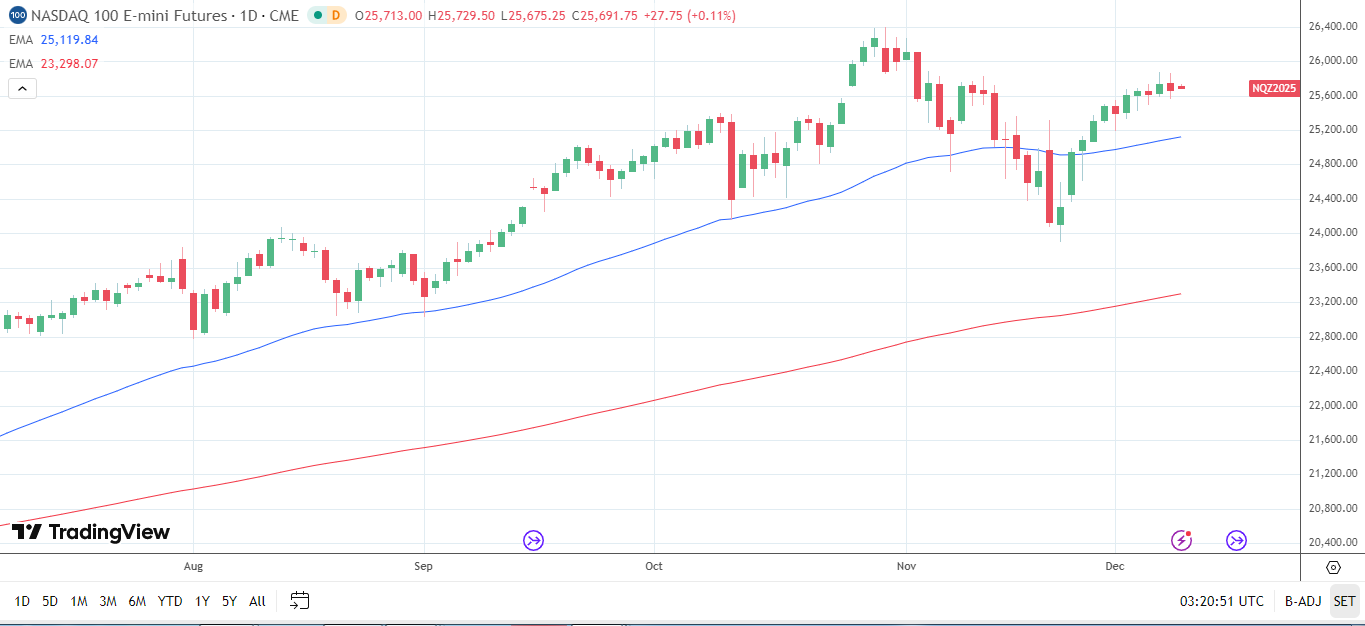
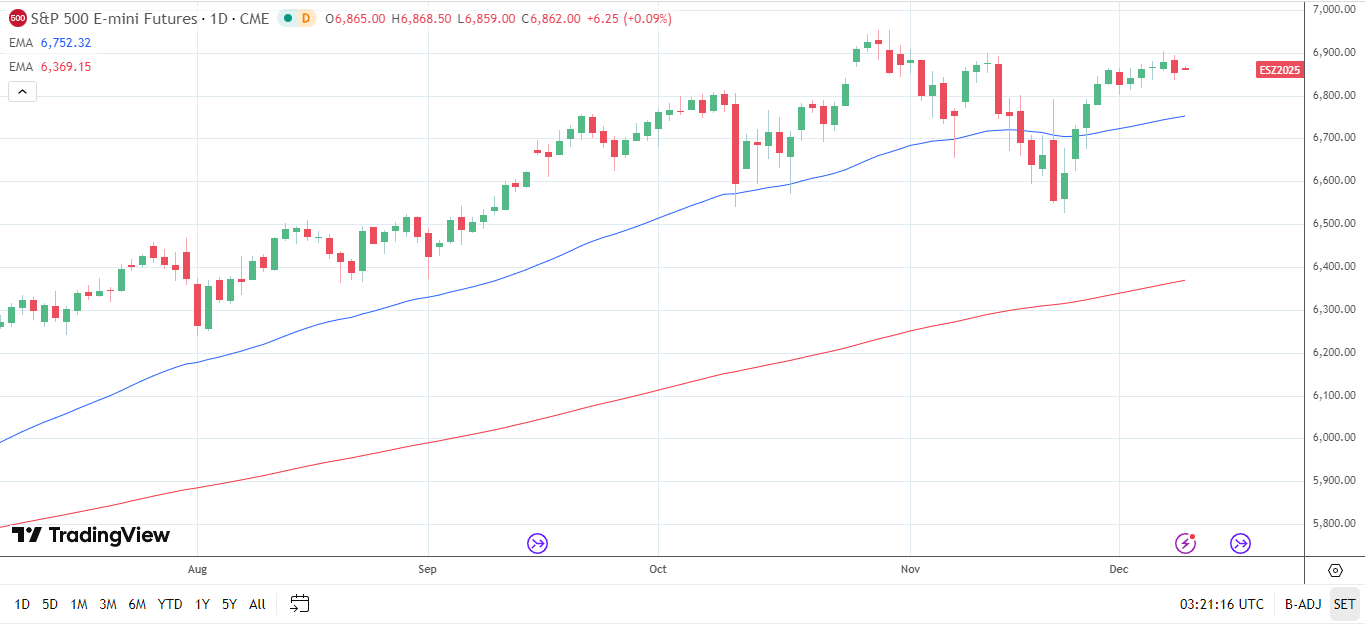
Futures posted modest gains during the Asian morning session. The Dow Jones E-mini advanced 8 points, the Nasdaq 100 E-mini gained 28 points, while the S&P 500 E-mini rose 6 points.
Market bets on a Wednesday Fed rate cut bolstered demand for US equity futures. However, uncertainty about the Fed rate path through H1 2026 capped the morning gains.
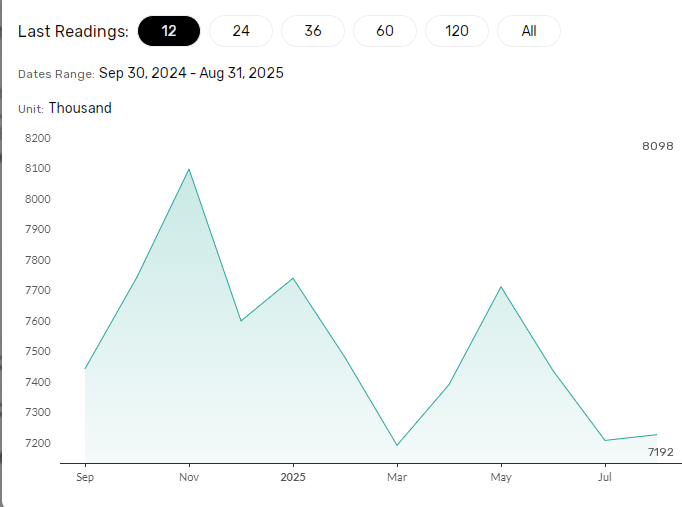
Later on Tuesday, US jobs data will likely fuel speculation about a December and Q1 Fed rate cut. Economists forecast JOLTs job openings to fall from 7.227 million in September to 7.2 million in October. A continued downward trend in job openings would indicate a weaker labor market, supporting a more dovish Fed policy stance.
Last week’s softer September inflation figures, delayed due to the US government shutdown, and weaker labor market data would support the bullish short- to medium-term outlook for US equity futures. Nevertheless, the FOMC Economic Projections will be crucial for the bullish stance.
Key Technical Levels for Dow Jones, Nasdaq 100, and S&P 500
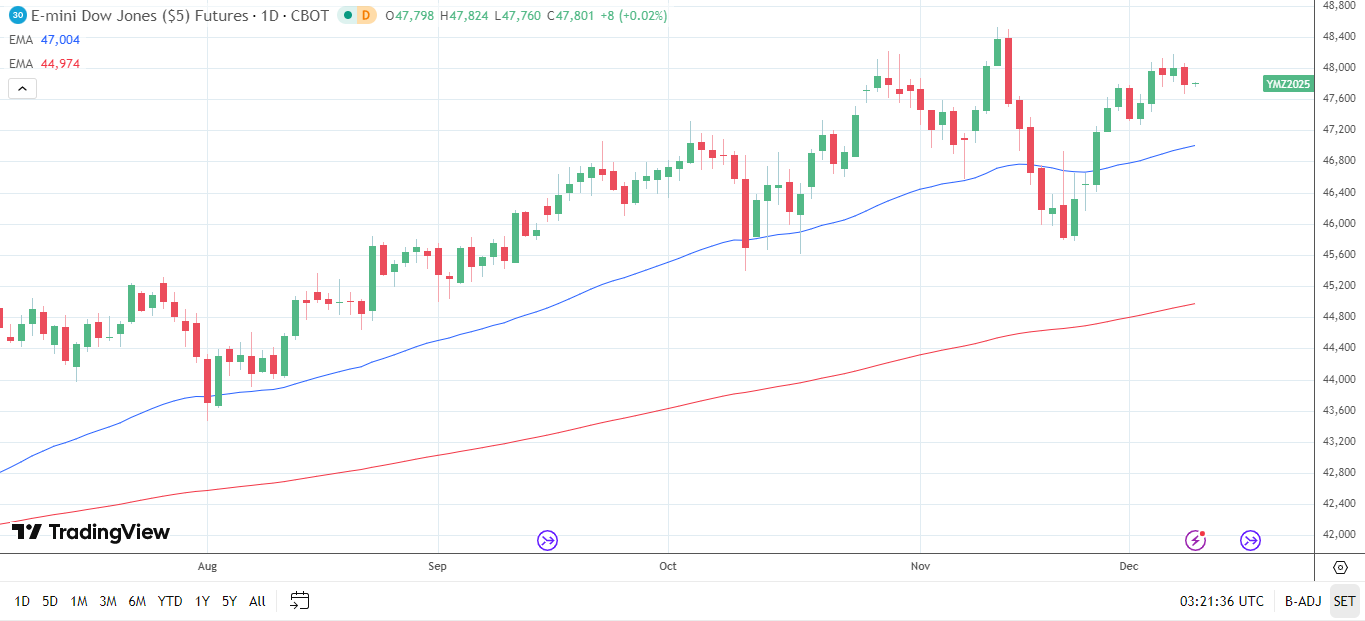
The Dow Jones E-mini, the Nasdaq 100 E-mini, and the S&P 500 E-mini traded above their 50-day and 200-day EMAs, signaling a bullish bias.
Near-term trends will hinge on BoJ rhetoric, JGB yields, USD/JPY trends, US data, and the FOMC rate decision and projections. Key levels to monitor include:
Dow Jones
- Resistance: 48,000, 48,250, and then the November 12 record high of 48,528.
- Support: 47,750, 47,500, the 50-day EMA (47,004), 46,000, and then the November 21 low of 45,779.
Nasdaq 100
- Resistance: 25,750, 26,000, and then the October 30 record high of 26,399.
- Support: 25,500, the 50-day EMA (25,120), 24,500, and then 24,000.
S&P 500
- Resistance: the October 30 record high of 6,954, and then 7,000.
- Support: the 50-day EMA (6,752), 6,500, and then 6,250.
Short-Term and Medium-Term Outlook Hinges on the Fed
In my opinion, the short- to medium-term outlook remains bullish. However, the Fed’s interest rate decision and economic projections will dictate risk sentiment through December.
A 25-basis-point Fed rate cut, a downward revision to the inflation forecast for 2026, and expectations of two to three rate cuts would likely drive investor appetite for risk assets. Crucially, a dovish Fed rate cut would likely send US equity futures toward their all-time highs.
However, several scenarios may reverse the bullish short- and medium-term outlooks, including:
- Bank of Japan signals cuts to JGB purchases and multiple rate hikes on a higher-than-expected neutral interest rate.
- A hawkish Fed rate cut, with FOMC members expecting elevated inflation, a robust labor market, and a single rate cut in 2026.
- Fed QE and BoJ QT announcements collide, sharply narrowing rate differentials, potentially triggering a yen carry trade unwind.
Conclusion: Outlook Bullish
In summary, rising bets on a Fed rate cut will likely bolster investor appetite for US equity futures. However, traders should closely monitor BoJ chatter, JGB yields, the USD/JPY, and the Nikkei 225 for potential signals for a yen carry trade unwind.
Key levels would include a USD/JPY drop to 150 and 10-year JGBs at 2%, an important level to watch. Crucially, these moves would likely weigh heavily on the Nikkei 225 and broader risk sentiment.
While 10-year JGB yields eased back in morning trading, yields remain elevated, leaving US stock futures exposed to unwind risk as the Fed interest rate decision looms.
Follow our live coverage and consult the economic calendar for real-time market updates.