
Ethereum (ETH) has gone down by 3.7% in the past 24 hours as it rejected a move above $3,000 once again.
Trading volumes have gone up by 16% during this period, currently accounting for 6% of the token’s circulating market cap.
Liquidation data shows that today’s downturn has wiped $266 million worth of long positions, and a big portion of those were ETH’s.
However, exchange-traded funds (ETFs) linked to this altcoin just flipped a 7-day streak of net outflows as they brought in $86 million yesterday.
During that bad batch, nearly $700 million flew out of Ethereum’s ETFs, reflecting the strength of the latest wave of bearish momentum.

Open Interest Shows That Traders (Short-Sellers?) Are Coming Back to the Market
Market sentiment does not seem to have improved following the Federal Reserve’s latest interest rate cut.
The Fear and Greed Index is still in panic territory at 29, although it has recovered from its recent record low of 11. Similarly, open interest (OI) in ETH in the futures market has been improving lately, even though the price has kept dropping.
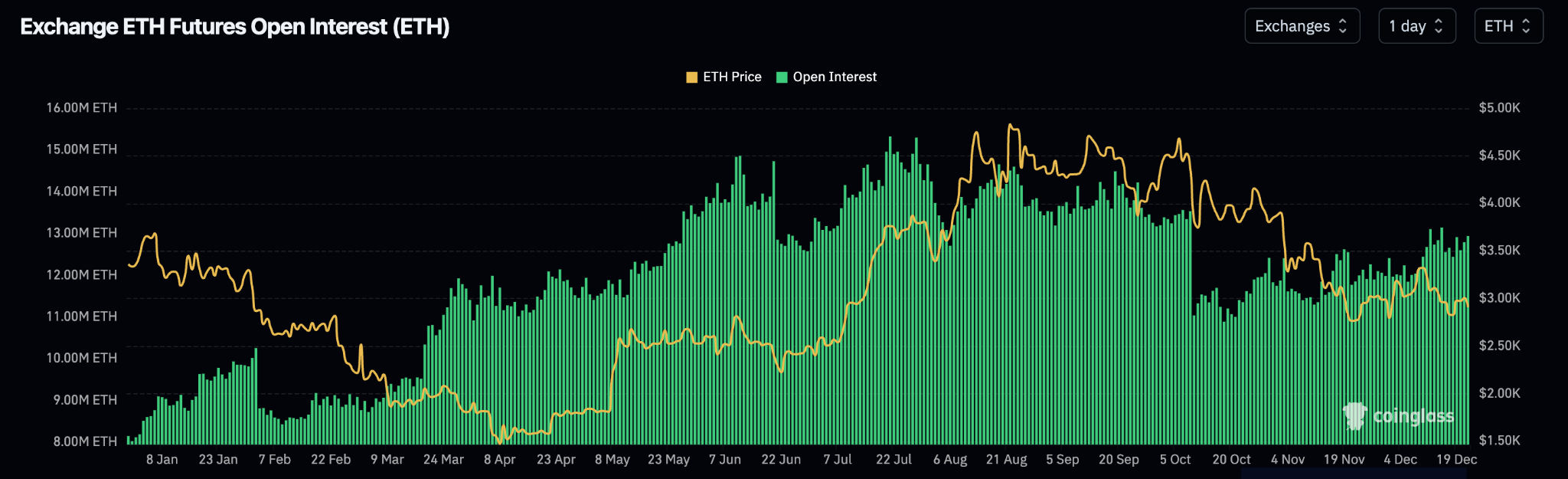
Ethereum Open Interest (OI) – Source: CoinGlass
Data from CoinGlass shows that the amount of outstanding futures contracts in ETH has increased from a low of 10.9 million back in October 18 (right after the flash crash) to 12.9 million at the time of writing.
This indicates higher trader participation. That said, it is not necessarily bullish as it could mean that short positions are building up as market participants expect the continuation of the current downtrend.
Ethereum Price Forecast
Every new Ethereum analysis as it publishes, today's technical signal and key levels, live price — on one page.
See all Ethereum forecastsETH Could Drop to $1,600 If It Loses This Key Support
In a recent article, we highlighted that Ethereum’s weekly chart sent a strong sell signal recently as the price dropped below the 100-day exponential moving average (EMA).
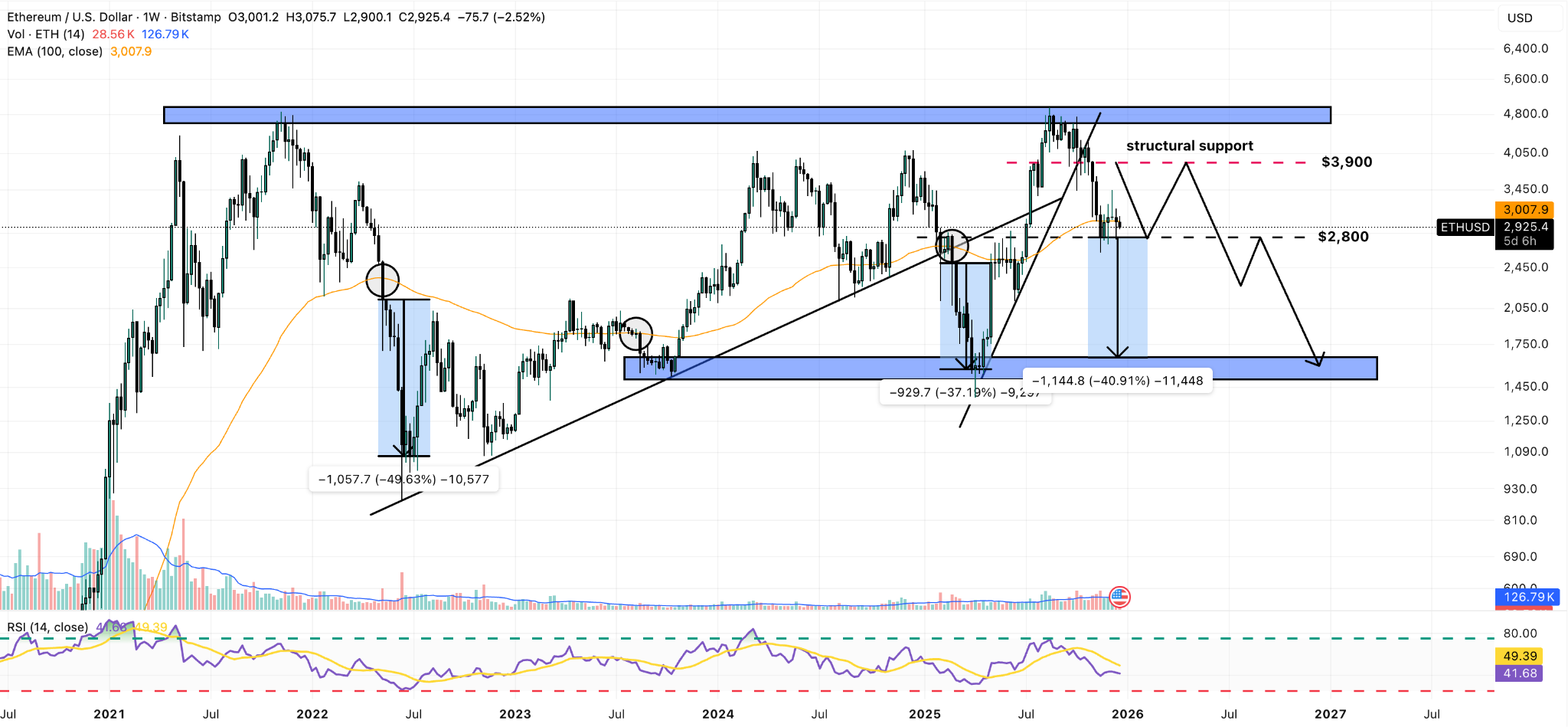
ETH/USD Weekly Chart (Bitstamp) – Source: TradingView
The last two times this happened, ETH went on to lose 49% (May 2022) and 37% (February 2025). The price has already broken below this key EMA recently and has retested this line from below multiple times as well.
Failing to recapture that zone could result in a heavy loss of around 40% for ETH in the next few weeks as the token will likely retest the $1,600 support. This means we will be back near April’s lows, even though macroeconomic conditions are entirely different.
The price has to drop below $2,800 to confirm this bearish outlook, as this would result in a move below a key structural support. We could also expect that, if the price stays above $2,800, ETH could retest the $3,900 before a final distribution to the lows mentioned earlier.
It would not be a bad idea to downsize long positions if ETH recovers to $3,900 at some point, as the state of the market seems fragile at the moment. If the market distributes right after tagging that key resistance, there will be a chance to buy ETH back at a much more attractive price.
The Relative Strength Index (RSI) also favors a bearish outlook as it has dropped below the 14-day moving average, indicating a change in the trend’s direction. Moreover, the oscillator has declined below the mid-line, reflecting that negative momentum is strong and accelerating.