


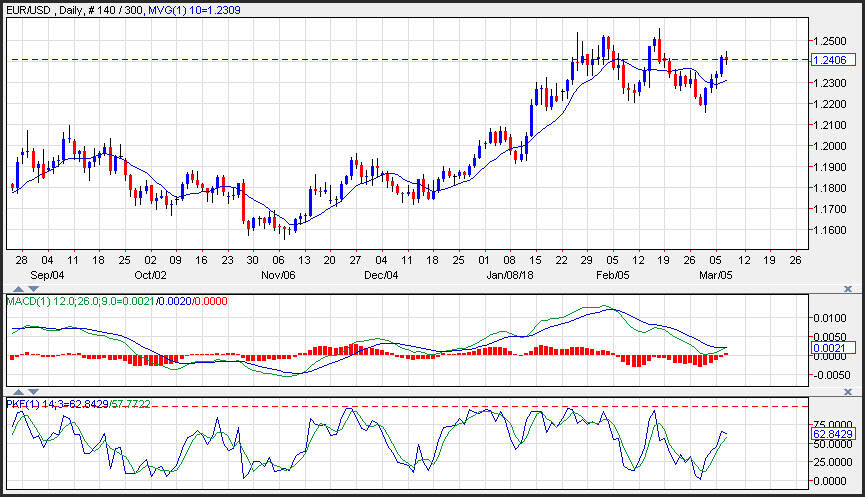
The EUR/USD where nearly unchanged on Wednesday, forming a doji day which is where the open and the close are at the same level which is a reflection of indecision. Growth in the Eurozone was in line with expectations while the ADP private payrolls in the U.S. where stronger than expected buoying U.S. yields and weighing on the currency pair.
Technicals
The EUR/USD initially attempted to test resistance but failed to continue to climb following the stronger than expected U.S. ADP Private Payroll report. Support on the currency pair is seen near the 10-day moving average at 1.2309. Resistance is seen near the February highs at 1.2555. Momentum has turned positive as the MACD (moving average convergence divergence) index generated a crossover buy signal. This occurs as the MACD line (the 12-day moving average minus the 26-day moving average) crosses above the MACD signal line (the 9-day moving average of the MACD line). Wednesday’s doji day saw a stall in the fast stochastic which confirms the consolidation.
Eurozone Q4 GDP Came in As Expected
Eurozone Q4 GDP was confirmed at 0.6% quarter over quarter and 2.7% year over year as expected. Household consumption growth slowed to 0.2% quarter over quarter from 0.3% quarter over quarter but net exports was the catalyst which added 0.4% points as exports surged and outpaced import growth. Household consumption and government consumption contributed 0.1% points each, a further 0.2% points came from investment, while inventory changes shaved off 0.2% points. Lower investment also means that growth potential and the output gap may be lower than previously thought.
UK house price growth slowed
UK house price growth slowed to a five-year low of 1.8% year over year in February data from the Halifax. This is the slowest annual increase since March 2013. This fits the picture being painted by other house price indicators. The prognosis for the market remains mixed, with real income erosion and prospects for higher mortgage rates.
U.S. ADP reported private payrolls increased
U.S. ADP reported private payrolls increased 235k in February from a revised 244k gain in January. The goods producing sector added 37k workers, with an additional 198k going into services. In the goods producing area, construction added 21k and manufacturing increased 14k. The services sector included a 50k climb in leisure, a 44k increase in trade, and a 43k rise in education/health.
U.S. Q4 nonfarm productivity was flat
U.S. Q4 nonfarm productivity was flat, and unit labor costs were 2.5% higher, versus the preliminary 0.1% decline in productivity and 2.0% rise in labor costs. Q3 showed a 2.6% gain in productivity and a 1.0% unit labor cost jump. For the guts of Q4, output was left unrevised at 3.2% and compares to the 4.0% rate in Q3. Employee hours were also kept at the prior 3.3% clip and versus Q3’s 1.4% rate. Q4 compensation per hour was revised up to 2.4% versus 1.8%, and compares to 3.6% in Q3. The price deflator was left at the 2.4% preliminary Q4, versus the 2.0% Q3 pace. On a 12-month basis, Q4 productivity was kept at the 1.1% year over year pace in the preliminary report, slower than the 1.4% year over year Q3 clip, while unit labor costs were revised up to a 1.7% year over year pace from the preliminary 1.3% year over year, and is up from the -.04% year over year in Q3.
The U.S. Trade Deficit Widened
U.S. January trade deficit widened 5.0% to -$56.6 billion from a revised -$53.9 billion in December which was revised from -$53.1 billion. Exports fell 1.3% after the 1.7% December gain which was revised from 1.8%, while imports were unchanged after the prior 2.6% increase which was revised from 2.5%. The “real” goods balance widened to -$69.7 billion versus December’s -$68.5 billion which was revised from -$68.4 billion, with real exports tumbling 3.3% and real imports falling 1.5% after respective December gains of 2.4% which was revised from 2.6% and 2.6%. Excluding petroleum, the trade deficit narrowed to -$49.5 billion versus -$50.6 billion. The trade deficit with China widened to -$36.0 billion versus -$30.8 billion, and was -$3.6 billion with Canada following the -$2.2 billion in December.