



European yields were mixed, which capped the climb in the Euro suggesting that at least so far Draghi has been successful in keeping tapering nerves down. The ECB sees the need for ongoing monetary support, which was confirmed with the slightly weaker than expected services PMI. European retail sales came in stronger than expected which was offset by the robust jobless claims.
Technicals
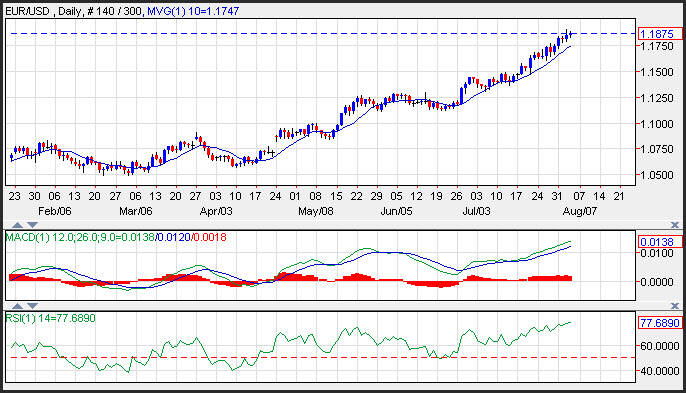
The EUR/USD made an inside day, edging higher, but making a higher low and a lower high. The trend continues to be impressive with support seen near the 10-day moving average at 1.1747. Resistance is seen near the weekly highs at 1.1910. Momentum remains positive as the MACD (moving average convergence divergence) histogram prints in the black with an upward sloping trajectory which points to a higher exchange rate. The RSI (relative strength index) moved higher with price action reflecting accelerating positive momentum. The current reading of 77, which is well above the overbought trigger level of 70 which could foreshadow a correction.
ECB Still Sees Need for Ongoing Monetary Support.
The introductory bulletin in the latest ECB report confirms that the central bank is getting more optimistic about the recovery, with risks to the outlook judged to be broadly balanced. However, the central bank stressed that supportive financing conditions “are necessary to make continuous progress towards a sustained convergence of inflation rates to levels below, but close to 2% over the medium term”. And while “the ongoing economic expansion provides confidence that inflation will gradually head to levels in line with the Governing council’s inflation aim, it has yet to translate into stronger inflation dynamics”. Indeed, measures of “underlying inflation remain low and have yet to show convincing signs of a pick-up, as domestic cost pressures, including wage growth, are still subdued”. So the case for ongoing QE purchases beyond December remains in place, even if the improved growth outlook will likely mean reduced monthly purchase volumes from January.
Eurozone Services Confirmed
Eurozone services PMI confirmed at 55.4, which with the downward revision to the manufacturing reading earlier in the week left the composite at 55.7, down from 55.8 in the preliminary reading and versus 56.3 in June. A slight deceleration in the pace of expansion, but the recovery is broadening across countries and the pace of expansion remains very robust, which is also leaving the labor market on course for further improvement. After the crisis, however, it will take time for wages to catch up and so far the ECB is facing robust growth and weak inflation, which in the light of geopolitical risks means Draghi remains very cautious when it comes to QE tapering. Bund futures remain down on the day after the numbers, but are up from earlier lows.
Italian, Spanish Services PMIs mixed. The Spanish services PMI fell back to 57.6 in July from 58.3 in June, the Italian reading by contrast unexpectedly rose to 56.3 from 53.6, which also left the Italian composite higher in July. Further signs that the recovery is broader based, with differences between countries leveling off as it matures.
Eurozone Retail Sales Rose More than Expected in June
Eurozone retail sales rose 0.5% month over month in June, more than expected, but not a total surprise after the stronger than expected German numbers. The annual rate rose to 3.1% year over year from 2.4% year over year and sales rose 0.9% quarter over quarter in Q2, indicating that consumption continues to underpin growth, although with preliminary Q2 GDP data already released this adds mainly background information.
Jobless Claims Dropped this Week
The 5k U.S. initial claims drop to 240k in the final week of July trimmed the 11k bounce to 245k from 234k in the BLS survey week, leaving little in the way of claims distortions through the auto retooling period. Claims are well above the 44-year low of 227k in the President’s Day week. Yet, claims have undershot the 2016 average of 263k in every week of 2017. Claims are averaging 242k in July, following similar prior averages of 243k in June, 241k in May, and 243k in April. The 234k BLS survey week reading sat toward the lower end of recent survey week readings of 242k in June, 233k in May, and 243k in April. Our 190k July nonfarm payroll estimate faces upside risk from still-firm consumer, producer, and small business confidence despite Q2 drop-backs, and we’ve seen a solid 217k average ADP rise in 2017 despite the lean 178k July increase.