


The EUR/USD edged higher on Thursday as the German trade surplus widened, and U.S. initial claims bounced. While German growth is expected to exceed former expectations, inflation is expected to remain subdued capping any upside in the currency pair.
Technicals
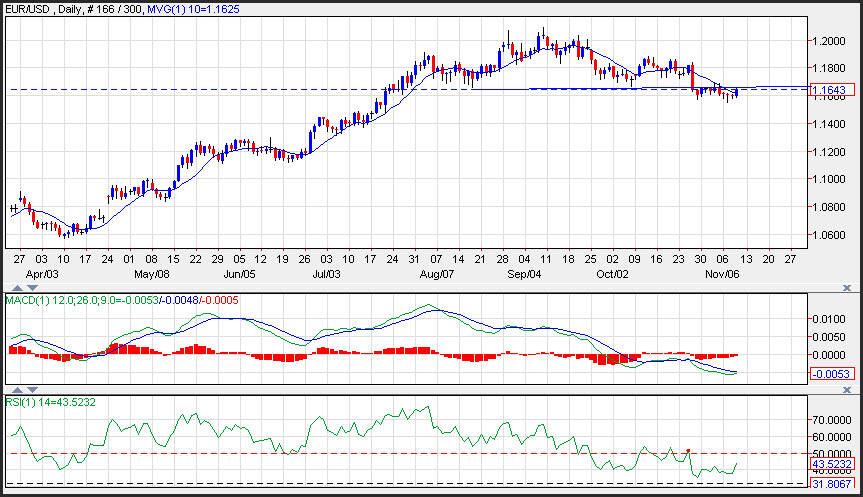
The EUR/USD moved higher pushing back above the 10-day moving average at 1.1625, which is short-term support. Additional support is seen near the weekly lows at 1.1550. Resistance is seen near the neckline of a head and shoulder reversal pattern. A close above the 1.17 level will negate the pattern, and lead to further consolidation. Negative momentum has decelerated as the MACD (moving average convergence divergence) histogram prints in the red with an upward sloping trajectory which points to consolidation.
ECB’s Nouy signals will to compromise on new NPL plans
The head of banking supervision Nouy signaled a willingness to compromise controversial plans for the treatment of non-performing loans in the future. The Parliament’s legal services said late yesterday that the ECB had overstepped its supervisory powers in draft guidelines that would force banks to increase provision on their secured loans, which the ECB wants to have “legally binding character” and will result in higher capital requirements than those enshrined in EU law.
German trade surplus widened in Q3
Germany posted a trade surplus of EUR 21.8 billion in September, slightly higher than the EUR 21.3 billion in August and bringing the total for the third quarter to EUR 63.0 billion, up from EUR 60.8 billion in the previous quarter. This is nominal data, which is impacted by currency and oil price fluctuations, but the numbers point to a positive contribution from next exports to overall trade. Both exports and imports dropped over the month in September, but the decline in imports was more pronounced and after the positive performance in August, the correction in exports was pretty muted. Accumulated data for the first nine months of the year show both current account and trade surpluses falling back compared to the levels posted in the corresponding period last year, as import growth outstripped export growth.
German growth to exceed potential through to 2019
The updated set of forecasts from the European Commission sees growth at 2.2% this year, 2.1% in 2018 and 2.0% in 2019. Still considerably below most estimates for German potential growth over that period. This ties in with warnings voiced by Germany’s council of economic advisors yesterday, who also highlighted capacity constraints. For the ECB though growth is not strong enough and Coeure defended again the ECB’s decision to keep pumping funds into the economy next year.
The European Commission is optimistic on growth but inflation to remain low
The latest update of the Commission’s forecast puts Eurozone growth at 2.2% this year, up from 1.7% projected at the time of the last forecast in May. The Commission sees growth decelerating to 2.1% in 2018 and 1.9% in 2019. For inflation the Commission projects a drop back to 1.4% next year from an estimated 1.5% in 2017. The headline rate is expected to rise back to 1.6% in 2019, but even that would mean a miss of the ECB’s target of below but close to 2%. Still, an overall optimistic assessment, with investment expected to remain very robust. Government debt and GDP rates are anticipated to improve further, but with average debt seen at 85.2% of GDP in 2019 this is still much higher than the limit originally laid down in the Maastricht Treaty.
The ECB Bulletin Stresses Need for Monetary Support
ECB bulletin stresses ongoing need for monetary support, despite strengthening growth. ECB bulletin repeated the central bank’s optimistic view on the economic outlook, citing a “solid and broad based economic expansion”, with private consumption underpinned by positive developments on the labor market and business investment benefiting from “very favorable financing conditions and improvements in corporate profitability”. At the same time underlying inflation is expected to “rise gradually over the medium term”. So, against the background, the central bank decided to half monthly asset purchases from the start of next year, but the majority at the council still argued that very favorable financing conditions “are still needed for a sustained return of inflation towards levels that are below, but close to 2%, as the “economic outlook and the path of inflation remain conditional on continued support from monetary policy”.
U.S. Jobless Claims Bounced in the Latest Week
U.S. initial jobless claims bounced 10k to 239k in the November 4 week after falling 5k to 229k in the October 28 week. That brought the 4-week average to 231.25k from 232.5k. Continuing claims rose 17k to 1,901k in the week ended October 28 following the prior week’s 16k drop to 1,884k. Despite the jump, initial claims remain around 4-decade lows. Claims are still being estimated in the Virgin Islands.