


The EUR/USD contracted on Tuesday falling for the second consecutive trading session following a rally on Friday last week. A stronger than expected German IFO survey was offset by steady consumer confidence and a warning from the OECD that economists could be overrating growth potential in Europe.
Technicals
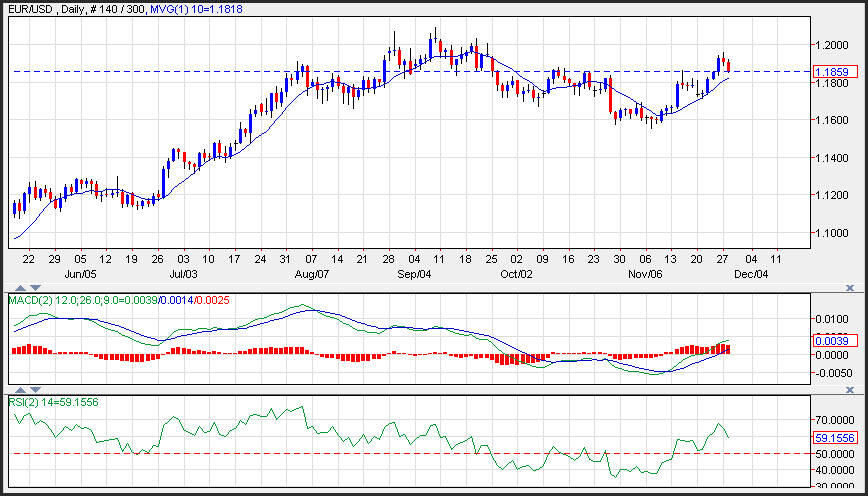
The EUR/USD edged lower moved down to test support near the 10-day moving average at 1.1818. Resistance on the currency pair is seen near the September highs at 1.2092. Momentum remains positive as the MACD (moving average convergence divergence) histogram prints in the black with an upward sloping trajectory which points to a higher exchange rate. The exchange rate has rejected a head and shoulder reversal pattern, which is a topping pattern, with a neckline near 1.1660. The recent rally has negated this reversal.
German Consumer Confidence Steadied
The German GfK consumer confidence remained steady at 10.7 in December, unchanged from the previous month. The full breakdown for November, when the headline reading declined over the month, showed a pickup in business expectations but a decline in income expectations and the willingness to buy. Readings remain at high levels, however, consistent with ongoing support from consumption to overall growth as the labor market continues to improve.
The German Ifo employment barometer at record high
The Ifo reading this month already jumped to the highest level on record and the employment barometer also suggests ongoing very robust job creation, with the indicator rising to 113.2 from 112.0 in the previous month, up 1.1% month over month. The German labor market is looking increasingly tight and wage growth is likely to be sizeable this year as unions demand their slice of the strong economy.
The OECD warns investors against overestimating growth outlooks
The OECD predicts world growth to peak at 3.7% in 208, before slowing down to 3.6% in 2019 and warned that “evidence continues to build that financial asset prices are inconsistent with expectations for future growth and the policy stance, exacerbating the risks of financial corrections and growth downdrafts”. US. growth is expected to accelerate to 2.5% next year from 2.2% this year, Eurozone growth is seen at 2.4% this year and 2.1% next, Japan at 1.5% and 1.2% respectively and the U.K. at 1.5% and 1.2% in 2017 and 2018. At the same time the OECD sees growth slowing down across all these countries and regions in 2019.
OECD lifts German growth forecast to 2.5% this year, falling to 2.3% next year and 1.9% by 2019. Net exports are seen to rise very modestly, while consumption growth is expected to slow down. Investment is anticipated to remain robust over the next couple of years, but slow down from an estimated 4.4% this year.
Eurozone Money Supply Slowed
Eurozone M3 money supply growth unexpectedly slowed to 5.0% year over year in October, from 5.2% year over year in the previous month. The counterparts, however, showed lending to non-financial corporations rose 1.7% year over year, up from 1.5% year over year in the previous month. Lending to households rose 3.2% year over year, after 3.1% year over year in September, with lending for house purchases steady at 3.4% year over year. So long growth continues to stabilize with corporate lending data suggesting that especially in the 1-5-year area loan growth is accelerating as companies try to lock in favorable interest rates. With ECB officials apparently also looking into further supporting the corporate bond sector any remaining investment weakness is clearly not due to a lack of funding opportunities, although for small and medium sized companies the ECB’s asset purchase program only lends indirect support via the banking channel.
ECB’s Hansson says QE likely to end in September 2018 if economy improves as expected.
The council member told MNI that “if the economy evolves broadly as we expect, if we see an uptick in inflation and if it looks sustainable, this element of the program (i.e. net asset purchases) could be phased out” and “is likely to end in September, except if still more is needed. He added that a reduction of the bond buys to zero “has to be one of the options, that is on the table”. Hansson stressed that the “options should be open on both sides”, because “the decisions which have been taken are based on a baseline scenario where you have uncertainty on both sides”, but the comments confirm once again that in the central scenario there won’t be another follow on QE program once the upcoming schedule ends in September next year.