



The dollar continued to gain traction on Monday against the Euro following a stronger than expected ISM manufacturing survey. U.S. yield rose relative to European yields, which initially dipped following a Eurozone manufacturing PMI which was revised lower. Additionally, the Eurozone unemployment rate remained steady compared to expectations that it would decline slightly.
Technicals
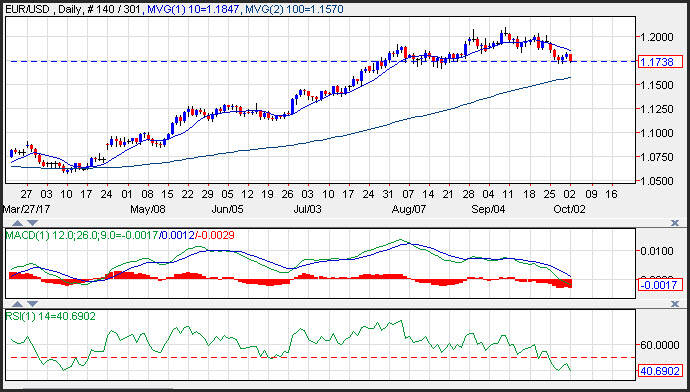
The EUR/USD moved lower on Monday, and is poised to test the September lows at 1.1716. Target resistance on a break of this level is seen near the 50-day moving average at 1.1570. Resistance on the currency pair is seen near the 10-day moving average at 1.1847. Momentum is negative as the MACD (moving average convergence divergence) histogram prints in the red with a downward sloping trajectory which points to a lower exchange rate.
U.S. ISM Was Stronger Than Expected
The Institute for Supply Management (ISM) said its index of national factory activity surged to a reading of 60.8 last month, the highest reading since May 2004, from 58.8 in August. Expectations were for the index to remain unchanged. A gauge of new orders jumped to 64.6 in September from 60.3 in August. Factories reported paying more for raw materials, with the survey’s prices paid index surging 9.5 point to 71.5, the highest reading since May 2011.
Eurozone Manufacturing PMI Was Revised Lower
Eurozone manufacturing PMI revised marginally lower to 58.1 from 58.2 reported initially, but still up from 57.4 in the August reading. Markit reported that job creation hit a survey-record high in September, as stronger output growth and capacity constraints boost employment growth. Output and new orders expanded across all nations covered by the survey, even the Greek reading hit a 111-month high. Conditions in the sector “strengthened to the greatest extent in over six-and a half years during September”, according to Markit.
Unemployment Remained Steady
Eurozone unemployment unexpectedly held steady at 9.1% in August, against expectations for a slight dip in the headline rate to 9.0%. Cross country divergence remains very high even among the big four and Spain’s 17.1% contrasts sharply with Germany’s 3.6%. Unemployment remains especially high among the under 25s, which highlights the need for further structural reforms, even if today’s PMIs surveys for the manufacturing sector report a further surge in job creation. At the same time wage growth has been limited and today’s weaker than expected headline number will add to the arguments of the doves at the ECB who remain reluctant to commit to and end date for QE just yet.
Spain’s Catalonia conflict weighing on Eurozone markets
Rajoy’s decision to suppress a referendum on Catalonia’s independence with the help of police and what looked to many like excessive force, has managed to catapult the tensions between Barcelona and Madrid onto the world stage, and is weighing on the Eurozone markets. The referendum had been declared illegal by the constitutional court, but was pushed through by the regional government against the will of the central administrations. The referendum may be illegal, but the regional government, equally on confrontation course as Rajoy, remains fully intent on enforcing the result that reportedly saw 90% in favor of Catalonia’s independence, even though it saw only 40% of voters making it to the polls.
UK Manufacturing PMI Was Worse than Expected
The UK’s manufacturing PMI undershot expectations with the September headline coming in at 55.9, correcting after surging in August to a four-month high 56.7 reading, which was itself revised down from 56.9. The median forecast had been for a more modest pullback, to 56.2, though the outcome still remains comfortably above the long-term average of 51.7 after 14 consecutive months above 50.0. The breakdown showed input price inflation lifting to a six-month high, while production and new orders readings came in above long-run averages. Despite the softer headline, the survey found most respondents reporting solid demand in both domestic and export markets. Growth in export orders was near the best in six-and-a-half years, although the boost from post-Brexit vote sterling weakness was reportedly less than earlier in year.
ECB’s Georghadji said that its too early to declare stimulus success
The Governing Council member said in an interview with MNI said the pickup in inflation is “still largely dependent on the ECB’s accommodative monetary policy stance”, adding that “only a sustained adjustment in the path of inflation would warrant the gradual withdrawal of our exceptional degree of monetary policy accommodation”. Nothing there to rock the boat and pretty much a repeat of Draghi’s message from the last meeting, confirming that not everyone is eager as Weidmann to end QE.