



The EUR/USD rebounded following a stronger than expected wholesale price inflation report. Yields backed up making the Euro more attractive relative to the greenback, as the issue in Catalonia continues to boil. The dollar did not give up all of its gains as same-store sales were stronger than expected soaring nearly 5%.
Technicals
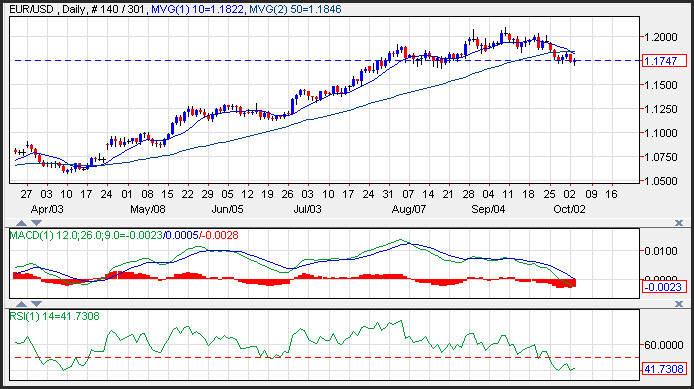
The EUR/USD rebounded on Tuesday, after testing support near the August lows at 1.1661. Resistance on the currency pair is seen near the 10-day moving average at 1.1822. The 10-day moving average crossed below the 50-day moving average which shows that a medium-term downtrend is in place. Momentum remains negative as the MACD (moving average convergence divergence) histogram prints in the red with a downward sloping trajectory which points to a lower exchange rate.
Eurozone Producer Prices
Eurozone producer price inflation came in higher than anticipated at 2.5% year over year, up from 2.0% year over year in the previous month. Prices were still down -0.3% in the three months to August, but a renewed uptick in energy prices, which rose 0.7% month over month and 3.4% year over year that underpinned the higher than expected reading. Excluding energy, the annual rate nudged to 2.2% year over year from 2.1% year over year. The latter is still above the 2% limit for price stability, but so far the ECB is still not satisfied that underlying inflation pressures are sufficiently picking up as wage growth remains weak.
Catalonia won’t get EU backing
Commission President Juncker and other officials have criticized the violence with which Spanish authorities tried to prevent the referendum on independence, but also rejected suggestions to keep an independent Catalonia within the EU. So far Brussels stance is that this is an internal matter for Spain and that the referendum was unconstitutional. Clearly the EU doesn’t want to set a precedent and officials stressed that this is a time for unity, not separatism and urged both sides to move forward with a serious dialogue on the basis of the Spanish constitution.
Still, Rajoy personally, who until Sunday had the backing of the EU, is now under pressure after he let the situation escalate into violence. Without the hope that an independent Catalonia could just continue as before and remain part of the EU and the Eurozone the regional government doesn’t seem in a hurry to declare independence as promised. Indeed, despite the referendum it is unclear whether the majority in the region actually wants independence and the most likely outcome still is that Catalonia will stay. At the same time pressure on Rajoy is mounting as officials elsewhere in the EU want to see serious efforts to resolve the conflict, which could also include a new system of financial equalization between the Spanish regions that would put Catalonia on a similar footing as the Basque country and Navarra, which have more say over their finances. That may not make Catalonia better off, but it could go some way to dispel the notion that the region is paying for a “corrupt and incompetent” national government.
UK Construction PMI Came in Worse than Expected
The UK’s construction PMI came in much worse than expected, at 48.1 in the headline, well off the 51.1 reading of August. The median forecast had been for an unchanged 51.1 outcome. This is the first time the indicator has been below the growth/contraction 50.0 threshold in 13 months. The data indicates the quickest pace of contraction in the sector since July 2016. The breakdown of the survey makes for pretty dismal reading. Business activity fell for the first time in 13 months, civil engineering work posted its biggest drop since April 2013, and new business volumes fell for the third consecutive month portending a lack of new work once ongoing construction projections are completed. Input buying fell for the first time in six months. Survey respondents pointed to fragile client confidence, particularly in the commercial market, though worries that the era of ultra-low mortgage rates are afflicting the residential market.
Fed Fund Futures Show Tightening
Fed funds futures inched up on the comments from FOMC voter Kaplan, who cautioned that he and his colleagues will have to “look hard” at raising rates in December while expecting the Fed to remain patient in its policy approach. However, there’s been no meaningful impact on rate hike probabilities, which are holding around 70%.
U.S. Chain Store Sales Soared
U.S. chain store sales soared 4.7% in the week ended September 30, according to The Retail Economist, rebounding from a 1.3% decline previously. The annual pace of sales climbed to a 1.6% year over year rate versus 0.5% year over year. Furniture store sales paced the rally, reflecting a strong housing market, said the report, along with consumers’ willingness to spend on discretionary items.