



The EUR/USD consolidated on Wednesday, opening and closing near the same levels, as a stronger than expected ISM Services report was offset by a slightly softer than expected U.S. ADP private payroll report. Eurozone retail sales were softer than expected which helped drag on the currency pair, but EU PMI services was revised higher, helping to keep the currency pair buoyed.
Technicals
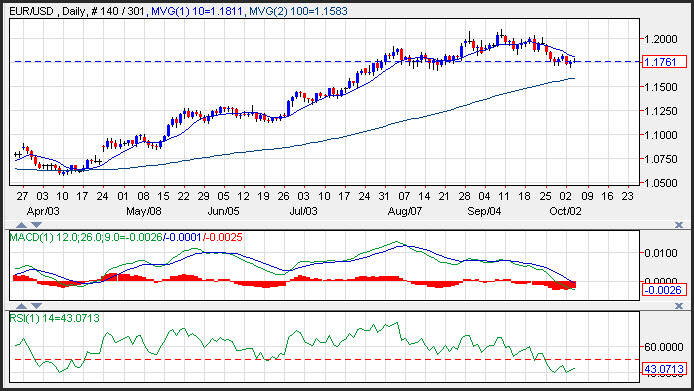
The EUR/USD was nearly unchanged on Wednesday, as safe-haven inflows moved into Bunds and Gilts. The exchange rates is settling just above the August lows which is support near the 1.1661 level. Resistance is seen near the 10-day moving average at 1.1811. The 10-day moving average has crossed below the 50-day moving average which means a short term down trend is in place. Momentum is negative as the MACD (moving average convergence divergence) histogram is printing in the red with a downward sloping trajectory which points to a lower exchange rate.
U.S. Private Payrolls Were Softer than Expected
U.S. ADP private payrolls increased 135k in September with the 237k August jump revised down to 228k, to leave the report weaker than expected. There were some effects from the hurricanes, especially in the trade/transport sector, which fell 18k. But it’s also the case that the tight labor market is weighing on hiring. The goods sector added 48 workers, while service sector employment increased 88k, with manufacturing up 18k. Construction jobs climbed 29k, with education also 29k higher. Leisure added 20k.
U.S. ISM Services Hit a 12-year High
The Institute for Supply Management reported that its index of non-manufacturing activity rose to 59.8, which was the highest since the August 2005 reading of 61.3. The latest reading also topped expectations of 55.5. The index was 55.3 the month before.
The U.S. MBA Mortgage Market Sank
U.S. MBA mortgage market index sank 0.4% in data released earlier, in addition to a 1.0% gain in the purchase index and a 1.8% drop in the refinancing index for the week ended September 29. The average 30-year mortgage rate inched up 1 basis point to 4.12%, though market rates settled slightly lower into quarter-end last week after a run higher into the September FOMC decision the week prior to launch QT. Fedspeakers have remained on the fence about another rate rise as soon as December, though markets have largely priced one in as the hurricane dampening effects on the economy are quickly replaced by rebuilding gains.
EU Retail Sales Dropped
Eurozone retail sales dropped -0.5% month over month, more than anticipated, and after already falling -0.3% month over month in the previous month. The annual rate decelerated to 1.2% year over year from 2.3% year over year. The trend growth rate slowed to 0.3% in the three months to August, from 0.9% in the three months to July. Still, retail sales seem increasingly out of synch with overall consumption trends, so that doesn’t necessarily mean a collapse in consumption and domestic demand, but it could add to the arguments of the doves at the ECB.
Eurozone PMI Services was Revised Higher
Eurozone services PMI revised up to 55.8 from 55.6, which left the composite unchanged from the preliminary number at 56.7. Markit said the economy ended the third quarter “with a flourish as output growth accelerated to a fourth month high”. And while the average in the third quarter was slightly weaker than in the second quarter, the improvement in September was underpinned by “the steepest gain in new work received for almost six-and-a-half years”, which is good news for growth in the last quarter. France and Germany are showing growth rates at 77-months and 76-months highs respectively, and Markit warned that the upturn in economic activity continued to test capacity, which led to the sharpest increase in the backlogs of work since February 2011. Employment growth continued to expand and price pressures increased.
UK’s September PMI Services Beat Forecasts
The UK’s September services PMI beat forecasts, rising to a headline of 53.6 after August’s 11-month low of 53.2. The median forecast had been for an unchanged 53.2 reading. This is a relief for sterling markets following the disappointing outcomes of the construction and manufacturing surveys. The report is now all rosy reading, however. The headline reading remains below the average seen during the first half of the year, new business growth eased to a 13-month low, and input cost inflation intensified. The survey also found respondents reporting relatively subdued domestic demand. There were concerns about the business outlook, despite the backdrop of a still-healthy labor market and resilient consumer spending. Business-to-business sales were reported as being subdued, while there were delays in decision making on large projects, said to be related to Brexit uncertainties. New business volumes expanded at the slowest pace since August 2016. Confidence for the year ahead was the lowest since June, which in turn was the lowest since 2011. On a more positive note, job creation in the sector remained strong.