



The EUR/USD rebounded during the U.S. trading session initially falling following the U.S. employment report and then rebounded after testing the August lows. The U.S. employment report was mixed, showing a decline in payrolls compared to the gains expected, but a drop in the unemployment rate and a surge in average hourly earnings. Dallas Fed Governor Kaplan said he was not yet ready to pull the trigger on another rate hike in December.
Technicals
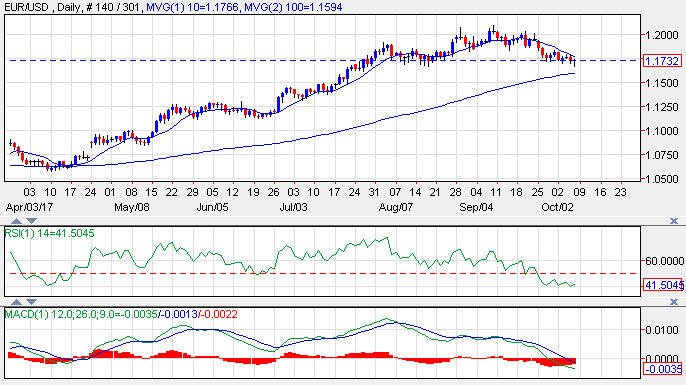
The EUR/USD moved lower during European hours testing support near the August lows at 1.1661. A break below this level would lead to a test of the 100-day moving average near 1.1594. Resistance on the currency pair is seen near the 10-day moving average at 1.1766. Negative momentum is decelerating. The MACD (moving average convergence divergence) index is printing in the red, but the trajectory of the MACD histogram is upward pointing which reflects consolidation. The relative strength index (RSI) is moving sideways which also reflects a consolidative tone.
Payrolls Fell More than Expected but Wages Soared
U.S. nonfarm payrolls fell 33k in September, with August revised up to 169k from 186k previously but July was lowered to 138k from 189k. Expectations were for a gain of 120K. That left the 3-month average at 91k. The unemployment rate dropped to 4.2% from 4.4%. Hourly earnings surged 0.5% versus August’s 0.2% gain which was revised higher from 0.1%. Hours worked were steady at 34.4. The labor force jumped 575k after the prior 77k gain, while household employment was sky high at 906k versus -74k in August. The labor force participation rate jumped to 63.1% from 62.9%. As for other job details, private sector employment was declined 40k. The goods producing sector added 9k, with construction up 8k while manufacturing dipped 1k. The jobs in the private services providing sector slid 49k thanks to a 111k plunge in the leisure/hospitality component. The government added 7k jobs, but Federal employment was flat.
The Feds Kaplan is on the Fence
Dallas Fed governor Kaplan had an interview with CNBC on Friday and said that he is evaluating a December rate hike, but was not there yet. While he sees that wages are growing the central banker seems to believe that companies are having a difficult time passing price increases into the market because customers can look on line for the least expensive price, while has a muting effect on consumer price increases. While wage growth is now 2.9% year over year, Kaplan does not see personal consumption expenditures reaching that level in the near term. He also still believes that there is slack in the labor market.
German Orders Surged
German orders surged in August. Manufacturing orders jumped 3.6% month over month in August, versus expectations for a modest rebound of around 0.6% month over month from a drop in July that was revised up to -0.4% month over month from -0.7% month over month reported initially. The annual rate jumped to 7.8% year over year, tying in with the buoyant PMI readings and ongoing improvements on the labor market. The German economy continues to fire on all cylinders and the labor market is looking increasingly tight, with wage growth of 2.9% year over year in the second quarter.
Spanish Markets Remain Under Pressure
Spanish markets under pressure again, as the central government in Madrid tightens its grip on Catalonia, while banks and companies reportedly prepare to move offices out of the independent region. The head of Catalan police has been questioned by a court, and the constitutional court issued an injunction against the regional parliament’s planned session Monday, which reportedly was planned to provide the backdrop for an official declaration of independence. Catalan’s separatists meanwhile are said to be split as Madrid continues to take a hardline stance and refuses mediated negotiations. The EU so far views this as an internal matter for Spain, but has made clear that an independent Catalonia won’t get automatic EU membership.
UK Productivity is Down
UK productivity is down for a second successive quarter according to the ONS stats office, which reported hourly output to have declined 0.1% in Q2. This follows a 0.5% decline in Q1. On an annual basis, hourly output fell by 0.3%, the first annual contraction seen since 2012-13. The data is consistent with Brexit concerns following the vote to exit the EU last June. The PMI surveys for September highlighted delayed projects and planning related to Brexit, with the government remaining divided and in some disarray after the general election in April.