


The Federal Reserve heads into today’s FOMC meeting with markets assigning an 87% probability of a 25-basis-point rate cut, according to the CME FedWatch tool. The latest PCE inflation release—core running at 2.8% year over year and 0.2% month over month—offered no reason to challenge that expectation.
For traders, however, the greater focus lies beyond the December decision. As inflation eases, labor conditions soften, and a 2026 leadership transition approaches, the committee faces a more complex set of policy trade-offs. The debates now forming inside the Fed will determine not only the pace of easing next year but the entire contour of the policy path through 2026.
Richmond Lee, CFA and Senior Market Analyst at PU Prime commented:

The US dollar is facing a pivotal moment as investors await the Federal Reserve’s upcoming interest rate decision. Following the recent US government shutdown, a series of key economic data has been released, and most readings have come in significantly weaker than expected. This trend has strengthened expectations for further Fed rate cuts to support the slowing economy.
Market consensus currently points to a 25-basis-point reduction, lowering the federal funds rate from 4.00% to 3.75%. If the Fed delivers this widely anticipated cut, the immediate impact on the dollar is likely to be limited, as the move is largely priced in. In this scenario, the dollar may consolidate near current levels, with short-term movements driven more by risk sentiment than by the rate decision itself.
However, risks remain for more pronounced swings. Should the Fed hold rates steady or adopt a more hawkish tone in its policy statement, the dollar could experience a sharp rally, catching some market participants off guard. Conversely, if the Fed signals an even more dovish outlook than expected, the greenback could weaken further, testing key technical support levels.
Investors should also note that other major asset classes, including gold, are simultaneously approaching critical support and resistance zones, which can amplify dollar volatility. This interplay underscores the importance of closely monitoring Fed communications, as the central bank’s statements will likely dictate near-term trends.
In summary, the dollar’s trajectory over the coming weeks hinges on the Fed’s policy tone. While a standard 25-basis-point cut may support a gradual weakening trend, any unexpected hawkish signals could trigger a swift reversal. Traders and investors should remain alert to the Fed’s statements and broader economic context, as these will define whether the dollar continues to soften or reasserts strength in global markets.
Inflation Progress Supports December Cut While Shaping the 2026 Debate
The September PCE report, delayed by the government shutdown, delivered broadly expected results: headline inflation held at 2.8% year over year, core edged down from 2.9% to 2.8%, personal income rose 0.4%, and personal spending gained 0.3%. Markets reacted with restraint, reinforcing that traders had already priced in these figures. Treasury yields moved modestly higher, equities held near highs, and rate-cut expectations were unchanged.
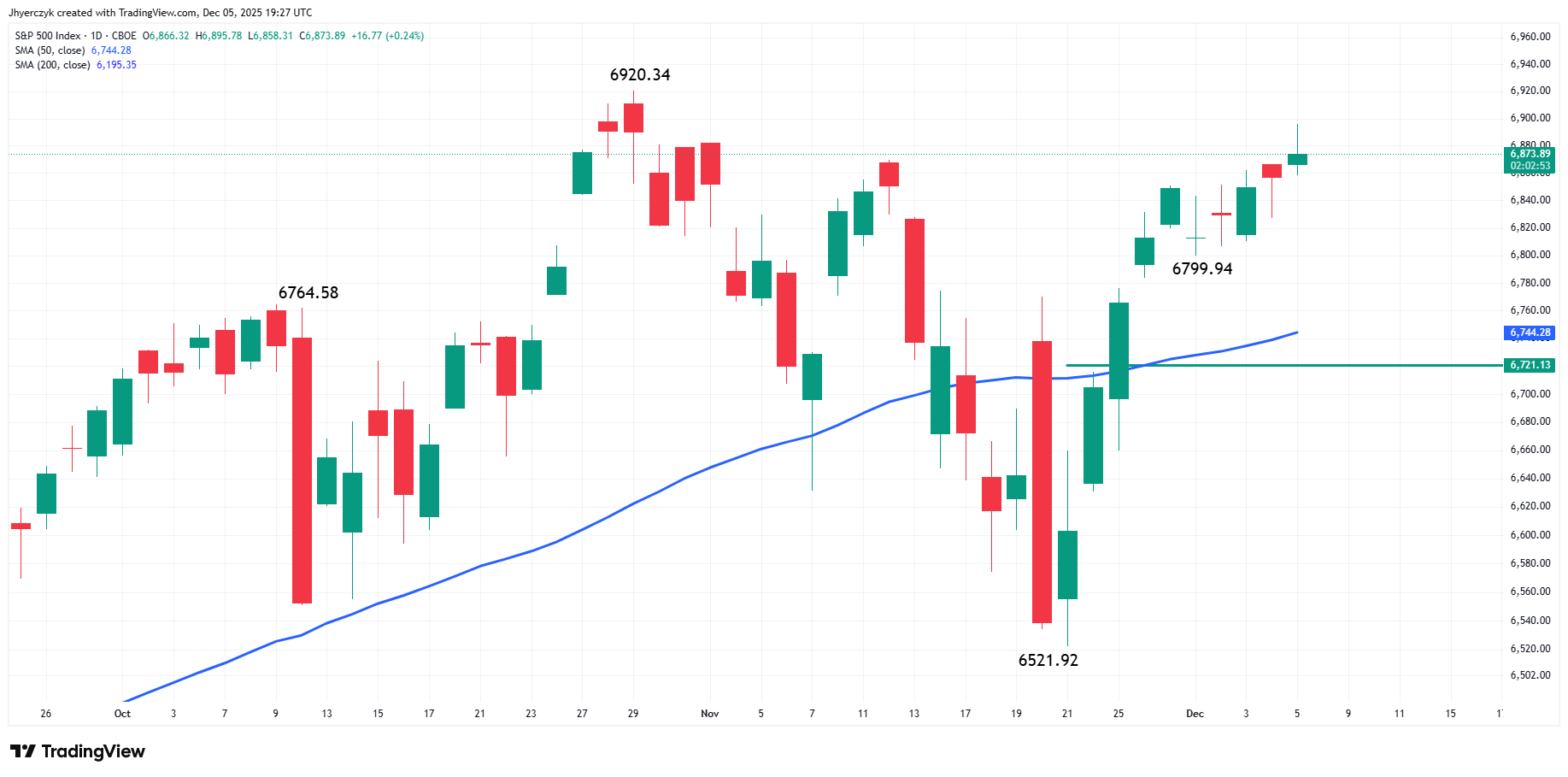
S&P 500 near recent highs as markets price in a December Fed cut. Source: TradingView.
A key part of the Fed’s internal conversation concerns how much of the inflation overshoot stems from tariffs. Powell has estimated that tariffs may be adding roughly 50–60 basis points to core PCE. Removing those effects places underlying inflation closer to 2.3–2.4%, an important consideration for members arguing that policy remains more restrictive than headline numbers suggest.
Inflation expectations reinforce that interpretation: University of Michigan survey data shows year-ahead expectations easing to 4.1% and longer-run expectations falling to 3.2%. For doves, this confirms that inflation pressure is moderating without destabilizing expectations—strengthening the case for continued easing into 2025.
US Dollar Index Price Forecast
Every new US Dollar Index analysis as it publishes, today's technical signal and key levels, live price — on one page.
See all US Dollar Index forecastsLabor Market Weakness Is Now the Fed’s Primary Concern
Even more influential than inflation is what Fed officials see in the labor market. While official data has been disrupted by the shutdown, alternative indicators point to a slowing trend. September payroll gains of 119,000 were above expectations but still soft for this stage of the cycle. ADP data showed private-sector job losses of 32,000, and announced layoffs exceeded one million for the year in November. Wage growth has cooled, labor-force participation has stalled, and job openings continue to trend lower.
Fed Chair Jerome Powell has framed recent cuts as “risk-management” decisions—designed to prevent labor-market deterioration from accelerating. Committee members increasingly agree that both labor demand and supply have weakened simultaneously. Underlying job growth trends, estimated near 39,000 per month, suggest that without policy support the unemployment rate could drift higher in 2026. This is the backdrop that makes a December cut not only likely but, for several members, necessary.
A Divided Federal Open Market Committee Ahead of a Critical Vote
Despite the strong market consensus around a December move, the committee itself remains split. October minutes revealed “strongly differing views” among participants. Doves such as Williams, Waller, and Miran emphasize easing inflation and rising labor-market risks. Hawks including Schmid, Musalem, and Collins argue the committee risks cutting before inflation is fully contained.
Multiple dissents are expected next week. Schmid dissented in October in favor of no cut, and many economists expect Musalem to dissent as well. These fractures signal a shift toward majority-rule decision-making rather than the unified front the Fed attempted to maintain for most of the post-2010 period. For markets, that means more two-way risk around each meeting through 2026.
The December Dot Plot: The Clearest Signal for Traders
The updated Summary of Economic Projections will be one of the most scrutinized parts of next week’s meeting. The September dot plot implied two cuts in 2025, one in 2026, and a long-run rate around 3%. Economists expect modest revisions: slightly stronger GDP expectations for 2025, marginally higher unemployment expectations for 2026, and incremental improvement in inflation outlooks.
But the central focus is the 2026 median fed funds rate, currently at 3.375%. It would take only one official shifting lower for the median to fall—a move that would signal growing support for continued easing beyond the baseline. Fed funds futures already price in two or three cuts in 2026, well above the Fed’s earlier guidance. That divergence reflects traders’ expectations that tariff effects will fade, growth will slow, and the Fed will need to provide more support than current projections imply.
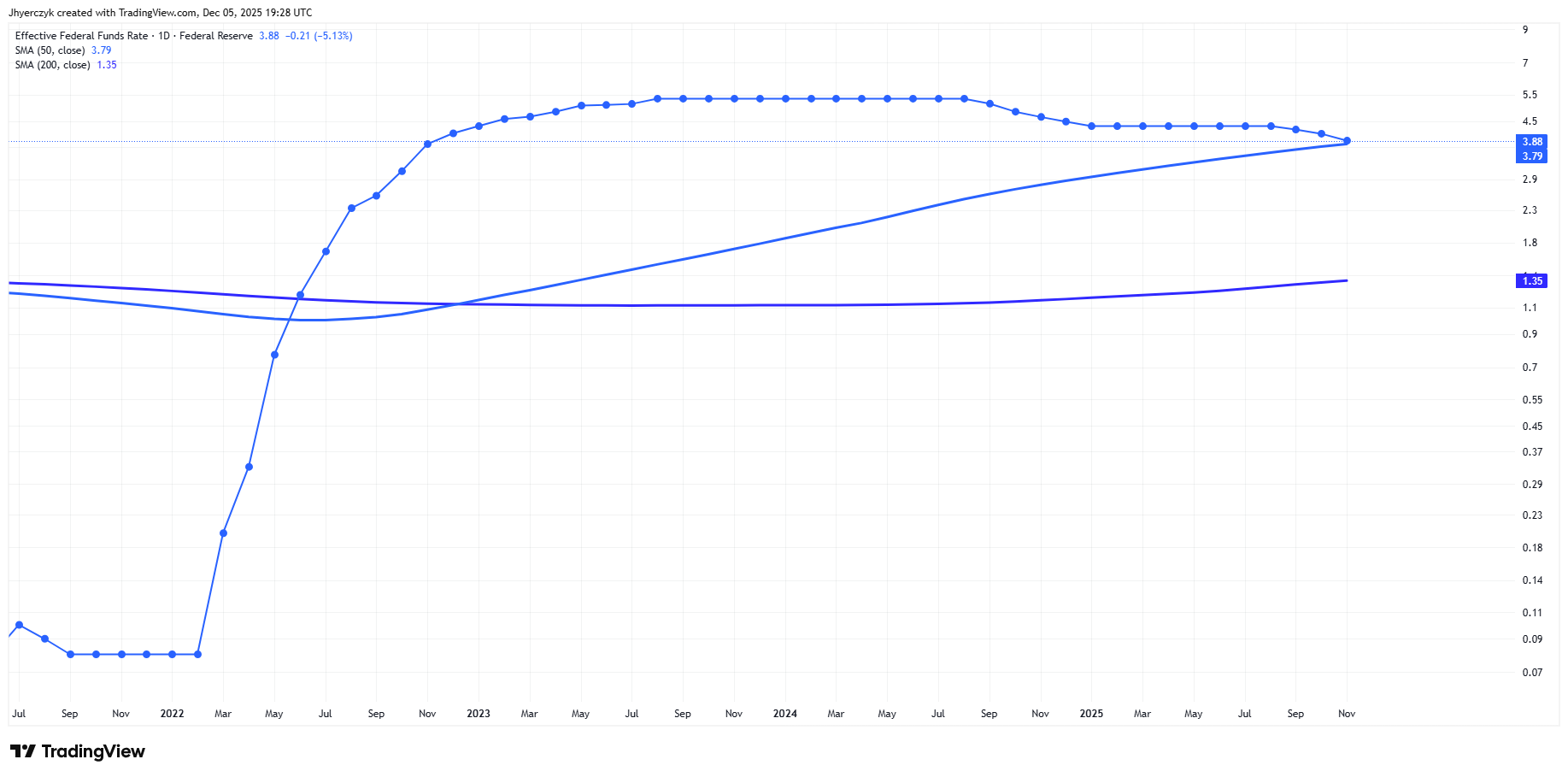
Fed funds rate and market-implied path point to gradual easing into 2026. Source: TradingView
2026 Outlook: Growth Questions, Leadership Transition, and Policy Uncertainty
Forecasts for 2026 vary sharply. Goldman Sachs projects 2–2.5% growth as tariff effects unwind and tax policy boosts demand. Morningstar expects closer to 1.3% growth, with the unemployment rate rising moderately. Most forecasters agree inflation will soften further as the tariff-driven price level shift drops out of year-over-year comparisons by mid-2026.
But the most consequential uncertainty is the expected Fed chair transition. Powell’s term expires in May 2026, and markets widely expect President Trump to nominate Kevin Hassett. Hassett has publicly argued for rates as low as 1.25–1.50%, substantially below the Fed’s current estimates of neutral. Even if he cannot push the committee that far, traders will respond to the perception of a more dovish leader—potentially pulling market-based rate expectations below the official dots. At the same time, if markets view the Fed as politically influenced, long-term yields could rise, increasing the burden on monetary policy.
Fiscal policy is another decisive factor. The anticipated “One Big Beautiful Bill” could include extensions of the 2017 tax cuts, reductions in corporate taxes, and new incentives designed to boost demand. For the Fed, that matters because fiscal stimulus increases aggregate demand, which could re-ignite inflation pressure and force policymakers to slow or pause rate cuts in 2026, even if labor conditions weaken.
Key Issues Fed Officials Must Resolve as Policy Approaches 2026
Several policy questions will dominate the Fed’s internal discussions:
- How quickly should the Fed ease to prevent further labor-market deterioration?
- How long will tariff-related inflation persist, and how much of it is temporary?
- Can the Fed cut without fueling asset-price excesses?
- How will the committee maintain credibility during a leadership transition?
- How aggressive should policy be if fiscal stimulus pushes demand higher?
These considerations create the widest distribution of policy outcomes since the early post-pandemic period.
Market Forecast: Dovish Rate Path With Elevated Policy Risk
Given current conditions, the near-term outlook points to a dovish rate path, with a December cut and a continued easing path into 2025 as inflation cools and labor-market risks accumulate. Market pricing and Fed communications are aligned on this point.
The medium-term path into 2026 is more uncertain. As inflation falls, tariff effects fade, and the labor market softens, the probability of two or more cuts in 2026 remains high, consistent with current futures pricing.
For traders, the environment supports positioning in intermediate-duration bonds, selective equity exposure tied to disinflation themes, and close tracking of fed funds futures as internal FOMC divisions and the 2026 leadership transition introduce new sources of volatility.
The next meeting will clarify the near-term policy path, but the broader outlook will continue to hinge on the interplay of inflation progress, labor-market resilience, fiscal expansion, and evolving Fed leadership.


