AI Trade Takes a Hit
Midway through the US session on Thursday, the AI trade took a bit of a knock. Reports suggested OpenAI is on course for annualised revenue of around US$50 billion. Although this is up on the prior year, it fell short of the near-US$70 billion some estimates had pencilled in. As expected, semiconductor shares took a hit, with the Philadelphia semiconductor index down about 3.4%.
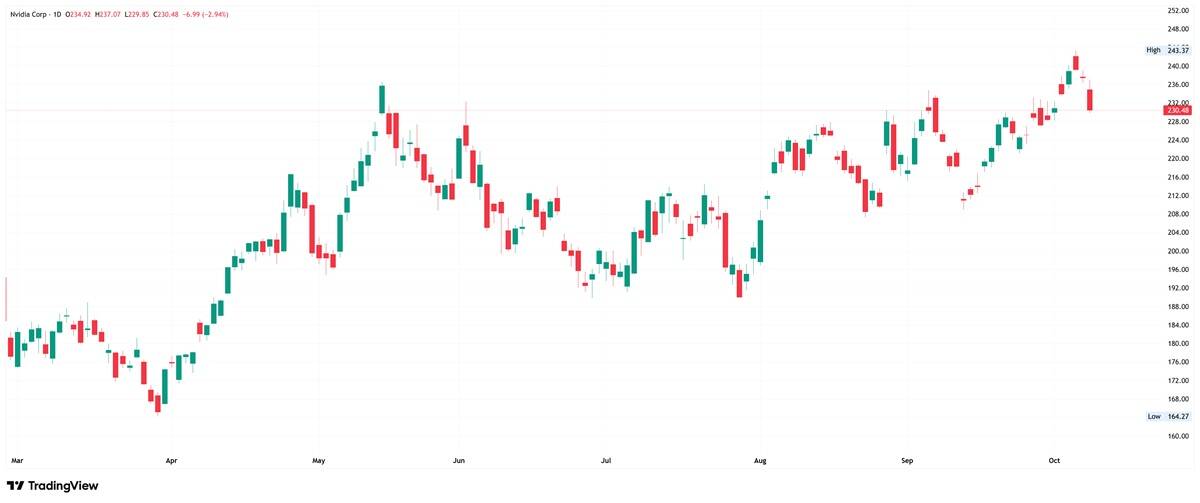
By the close, the S&P 500 finished 0.5% lower, with information technology the weakest sector, down almost 2%. The Nasdaq Composite and Nasdaq 100 each fell about 1%, Nvidia dropped almost 3%, SpaceX slipped more than 4%, and Microsoft eased by about 1.4%.
Despite the S&P 500 finishing lower, 338 constituents advanced against 163 decliners. The VIX remains below 16, comfortably under its one-year average, so there is no sign of panic. Simply put, a narrow group of heavyweights is doing the damage while the wider market holds up reasonably well.
In Asia, trading is a little harder to read than usual, with South Korea’s KOSPI and Taiwan closed for bank holidays. Japan’s Nikkei 225 is also offering little, trading flat after recovering from session lows.
Fed Speak & the USD
We had another round of Fed speak yesterday. St. Louis President Alberto Musalem and Governor Christopher Waller issued hawkish signals, explicitly putting rate hikes back on the table amid robust economic activity, AI investment, and persistent inflationary pressures.
The USD index closed lower on Thursday, down 0.2% this morning, after the unit refreshed its YTD high at 102.54 at the start of the week. Fed rate pricing remains largely unchanged. I feel the door is pretty much closed to an October Fed rate hike, with markets eyeing December. Of course, this could change depending on the upcoming September US CPI print.
Brent Oil Price Forecast
Every new Brent Oil analysis as it publishes, today's technical signal and key levels, live price — on one page.
See all Brent Oil forecastsOil and Geopolitics
Renewed tensions in the Middle East, with strikes spreading far beyond the Strait of Hormuz, and Hurricane Isaias disrupting supplies and forcing Gulf oil shutdowns sent WTI and Brent higher by around 2.5% at the close yesterday.
However, despite reports that President Trump was mulling fresh US strikes on Iran before the Midterms, he posted on social media that no attacks will take place until after the Midterms, which saw oil pare back some of its upside.
Frankly, I have lost count of Trump’s threats and pullbacks, and markets have all but become numb to them. Unless shots are fired, cargo flows change, or something is signed, sealed, and delivered, the market seems to be overlooking any threat.
Canadian Jobs Data in Focus Today
September Canadian jobs data is a print worth watching today, hitting the wires at 12:30 pm GMT. Employment forecasts cluster between 5,000 and 15,000, with the median at 9,200. You will recall that August’s reading showed a loss of 42,000. Interestingly, Capital Economics, Citi, and Scotiabank are on the low side at 0, while BofA is the outlier at 27,400. For the unemployment rate, the median estimate suggests an uptick to 6.5% from 6.4%. According to the forecast distribution, only BMO, Desjardins, and RBC estimate 6.4%.
In money markets, the hike probability for this month’s BoC meeting is around 32% (c.10 bps), while December’s meeting is priced in at around an 80% chance of raising the overnight rate, currently at 2.25%. Implied cumulative tightening until September 2027 is about 100 bps, up from 92 bp a month ago. Because much is already priced in, I think a soft jobs print has more room to hurt CAD than a firm one has to help it.
Consequently, a print near the median likely leaves December pricing intact and offers CAD little support. A negative surprise, particularly alongside a rise in unemployment, would put the December hike in doubt and could pressure the currency, while only a clear upside beat (BofA) would likely meaningfully add to hike bets and give CAD a lift.
Written by FP Markets Chief Market Analyst Aaron Hill